
The Mounts of the Palm and the Graha Each One Is Named For
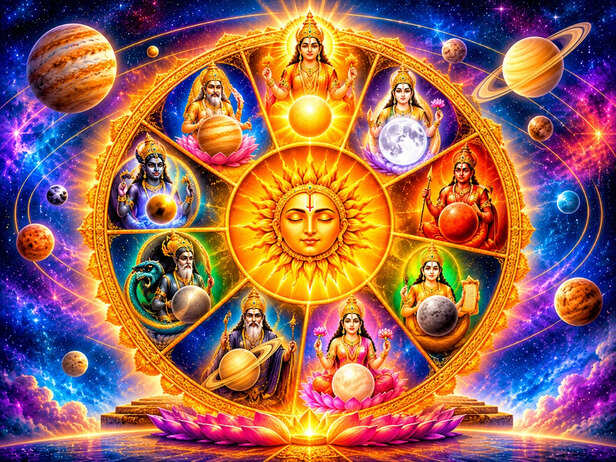
Pick up your hand and look at the palm. Between the base of each finger and the hollow at the centre, the skin rises into small, fleshy pads. These are the mounts, and in palmistry they are not decorative geography. Each one is named for a graha, a planet or luminary from Vedic tradition, and the tradition holds that the mount carries the qualities of the graha it is assigned to. A mount that is well-developed, firm, and sits directly below its finger is read as a sign that those qualities are present. One that is flat, shifted, or soft is read differently.
The system used in Indian palmistry draws from the same nine-graha framework that underlies Vedic astrology: Surya, Chandra, Mangal, Budh, Guru, Shukra, Shani, and the two shadow planets Rahu and Ketu. Seven of these grahas give their names to the seven primary mounts. The remaining two appear in the system as well, though their placement varies across regional traditions.
The Mount of Guru Sits Below the Index Finger
The index finger is called the Tarjani, and the mount beneath it belongs to Guru, Jupiter. In Vedic astrology, Guru is the teacher, the expander, the planet associated with wisdom, generosity, and dharma. The tradition describes a well-developed Mount of Guru as a sign of ambition rooted in principle rather than appetite, of a person who leads through knowledge. Where the mount is overdeveloped, puffed and soft, the tradition reads excess: pride, a tendency to lecture. Where it is flat, it is read as a lack of confidence or direction.
The Mount of Shani Sits Below the Middle Finger
The middle finger is the Madhyama, and its mount is Shani, Saturn. Shani in Vedic tradition is the planet of discipline, patience, karma, and the long view. The Mount of Shani is often the flattest of the primary mounts on most hands, and palmistry treats that as normal; Shani's qualities are not exuberant. A moderately developed mount here is read as seriousness and capacity for sustained effort. An overdeveloped one is associated with melancholy or an excessive pull toward solitude. A flat or absent mount is read as a difficulty with responsibility or routine.
The Mount of Surya Sits Below the Ring Finger
The ring finger is the Anamika, and its mount belongs to Surya, the Sun. Surya governs vitality, self-expression, leadership, and the creative impulse. The Mount of Surya is also called the Mount of Apollo in the Western system, and the two traditions largely agree on its meaning. A full, firm mount here is read in Indian palmistry as a sign of creative confidence, a person at ease with being seen. Where the mount is overdeveloped, the tradition reads vanity or a need for recognition that outpaces the work. Where it is flat, it is read as a dimming of creative or public energy.
The Mount of Budh Sits Below the Little Finger
The little finger is the Kanishtika, and its mount is Budh, Mercury. Budh governs communication, intellect, trade, and the facility with language and numbers. The Mount of Budh is the smallest of the primary mounts in most hands, which the tradition treats as appropriate; Mercury's qualities are precise rather than large. A well-developed mount here is read as sharpness in speech and thought, an aptitude for negotiation or writing. An overdeveloped one is associated with cunning or a tendency to talk past the truth. A flat mount is read as difficulty in expression or a tendency to be misunderstood.
The Mount of Shukra and the Mount of Chandra Occupy the Lower Palm
Below the thumb, between the base of the thumb and the wrist, sits the Mount of Shukra, Venus. Shukra governs beauty, pleasure, love, the arts, and the body's sensory life. This mount is typically the largest and most prominent on most hands, and palmistry reads its fullness as vitality and warmth. A well-developed Mount of Shukra is associated with affection, physical energy, and a genuine enjoyment of the world. Where it is overdeveloped, the tradition reads indulgence. Where it is flat or thin, it is read as a cooling of physical vitality or emotional warmth.
On the opposite side of the palm, the outer edge below the little finger, running down toward the wrist, sits the Mount of Chandra, the Moon. Chandra governs imagination, emotion, intuition, and the inner life. The Mount of Chandra is read through its softness and fullness. A well-developed mount here is associated with a rich interior world, empathy, and creative imagination. Where it is overdeveloped and soft, the tradition reads an excess of fantasy or emotional instability. Where it is flat, it is read as a dryness of imagination or a difficulty accessing emotion.
The Mount of Mangal Appears in Two Places
Mangal, Mars, is unusual in the system because it occupies two mounts rather than one. Positive Mars, sometimes called the Upper Mount of Mangal, sits between the Mount of Guru and the Mount of Shukra, just inside the thumb side of the palm. This mount is associated with courage, initiative, and the energy to begin things. Negative Mars, or the Lower Mount of Mangal, sits on the opposite side of the palm between the Mount of Chandra and the Mount of Budh. This mount is associated with endurance, resistance, and the capacity to hold ground under pressure. The tradition reads the two together: one is the force that starts, the other is the force that sustains.
Rahu and Ketu in the Palm
The two shadow planets, Rahu and Ketu, appear in some traditions of Indian palmistry but not all. Where they are included, Rahu is placed at the centre of the palm, the hollow, the plain of Mars, and Ketu is placed at the base of the palm near the wrist, sometimes overlapping with the lower edge of the Mount of Chandra. Rahu is associated in the tradition with worldly desire, ambition, and the pull of the material; Ketu with detachment, spirituality, and the things a person is moving away from. Their inclusion varies by regional school and by the individual palmist's training, and no single placement is universal across Indian palmistry traditions.
The mounts are not read in isolation. A mount that is well-developed tells one thing; where it leans, toward which adjacent mount, tells another. A Mount of Surya that tilts toward Shani is read differently from one that tilts toward Budh. The system is a map, and like any map, a single landmark only makes sense when you can see what surrounds it.
- Facing repeated career and financial challenges? Your name energy may be influencing it. Check here.
Unlock insightful tips and inspiration on personal growth, productivity, and well-being. Stay motivated and updated with the latest at My Life XP.