
What the Life Line in Palmistry Actually Marks (And What It Does Not)
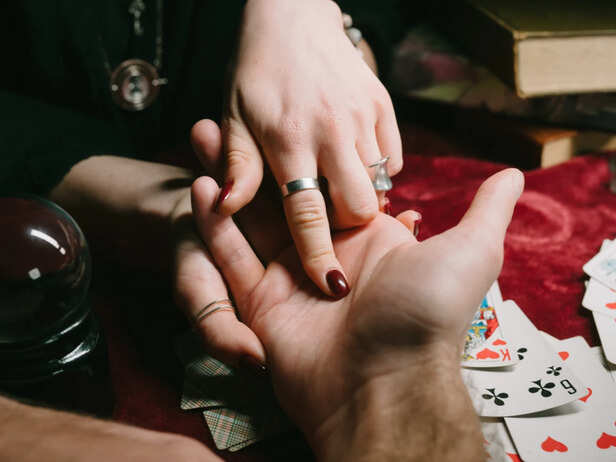
Pick up almost anyone's hand and they will point to the arc curving around the base of their thumb and say: that is my life line, and it is short. The worry in their voice is real. So is the misreading. Palmistry, as it is practised across Indian, Chinese, and Western traditions, has never held that the life line predicts how long a person lives. That idea arrived through popular shorthand and stayed because it is dramatic. What the tradition actually says is quieter and, for most people, more interesting.
Where the Life Line Sits and What Defines It
In palmistry, the life line begins at the edge of the palm between the thumb and index finger and sweeps in an arc downward toward the wrist, curving around the mount of Venus, the fleshy pad at the base of the thumb. Its length is measured by how far it travels along that arc, not by how close it comes to the wrist. A line that ends halfway down the palm in a wide arc may be longer, in the palmist's reading, than a line that reaches the wrist in a tight curve close to the thumb. This distinction alone undoes most amateur readings, which simply look at where the line stops rather than how it travels.
What the Tradition Says It Marks
Classical palmistry texts describe the life line as a map of vitality rather than longevity. The line is said to speak to the quality and energy of a person's physical life: how robustly they recover from illness or difficulty, how strongly they engage with the world around them, and whether their energy tends to be steady or to arrive in bursts followed by periods of withdrawal. A deep, clearly etched line is traditionally read as indicating strong physical constitution and consistent energy. A faint or broken line is said to point to variability, periods of high output followed by exhaustion, or a constitution that requires more careful tending. Breaks in the line are not read as a death date. In most traditions, a break with an overlapping continuation is read as a significant change in circumstances or direction, a relocation, a shift in vocation, a major transition, from which the person recovers and continues.
The Mount of Venus and What It Adds
The life line does not travel alone. It borders the mount of Venus, and palmistry reads the two together. A well-developed mount, full and firm, is traditionally associated with warmth, sensory pleasure, and a strong appetite for life in its physical and relational dimensions. A flat or underdeveloped mount is read as suggesting a more restrained, inward temperament. Where the life line curves wide, leaving a generous mount, the tradition tends to read this as someone who moves through life with openness and physical confidence. Where it curves tight, hugging the thumb, the reading shifts toward caution, self-containment, and a narrower but more focused energy.
What Palmistry Has Never Claimed
The tradition is clear on this, even if popular culture is not: no line on the hand predicts the date or cause of death. Classical palmistry texts, whether the Hasta Samudrika Shastra in the Indian tradition or the European chiromancy texts of the medieval and early modern period, describe the hand as a map of tendency and temperament, not a fixed timetable. A short life line in the tradition's own terms means a person whose vitality is concentrated rather than expansive, or whose path will involve a significant redirection. It does not mean a short life. Palmists who claim otherwise are working outside the tradition they invoke. The hand is also understood, in most traditions, to change. Lines deepen, fade, fork, and extend over a lifetime. A reading taken at thirty is not a sealed document.
How to Look at Your Own Life Line Without Misreading It
If you want to engage with what the tradition actually offers, start with the arc rather than the endpoint. Does the line curve widely, giving the mount of Venus room, or does it sit close to the thumb? Is it deeply etched and continuous, or faint and interrupted? Are there branches, smaller lines rising from it or falling away? Rising branches are traditionally read as periods of increased energy and ambition. Falling branches suggest periods of drain or difficulty. Islands, oval breaks within the line itself, are read as times of uncertainty or reduced vitality. None of these are verdicts. In palmistry's own framing, they are tendencies that a person may or may not recognise in their own history, and which may or may not repeat. The honest use of the life line is not prediction. It is reflection, a way of thinking about one's own patterns of energy, resilience, and engagement with the world, using the hand as a starting point for that conversation rather than as its conclusion.
Facing repeated career and financial challenges? Your name energy may be influencing it. Check here.
Unlock insightful tips and inspiration on personal growth, productivity, and well-being. Stay motivated and updated with the latest at My Life XP.