
Why a Dupatta or Bag Strap Wears Your Hair Down Where It Rubs
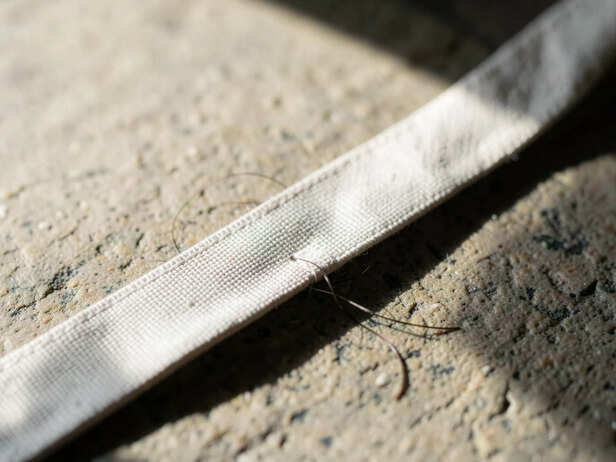
Hair is stronger than it looks, but only in the direction it was built for. Pull it lengthwise and it stretches before it snaps. Rub it sideways, repeatedly, against fabric, and it fails much faster than most people expect. A dupatta draped over the shoulder or a bag strap worn the same way every day creates exactly that kind of repeated sideways friction, concentrated at one point on the shaft. The result is breakage at a consistent height, which looks like a patch of shorter hair or a thin line rather than the diffuse shedding that comes from the scalp.
What the Hair Shaft Is Made Of and Why Friction Finds It
The outer layer of a hair strand is called the cuticle, a series of overlapping scales, like roof tiles, running from root to tip. These scales lie flat when hair is healthy and well-moisturised. When something rubs across them repeatedly, the scales lift, chip, and eventually break away. Once the cuticle is gone at a particular point, the inner layers of the shaft, the cortex, are exposed and unprotected. The cortex gives hair its strength and elasticity, but it cannot survive sustained friction on its own. It frays, then snaps. This is why the breakage happens at the contact point and not randomly along the length.
Why a Dupatta Does More Damage Than a Collar
Fabric texture matters more than most people realise. A cotton dupatta, a stiff polyester strap, a canvas bag, these all have a slightly rough weave at the microscopic level. Every time the fabric shifts against the hair, that weave acts like very fine sandpaper. A collar sits against the nape and moves relatively little through the day. A dupatta moves constantly: you adjust it, it slips, you pull it back. A bag strap shifts with every step. The cumulative abrasion across a day is significant, and across months it is enough to remove the cuticle entirely from the strands that sit in that zone. Silk and satin-edged dupattas create less friction for the same reason silk pillowcases do, the weave is smoother and the fabric slides rather than catches.
Why Some Hair Is More Vulnerable at That Point
Hair that is already chemically treated, heat-styled frequently, or naturally fine has a thinner or more fragile cuticle to begin with. The cuticle on colour-treated hair has been lifted by the colouring process and never fully returns to its original density. On fine hair, the cuticle has fewer layers. Both types reach the breakage threshold faster under the same friction load. Hair that is dry, from low humidity, from washing too often, or from not sealing moisture in, is also more brittle at the shaft, which means the cortex snaps rather than bending when the cuticle is gone. This is why the same bag strap worn by two people can produce visible breakage in one and none in the other.
What to Do About It Without Changing Everything
The most direct fix is to change where the contact happens. Alternate which shoulder carries the bag. Drape the dupatta differently on different days so the friction point moves. Braid or loosely twist the hair that sits in that zone before putting the strap on, a braid distributes the friction across many strands rather than concentrating it on the same ones. A small square of silk fabric tucked under a bag strap where it meets the shoulder is not glamorous but it works. If the dupatta itself is the culprit, switching to one with a satin border or a softer weave at the edge changes the abrasion load immediately. Keeping hair well-moisturised, a light oil on the lengths before a long day, gives the cuticle more flexibility and delays the point at which it begins to chip.
What the Shorter Hair at That Point Actually Tells You
The shorter strands you can see are not new growth. They are the surviving portion of strands that broke somewhere along their length. The root is still intact, which is why the hair grows back when the friction stops, but it grows back to the same length as the rest only after the full growth cycle, which can take a year or more depending on your individual rate. If the friction continues, the new growth breaks at the same point and the patch stays thin indefinitely. This is the detail that makes it feel like the hair is not growing, when what is actually happening is that it is growing and breaking at roughly the same rate. Stopping the friction is what breaks that loop, not a treatment applied to the scalp.
Friction breakage and shedding from the root look similar at a glance but come from entirely different places. Shedding leaves a white bulb at the end of the fallen strand; breakage leaves a tapered or ragged tip with no bulb. Running a finger along the shorter strands in the affected zone and looking at the ends is usually enough to tell which one you are dealing with. Where it is breakage, the scalp is fine and the solution is mechanical, not topical.
Unlock insightful tips and inspiration on personal growth, productivity, and well-being. Stay motivated and updated with the latest at My Life XP.