
Why Vitamin C Serum Loses Its Strength Once You Open the Bottle
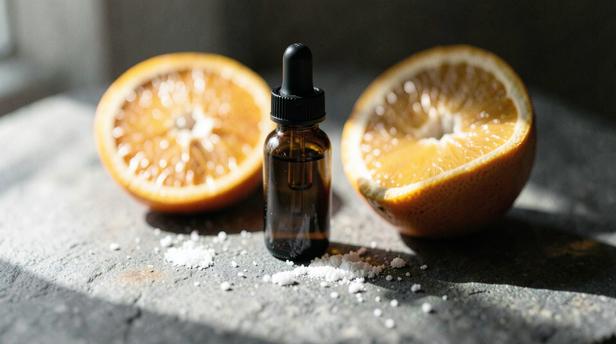
You open a fresh bottle of vitamin C serum and it is pale yellow, almost clear. A few weeks later it has turned amber, then orange, then a deep rust brown. The serum still smells the same. The texture has not changed. But something has gone wrong, and it happened quietly, one molecule at a time.
The Ingredient Behind the Change
Most vitamin C serums are built on L-ascorbic acid, the form of vitamin C that skin can actually use. L-ascorbic acid is a reducing agent, which means it gives electrons away easily. That generosity is exactly what makes it useful in skin, it donates electrons to neutralise free radicals, which are the unstable molecules that break down collagen and contribute to uneven tone over time. The problem is that L-ascorbic acid will donate those electrons to anything that asks, including oxygen in the air.
What Oxidation Actually Does to the Molecule
When L-ascorbic acid meets oxygen, it converts first into dehydroascorbic acid, which still has some biological activity. Left to continue, it breaks down further into diketogulonic acid, which has none. This second conversion is irreversible. The molecule is not weakened at that point, it is a different molecule entirely, one that does nothing useful on skin. The amber and rust colour the serum takes on as it ages comes from these breakdown products, which are called oxidation byproducts. The colour is a reliable signal. A serum that has turned deep orange or brown has already lost most of its active ingredient.
Why Light Makes It Faster
Ultraviolet and visible light carry enough energy to accelerate the oxidation reaction directly. This is called photodegradation, and it is why vitamin C serums are almost always packaged in dark or opaque bottles. A clear glass bottle left on a sunny bathroom shelf will degrade its contents significantly faster than the same formula stored in a dark amber or opaque container kept away from windows. The packaging is not decoration. It is the first line of preservation.
Why Heat and Water Complicate Things Further
L-ascorbic acid is also unstable in water at a neutral pH. Most serums solve this by formulating at a low pH, typically between 2.5 and 3.5, which slows the breakdown considerably. But every time the bottle is opened, warm air enters. If the bathroom is humid and warm, condensation can form inside the cap or dropper. Water at a higher temperature speeds the oxidation reaction. A serum stored in a cool, dry place, a drawer rather than a bathroom shelf, stays stable longer for exactly this reason. The formula did not change. The environment it lives in did.
What Derivative Forms Do Differently
Some serums use vitamin C derivatives rather than L-ascorbic acid: ascorbyl glucoside, sodium ascorbyl phosphate, and ascorbyl tetraisopalmitate are the most common. These are more stable in air and light because the molecule has been modified at the point where oxidation usually begins. The trade-off is that skin has to convert the derivative back into usable ascorbic acid, and that conversion is less efficient. A stable serum at 10% ascorbyl glucoside delivers less active vitamin C to the skin than a freshly opened L-ascorbic acid serum at the same concentration, but it may deliver more than an L-ascorbic acid serum that has been sitting open for six weeks on a lit bathroom counter. Stability at the point of use matters as much as the percentage on the label.
How to Slow the Process Down
No storage habit reverses oxidation that has already happened, but several slow the rate considerably. Keep the bottle in a cool, dark place, a drawer or a cabinet, not a shelf near a window. Close the cap immediately after each use rather than leaving the dropper out while you apply. Use up the bottle within three months of opening, which is the window in which most well-formulated L-ascorbic acid serums hold most of their potency. If the serum has turned deep rust-coloured before that point, the active ingredient is largely gone regardless of what the expiry date says. The date on the bottom is calculated for an unopened, properly stored bottle. Once it meets air, the clock runs faster than the label assumes.
The percentage printed on a vitamin C serum tells you what was in the bottle when it was sealed. What reaches your skin depends on how much of that percentage survived the journey from factory to bathroom shelf to the moment of application. The chemistry does not make an exception for expensive formulas, it runs the same reaction in every bottle. Keeping the serum cool, dark, and closed is the only part of that reaction you can actually control.
Unlock insightful tips and inspiration on personal growth, productivity, and well-being. Stay motivated and updated with the latest at My Life XP.