
Why Your Hair Looks Thicker After a Haircut Even Though Nothing New Grew
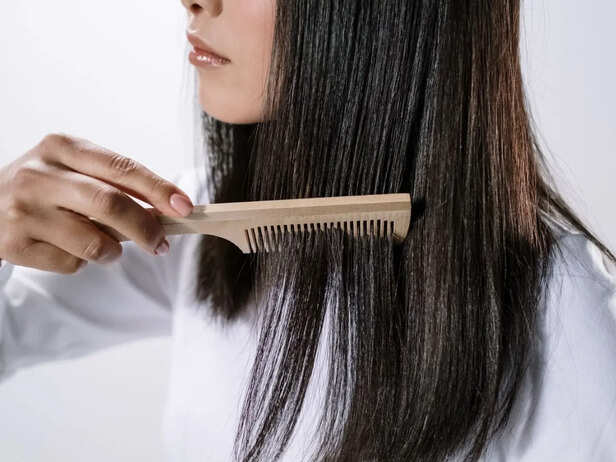
Hair does not grow between the salon chair and the mirror. What changes is the shape of what was already there, and shape turns out to matter more than quantity when it comes to how full a head of hair appears.
Most people assume thickness is about strand count. It is partly that, but strand count does not change with scissors. What changes is the geometry of each strand's tip, the way strands cluster at the ends, and how the overall weight of the hair sits against the scalp. A cut reorganises all three at once.
What a Tapered End Does to the Way Light Falls
Each hair strand grows from a follicle in a roughly cylindrical shape and then, over months and years, narrows toward its tip as the cuticle layers wear away. The longer the strand, the more weathered and tapered that tip becomes. A very tapered tip is nearly translucent. Light passes through it rather than bouncing off it, so the ends of long, uncut hair look wispy and thin even when the roots are dense.
When scissors cut across a strand, the new tip is blunt and flat. A flat tip has a larger cross-sectional surface area than a tapered one. It catches and reflects light across its full width. The strand appears thicker at the end than it did before, not because more of it exists, but because more of it is now visible to the eye.
Multiply this across hundreds of strands and the cumulative optical effect is substantial. The ends of freshly cut hair look denser because each strand is now presenting its full diameter to the light rather than a fading taper.
How Weight Changes the Way Hair Sits
Long hair is heavy. The weight of several extra centimetres pulls each strand downward and outward, flattening the natural arc of the hair against the scalp. This is why very long hair often lies flat at the crown even on someone with a high follicle density.
Remove length and you remove weight. Lighter strands spring back toward the scalp at a different angle. Hair that was being pulled flat now curves slightly upward or outward, creating a gap between the scalp and the hair mass. That gap reads as volume. The hair has not multiplied; it has simply stopped being pressed down by its own length.
This effect is strongest at the crown and at the sides, where the angle of growth already pushes hair outward. It is least obvious at the nape, where hair tends to grow downward regardless of length. Asking a stylist to take more weight off the mid-lengths and ends rather than just trimming the very tips targets this mechanism directly.
Why the Ends Cluster Differently After a Cut
Tapered, fine ends tend to separate. They are light and individual, and they drift apart, which means the boundary of the hair, the outer edge visible against a background, looks sparse and uneven. A blunt cut brings all the ends to the same length. They now sit together in a cohesive line rather than trailing off at different points.
That cohesive line creates a defined perimeter. A defined perimeter reads as fullness because the eye interprets a clear edge as density. The same number of strands that looked wispy when they ended at scattered lengths look substantial when they end at one.
This is why a blunt cut is often recommended for fine hair. It is not that blunt cuts add strands. They add a perimeter, and perimeter is most of what the eye uses to judge volume.
The Role of the Scalp and Root Lift
Hair grows from the follicle at an angle specific to each part of the scalp. At the crown, many follicles push hair upward and slightly outward. When those strands are long, gravity eventually wins and the hair folds over, lying flat. When they are shorter, gravity has less leverage and the natural growth angle holds. The hair stands slightly away from the scalp at the root, and that root lift is what creates the appearance of body.
Root lift is not the same as volume from a product. A volumising spray or mousse creates lift through coating and stiffening the shaft. A haircut creates root lift by removing the weight that was suppressing the follicle's natural angle. The lift from a cut is structural rather than cosmetic, which is why it lasts until the hair grows back to the same length rather than washing out.
What a Trim Cannot Do
A cut works with the hair that exists. It cannot compensate for a genuinely low follicle density, and it cannot replace strands that have shed and not regrown. Someone experiencing active hair thinning, fewer strands at the root rather than finer ends, will see a real but limited improvement from a cut. The optical effects still apply, but the underlying density is not there to amplify.
A trim also does not change the hair shaft's diameter, which is set at the follicle. Fine hair remains fine after a cut; it simply presents that fineness more neatly. The difference between fine hair that looks thin and fine hair that looks full is almost entirely a question of how the ends are shaped and how the weight is distributed, both of which a cut controls directly.
The thickness you see in the mirror after a trim is not an illusion in the dismissive sense. It is a real optical and structural change produced by real geometry. The hair that was already growing from your scalp has simply been given a shape that lets it show itself properly.
Unlock insightful tips and inspiration on personal growth, productivity, and well-being. Stay motivated and updated with the latest at My Life XP.