
Why Sweat Breaks Down Your Sunscreen But Not Your Moisturiser
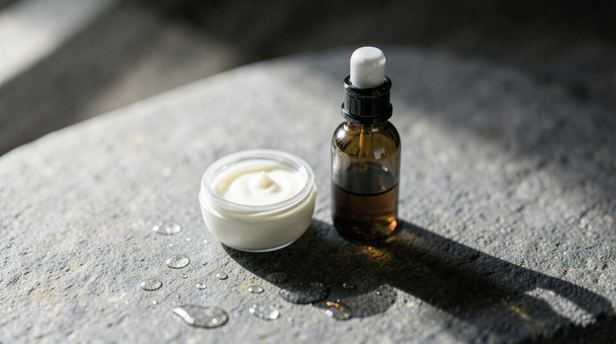
There is a version of this you have probably lived: you step out in the afternoon, sweat through a commute, and feel your skin go from protected to bare in a way that never happens with your morning cream. The moisturiser you put on at seven is still doing something at noon. The sunscreen you layered over it at nine feels like it evaporated. Both products sat on the same skin, in the same heat. The difference is not sweat volume. It is chemistry.
What Sunscreen Is Actually Trying to Do
Sunscreen works by forming a continuous, unbroken film across the surface of your skin. UV filters, whether chemical or physical, need to be evenly distributed to intercept light before it reaches the cells underneath. A gap in that film is not a minor inconvenience. It is a corridor that UV passes through unimpeded. The film depends on the filters staying where they were applied: not pooled, not patchy, not rinsed to one side.
Moisturiser has a different job. It works by delivering humectants, emollients, and occlusives into and onto the skin. Humectants pull water from the air and from deeper skin layers. Emollients fill the spaces between surface cells. Occlusives sit on top and slow water from leaving. None of these functions require a continuous, even film across the whole surface. A moisturiser that has shifted slightly or been partially absorbed is still doing most of what it was designed to do.
Why Sweat Disrupts One and Not the Other
Sweat is a dilute salt solution. When it arrives at the surface of your skin, it does three things to a sunscreen film: it dilutes the concentration of UV filters, it physically pushes and moves the film as it spreads across the skin, and the salt it carries can break the emulsion that holds the formula together.
Chemical sunscreen filters are often slightly water-soluble by design, this is part of what allows them to be formulated into a product that spreads smoothly and does not feel like paste. That same mild solubility means sweat can pick them up and carry them off, either into your clothes or down your face. Physical filters, zinc oxide and titanium dioxide, are not water-soluble, but they sit in an emulsion carrier that sweat can destabilise. The film breaks into islands. The gaps appear.
Moisturiser ingredients behave differently under the same conditions. Humectants like glycerin are already water-compatible; sweat does not dissolve them so much as join them. Emollients have already done their work by the time sweat arrives, they have softened the surface cells and are not sitting as a film waiting to be disrupted. Occlusives are typically the most sweat-resistant layer, because they are formulated to resist transepidermal water loss, which is a far more persistent force than intermittent sweat.
Heat Adds a Second Problem for Sunscreen
Sweat does not arrive alone. It arrives with heat, and heat changes how sunscreen behaves independently of the water.
Many chemical UV filters are activated by UV light, they absorb UV energy and release it as heat, which is the mechanism by which they protect you. Over time, this photodegradation means the filters themselves break down and lose potency. Heat accelerates the process. On a hot day, you are not just sweating off your sunscreen; you are also running through its active lifespan faster than the product's stated SPF was tested for. SPF testing happens in controlled laboratory conditions, not in thirty-eight-degree humidity.
Moisturiser ingredients are not photodegradable in the same way. Glycerin does not break down under UV exposure. Ceramides and fatty acids are stable. The formula may feel different in heat, thinner, more liquid, but the ingredients are still present and still functioning.
What This Means for How You Apply Each One
The practical consequence is that sunscreen and moisturiser have genuinely different reapplication logics, and treating them the same is where the protection gap opens up.
Moisturiser is applied once, sometimes twice, and the second application is usually about feel rather than function. It does not need reapplication because sweat has stripped it, it needs reapplication when the skin feels dry, which is a different signal entirely.
Sunscreen needs reapplication on a clock, not on a feel. The common guidance from dermatology bodies, every two hours of sun exposure, immediately after swimming or heavy sweating, exists because the film degrades on a timeline, not because your skin tells you it has. By the time your skin feels unprotected, the film has been gone for a while. The fact that it feels like your skin rather than like a product is not reassurance; it is the problem.
For heavy sweating specifically, a water-resistant formulation extends the window. Water resistance in sunscreen is a tested and regulated claim: it means the product has been shown to retain a meaningful portion of its SPF after a set period of water immersion. It does not mean sweat-proof, and it does not extend the reapplication window beyond two hours, it just means the film holds a little longer before it breaks.
The Layering Order Matters Too
One detail that changes how sweat interacts with both products is the order they go on. Sunscreen applied directly onto bare skin adheres more reliably than sunscreen applied over a heavy moisturiser, because a thick, occlusive moisturiser gives the sunscreen film a slippery surface to sit on rather than a stable one.
A light moisturiser applied first and given a few minutes to absorb, followed by sunscreen on top, gives the UV filters the best chance of forming an even film. A heavy cream applied immediately before sunscreen, with no time to sink in, means the sunscreen is partly floating on the cream rather than bonding to the skin, and that film is the first thing sweat will move.
The gap between the two products is not about quality or price. It is about what each one is trying to hold onto, and how sweat interacts with each goal differently. A moisturiser that has shifted is still a moisturiser. A sunscreen with gaps in its film is no longer a sunscreen.
Unlock insightful tips and inspiration on personal growth, productivity, and well-being. Stay motivated and updated with the latest at My Life XP.