
Why Palm Sweat Smells Different From Sweat After Exercise
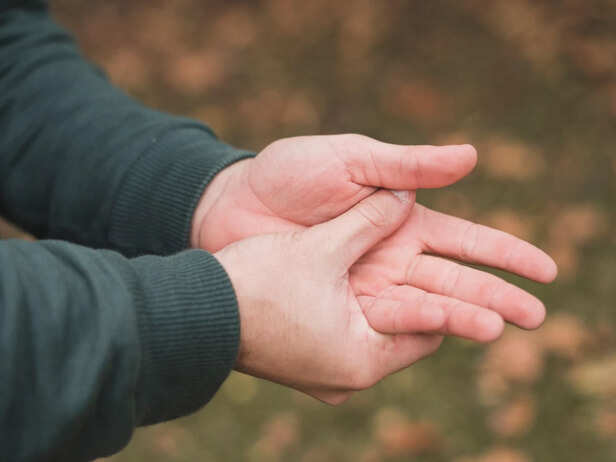
Most people assume sweat is sweat, a salty liquid the body pushes out to cool down. That is true for most of the body. It is not true for your palms, your soles, or your underarms, which run on an entirely different sweat system with a different trigger, a different composition, and a different smell profile. The distinction matters because the two systems evolved for different reasons, and understanding them makes the experience of your own body considerably less confusing.
Your Body Has Two Separate Sweat Systems
The skin contains two kinds of sweat glands. Eccrine glands cover almost the entire body surface, roughly two to four million of them, and their job is thermoregulation. When your core temperature rises during a run, a hot day, or a fever, eccrine glands release a dilute, mostly watery fluid that evaporates and pulls heat away from the skin. The fluid is about 99 percent water, with small amounts of sodium, chloride, potassium, and trace minerals. Fresh eccrine sweat from your back or chest has almost no smell of its own.
Apocrine glands are concentrated in specific areas: the underarms, the groin, around the nipples, and, critically, the palms and soles. These glands are larger, sit deeper in the skin, and connect to hair follicles rather than directly to the skin surface. They do not respond to heat. They respond to adrenaline. Their fluid is thicker and richer, containing proteins, lipids, and fatty acids alongside water. This is the sweat that appears when you are nervous, startled, or under pressure, and it is the sweat that produces the strongest odour.
Why Stress Sweat Smells Stronger
Apocrine fluid is not inherently foul-smelling when it leaves the gland. The odour develops when the bacteria that live on skin, a normal, permanent community, metabolise the proteins and fatty acids in the fluid. The breakdown products of that process are what register as the sharp, sometimes sour smell associated with anxiety or stress. Because apocrine fluid is nutritionally richer than eccrine sweat, it feeds bacteria more generously, and the resulting smell is correspondingly stronger.
Your palms are an interesting case within the apocrine system. The palm surface has a very low density of the bacteria that produce the most pungent breakdown products, partly because palms are washed more often and partly because the microbial community there differs from the one under the arm. Palm sweat tends to smell faintly acidic or slightly metallic rather than strongly organic. Some people describe it as similar to the smell of coins, a comparison that makes sense, because skin contact with metal produces a similar short-chain fatty acid reaction on the surface.
What Exercise Sweat Actually Contains
The sweat produced during a run is almost entirely eccrine in origin. It is high in sodium and chloride, the saltiness you can taste at the corner of your mouth, and relatively low in the proteins and lipids that bacteria find most useful. Fresh exercise sweat smells faintly of salt and very little else. The stronger smell that develops during a long workout or that lingers in gym clothes comes from two sources: apocrine sweat from the underarms and groin mixing with the eccrine output, and bacteria processing both over time as clothing traps warmth and moisture.
The salt crust that forms on skin after exercise, visible as a white residue on darker clothing, is dried sodium chloride from eccrine output. It has no smell. The smell in the fabric is almost entirely the product of bacterial activity in areas where apocrine glands contributed.
Why Palms Sweat When You Are Nervous but Not When You Are Hot
The palm's sweat response is controlled by the sympathetic nervous system, specifically the branch that handles the stress response. When the brain perceives a threat, a difficult conversation, a presentation, a sudden fright, it signals the adrenal glands to release adrenaline, and it simultaneously activates apocrine glands in the palms, soles, and underarms. This happens before the body temperature rises at all. You can be sitting perfectly still in a cool room and your palms will be wet.
The evolutionary reasoning, while speculative, is consistent across primates: moist palms improve grip on rough surfaces. A hand that is slightly damp holds a branch, a tool, or a surface more securely than a completely dry one. The stress response evolved partly as a preparation for physical action, and palm sweating may be one of its physical preparations. Whether or not that framing is accurate, the mechanism is well established: palm sweating is a stress response, not a temperature response, which is why it does not happen during exercise the way back and chest sweating does.
When Palm Sweating Is Worth Mentioning to a Doctor
Palms that sweat in response to stress are normal. Palms that sweat heavily and continuously, soaking through paper, making it difficult to hold a pen, or causing significant daily interference, may reflect a condition called palmar hyperhidrosis, in which the sympathetic nervous system's sweat signal is disproportionate to any external trigger. This is a recognised medical condition with several treatment options, and it is worth a conversation with a dermatologist rather than something to manage indefinitely with home measures. The threshold for seeking a look is not embarrassment but functional difficulty: if the sweating interferes with work, with holding objects, or with daily interactions in a consistent way, that is a reasonable reason to get it assessed.
The two sweat systems, one for heat, one for stress, run largely in parallel and rarely need managing at all. Knowing which one is active, and why, is usually enough to make the experience of your own body feel considerably less strange. Eccrine sweat is your cooling system doing its job. Apocrine sweat, including what appears on your palms before a difficult moment, is your stress system doing something older and less convenient. Both are working exactly as designed.
.