
When Your Child's Notebook Comes Home With a Remark About Handwriting
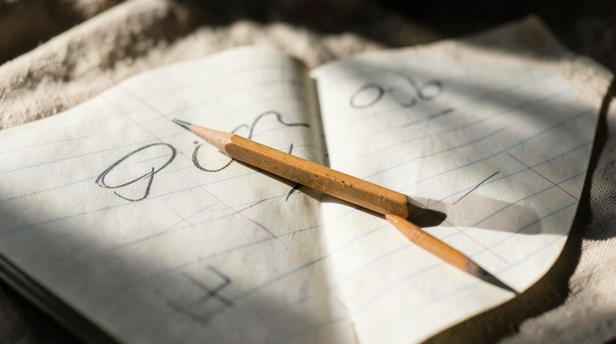
The notebook lands on the kitchen table and you see it before your child does. A line in the margin, sometimes circled, sometimes underlined: "Please improve handwriting." It is four words, but it does not feel like four words. It feels like a file being opened.
Before anything else, it is worth knowing what handwriting actually is, because it is not a single skill. It is a chain of at least four things working together: the small muscles of the hand and wrist developing enough strength and coordination, the brain learning to hold a letter shape in memory while the hand produces it, the eye tracking where the pencil has been and where it needs to go next, and the child sitting in a posture that lets all of this happen without fighting gravity. A remark about handwriting may be pointing at any one of those links, or at none of them, it may simply be pointing at a child who was rushing because the lesson before had run long.
What the Hand Is Actually Doing
Fine motor control, the kind handwriting needs, develops unevenly. Some children have it early and some do not, and neither group is telling you anything reliable about intelligence, effort, or how the next decade will go. The muscles that manage a pencil are the same ones that manage scissors, buttons, and the threading of a needle. Children who are physically active in large-muscle ways, climbing, running, catching, are not necessarily also building the small-muscle precision that a pencil grip needs. That precision comes from specific practice: tearing paper, rolling clay, picking up small objects, drawing freely. If a child has had less of that, the hand simply has less practice. It is a gap, not a flaw.
Why Some Children Write the Way They Do
Grip is the piece parents notice most, because it looks wrong when it is not the standard tripod hold. A child wrapping four fingers around a pencil, or pressing so hard the paper indents three sheets down, or holding the pencil so loosely it wobbles, each of these is the hand trying to solve a problem. The over-grip usually means the hand is working harder than it should to control something that does not feel stable. The loose grip often means the child is avoiding the discomfort of pressing. Neither is stubbornness. Both are the hand doing its best with what it has.
Letter formation is a separate question from grip. A child can hold a pencil correctly and still reverse letters, mix capitals into the middle of words, or write in a size that does not fit the line. Letter reversals, particularly b and d, p and q, are common well into the early school years and are not, on their own, a sign of a reading or writing difficulty. The brain is still building the spatial map that tells it which direction a letter faces. Most children sort this out without intervention, given time and low-stakes practice.
What the Remark Is Usually Asking For
Teachers who write margin comments about handwriting are, in most cases, asking for legibility rather than beauty. The distinction matters. Legibility means the reader can tell which letter is which. Beauty means consistent sizing, even spacing, smooth joins. Schools ask for legibility. The margin comment is almost always about the first, even when it sounds like it is asking for the second.
It is worth reading the comment alongside the notebook itself. If the handwriting is difficult to read even when you know what the child was trying to write, that is the concern worth taking seriously. If the letters are clear but uneven, or clear but large, or clear but slow, the concern is smaller and the solution is usually time and practice rather than remediation. If the child is writing in a way that causes visible physical discomfort, the hand cramping, the wrist bending at an odd angle, complaints of tiredness in the fingers after short periods of writing, that is worth raising with a doctor or an occupational therapist, not because something is wrong, but because the right support early costs less than the wrong support later.
What Actually Helps at Home
The instinct is to buy a handwriting workbook and sit down with the child each evening. This can work, and it can also make a child who already feels self-conscious about their writing feel watched and judged at home too. The more durable approach is to build the underlying capacity rather than drilling the output.
Drawing helps more than copying letters. Free drawing, not colouring inside lines, but choosing what to draw and drawing it, builds the hand-eye coordination and the small-muscle control that handwriting runs on. Clay, playdough, and any activity that involves pinching, rolling, or pressing builds grip strength without the pressure of producing something that will be assessed. Letting a child write anything they want, a list, a label for a drawing, a note to a sibling, in a context where no one is grading it builds the habit of writing without the anxiety of performance.
If the school has raised the concern more than once, or if the child is avoiding writing tasks in ways that go beyond ordinary reluctance, a conversation with the class teacher about what specifically they are seeing is more useful than a second opinion from a workbook. Teachers see a child's handwriting across many tasks and many moods. They have a comparison group. The information they hold is more precise than a single notebook can show.
The Part Nobody Says Out Loud
A remark about handwriting sometimes lands as a remark about parenting, and that is worth naming because it is what makes the notebook feel heavier than it is. The logic runs: if the child cannot write neatly, someone at home has not been practising with them. This logic is wrong. Handwriting development is not primarily a function of home drilling. It is a function of physical maturation, of the specific fine motor experiences a child has had, and of the pace at which a particular nervous system is building particular connections. None of those are things a parent controls entirely, and none of them are things a margin comment can measure.
The notebook is not a verdict. It is one teacher's observation on one piece of work, and it is asking for something specific: more legibility, more care, more practice. Those are reasonable asks. They are also asks that can be met without turning the kitchen table into a second classroom every evening.
Handwriting that is hard to read at seven is often perfectly readable at nine, not because anyone drilled it into shape, but because the hand caught up with the idea the child already had. The remark in the margin is the beginning of a conversation, not the end of one.