
3 Kings Who Challenged the Gods and Broke Every Rule
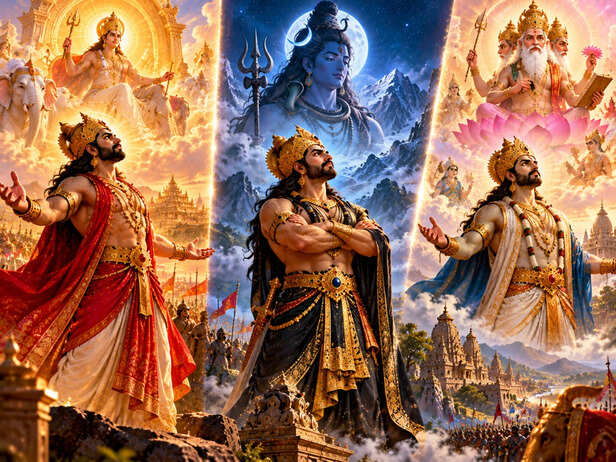
What if a human being refused to accept the limits placed on mortality? What if a king became so powerful that sages were forced to carry him, or a powerful ruler became so devoted that Lord Vishnu himself was believed to stand guard at his door? Hindu mythology preserves fascinating stories of kings who crossed boundaries that seemed impossible to cross. Among them are Trishanku, Nahusha and King Bali. Their stories are not simply about power or miracles. They explore ambition, ego, devotion and the consequences of challenging the cosmic order.
Trishanku Wanted Heaven While Still Alive
According to the traditional story, King Trishanku belonged to the Ikshvaku dynasty of Ayodhya, the same royal lineage associated with figures such as King Harishchandra and Lord Rama. Trishanku was a capable ruler, but he developed an extraordinary desire: he wanted to enter Swarga, or heaven, without leaving his physical body behind. Such a wish challenged the traditional understanding of life, death and the journey of the soul. When his priests and sages rejected the idea, Trishanku turned to Sage Vishwamitra, hoping that the powerful sage could accomplish what others considered impossible.
Vishwamitra Created a Heaven for Trishanku
Vishwamitra agreed to help Trishanku and performed a powerful yajna with the support of other sages. Through his spiritual power, Trishanku was sent towards heaven while still alive. But according to the legend, the gods rejected his entry and pushed him back. This is where the story takes its most dramatic turn. Vishwamitra refused to let his efforts fail and used his power to stop Trishanku's fall. He then created a separate celestial realm for him. The expression Trishanku Swarga comes from this extraordinary episode and is often used to describe a state suspended between two worlds.
Nahusha Rose to Heaven Then Lost Everything
King Nahusha offers a completely different lesson. According to the Mahabharata, Nahusha became ruler of the gods for a period when Indra was absent. His rise was extraordinary, but power gradually changed him. The king became proud and began demanding greater respect. In one famous episode, he ordered sages to carry his palanquin. Among them was Sage Agastya. Nahusha became impatient with the slow pace and, in the traditional account, kicked Agastya. His arrogance led to a terrible fall. The story of Nahusha shows how quickly power can become destructive when humility disappears.
King Bali Chose Devotion Over His Kingdom
The story of King Bali is different from Trishanku and Nahusha. Bali was a powerful Asura king known in Hindu mythology for his generosity, strength and devotion. His growing influence eventually concerned the gods, and Lord Vishnu appeared as Vamana, a dwarf Brahmin. Bali promised to grant him whatever land he could cover in three steps. Vamana then revealed his divine form and covered the earth and heavens in two steps. With nowhere left for the third step, Bali offered his own head. His surrender became the defining moment of his story.
Why Vishnu Became Bali's Guardian
After Bali surrendered everything, Lord Vishnu is traditionally said to have granted him a special blessing. In some traditions, Vishnu promised to remain near Bali as his protector. This is why stories of King Bali and Vamana Avatar are remembered not simply as a tale of an Asura losing his kingdom, but as a story of devotion and humility. Bali accepted the outcome without abandoning his word. His character therefore stands in contrast to Nahusha's pride and Trishanku's relentless desire. The three legends show that power alone does not determine how a person is remembered.
Three Kings, Three Different Desires
The stories of Trishanku, Nahusha and King Bali become even more meaningful when placed together. Trishanku wanted to overcome the boundary between human life and heaven. Nahusha received extraordinary power but allowed pride to control him. Bali possessed immense power yet ultimately chose to honour his promise even when it cost him his kingdom. Their stories are therefore more than supernatural episodes from Hindu mythology. They explore very human emotions: ambition, ego, insecurity, responsibility and surrender. Each king reaches an extraordinary position, but what happens after that reveals the true nature of his character.
The Real Lesson Behind These Ancient Legends
The most powerful message in these ancient Indian legends is not that humans should never dream beyond their limits. Trishanku's story reflects extraordinary ambition, Nahusha's fall warns against arrogance, and Bali's surrender highlights the strength of keeping one's word. Together, they suggest that achievement without wisdom can become dangerous. Power without humility can lead to downfall, while genuine devotion can transform even loss into spiritual significance. That is why these stories continue to survive across generations. They are not only tales of kings and gods. They hold questions that remain relevant whenever ambition, authority and personal desire begin to take control of our lives.