
33 Hindu Gods or One Reality? The Vedic Mystery Explained
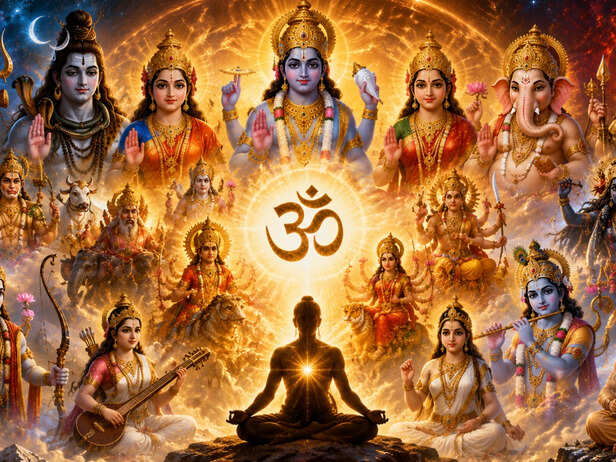
The phrase “33 Hindu gods” is often surrounded by confusion. Many people have heard that Hinduism speaks of 33 crore gods, but the ancient Vedic and Upanishadic texts present a much more specific picture. The Brihadaranyaka Upanishad describes thirty-three principal deities as eight Vasus, eleven Rudras, twelve Adityas, Indra and Prajapati. What makes this teaching fascinating is that these groups are connected not only with divine figures, but also with nature, time, life, the senses and cosmic forces. The story is therefore less about counting gods and more about understanding how Vedic thought viewed reality.
Where the Number 33 Comes From
The clearest explanation of the thirty-three appears in the Brihadaranyaka Upanishad, where the sage Yajnavalkya is asked how many gods there really are. He first gives the number thirty-three and then explains the groups behind it. Eight are the Vasus, eleven are the Rudras and twelve are the Adityas, making thirty-one. Indra and Prajapati bring the total to thirty-three. This is important because the text itself provides the classification rather than presenting an unlimited collection of separate deities.
The Eight Vasus
The eight Vasus are described as fire, earth, air, the intermediate atmosphere, the sun, heaven, the moon and the stars. The Upanishad calls them Vasus because everything is established or dwells within these aspects of existence. Their description shows how closely Vedic thought connected the divine with the natural world. Instead of viewing nature as completely separate from spirituality, the teaching places cosmic elements within a sacred framework. The Vasus therefore help explain the physical surroundings through which human beings experience the universe.
The Eleven Rudras
The eleven Rudras have a strikingly different explanation. In the Brihadaranyaka Upanishad, they are described as the ten organs or vital faculties together with the self as the eleventh. When these leave the mortal body, they cause people to grieve, which explains the association with the name Rudras. This interpretation brings the teaching directly into human experience. The Rudras are therefore not simply distant divine figures. They are connected with life, the functioning of the person and the profound change that occurs when life departs from the body.
The Twelve Adityas
The twelve Adityas are identified in the Upanishad with the twelve months of the year. The text explains their name through their movement and their role in carrying everything along with the passage of time. This makes the Adityas closely connected with the rhythm of the year and the unavoidable movement of existence. Their symbolism also shows how Vedic thinkers observed recurring natural cycles and gave them a sacred meaning. The changing months become more than a calendar system. They represent the continuous movement of life, time and the world around us.
Indra and Prajapati Complete the Count
After listing the eight Vasus, eleven Rudras and twelve Adityas, the Upanishad adds Indra and Prajapati to complete the thirty-three. In the passage, Indra is associated with thunder, while Prajapati is associated with sacrifice. Their inclusion is significant because the classification brings together different dimensions of existence, including natural forces and ritual principles. It also demonstrates that the number thirty-three is not an arbitrary figure. The text deliberately builds the count through specific groups before asking a much deeper question about whether reality can ultimately be reduced to even fewer principles.
Is It Really 33 Crore Gods?
The popular phrase “33 crore gods” needs careful explanation. The Brihadaranyaka Upanishad explicitly speaks of thirty-three and then describes other larger numbers as manifestations or powers of these principal deities. Some modern explanations argue that koti can carry meanings beyond the numerical “crore,” including ideas such as category or excellence, although the exact interpretation of koti has been debated. Therefore, it is safer to distinguish the ancient textual teaching of thirty-three deities from the later popular expression of “33 crore gods,” rather than treating the two as automatically identical.
The Deeper Message Behind the 33
The most fascinating part of the teaching comes after the number thirty-three. Yajnavalkya is repeatedly asked how many gods there really are, and the number moves from thirty-three to six, three, two, one and finally one. This progression changes the meaning of the entire discussion. The thirty-three are not presented simply as a crowd of competing divine personalities. They form a framework through which different aspects of existence can be understood. The deeper philosophical movement is from diversity toward unity, encouraging the seeker to look beyond visible forms toward the principle underlying them.
What the Vedas Really Teach
The story of the thirty-three deities is far more nuanced than the familiar claim that Hinduism simply has “33 crore gods.” The Brihadaranyaka Upanishad gives a structured account of thirty-three principal deities through the Vasus, Rudras, Adityas, Indra and Prajapati. More importantly, the dialogue does not end with the number thirty-three. It gradually moves toward fewer principles and ultimately one.
That is what makes this ancient teaching so powerful. It uses the language of gods, nature, time and human life to ask a much larger question: Are the many forms of existence expressions of a deeper unity? For readers today, the answer is not simply a number. It is an invitation to understand the philosophy behind the tradition rather than relying only on popular retellings.
Unlock insightful tips and inspiration on personal growth, productivity, and well-being. Stay motivated and updated with the latest at My Life XP