
7 Powerful Nagas and Their Surprising Divine Connections
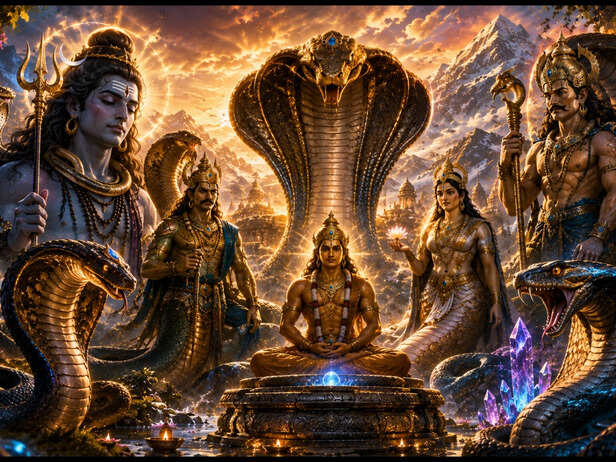
What if the serpents seen around Hindu deities are not simply symbols of danger?
Across Hindu mythology, nagas appear in some of the most powerful divine stories. Adishesha is associated with Lord Vishnu, Vasuki is famously depicted around Lord Shiva’s neck, and other serpent figures are connected with deities such as Indra, Kubera and Shani.
These sacred serpents are often associated with protection, cosmic power, transformation and spiritual symbolism. Their stories are also connected with the ancient tradition of serpent worship, which has existed across different parts of India for centuries.
But why are different nagas associated with different gods?
The answer reveals a fascinating side of Hindu mythology.
Adishesha and Lord Vishnu
Adishesha, also known as Shesha or Ananta, is among the most prominent serpents in Hindu mythology. He is traditionally depicted as the divine serpent who forms the resting place of Lord Vishnu in the cosmic ocean. The name Ananta means “endless” or “infinite,” reflecting his association with eternity. In many depictions, Vishnu reclines upon Shesha while Goddess Lakshmi sits nearby. Adishesha is therefore not presented as an ordinary snake but as a powerful cosmic being connected with preservation, infinity and the divine order of the universe.
Vasuki Rests Around Shiva’s Neck
Vasuki is one of the best-known nagas in Hindu mythology. He is famously associated with Lord Shiva and is often depicted coiled around Shiva’s neck. Vasuki also plays a major role in the Samudra Manthan, or churning of the ocean, where he was used as the cosmic rope wrapped around Mount Mandara. His association with Shiva gives the serpent another layer of meaning. Rather than representing fear alone, Vasuki can symbolise power under control. His presence around Shiva reflects Mahadev’s ability to remain calm while surrounded by immense forces.
Karkotaka Has a Different Story
Karkotaka is a prominent naga in the Mahabharata tradition, particularly in the story of King Nala. According to the narrative, Karkotaka bit Nala in a way that changed his appearance and played a role in his difficult journey. The story eventually contributed to Nala’s transformation and return to his rightful life. Karkotaka is therefore associated with a much more complex idea than simple protection. His story involves disguise, transformation, destiny and hidden consequences. Different traditions may portray Karkotaka differently, so his connection should be understood through the specific text or regional tradition being followed.
Padma and Mahapadma Represent Naga Power
Padma and Mahapadma are traditionally counted among important naga names in Hindu texts and later traditions. Their names appear in different accounts of the Naga world and are associated with the powerful serpent beings believed to inhabit the subterranean realm of Patala. Their exact relationships with individual deities can vary across traditions, so it is important not to treat every popular association as universally established in scripture. What remains consistent is the importance of naga symbolism. Serpents are repeatedly connected with hidden realms, protection, fertility, water and mysterious spiritual forces.
Kulika and the Planetary Tradition
Kulika, also called Kulik in some traditions, is traditionally included among the important nagas mentioned in Hindu literature. Popular religious and astrological traditions sometimes connect serpent figures with planetary influences and Naga Dosha. However, these associations can differ between schools of astrology and regional practices. Naga Dosha itself is primarily an astrological concept rather than a universally defined doctrine across all Hindu scriptures. Therefore, claims about specific nagas being “in charge” of a particular dosha should be understood as belonging to particular traditions rather than as a single universally accepted scriptural rule.
The Peacock and the Serpent
Lord Murugan, also known as Kartikeya or Skanda, is traditionally associated with the peacock as his vehicle. In many artistic depictions, the peacock is shown standing over or subduing a serpent. This image carries symbolic meaning. The peacock can represent beauty, courage and spiritual awareness, while the serpent may represent lower impulses, fear or negative tendencies in particular interpretations. The image therefore does not simply portray an animal defeating another animal. It can be understood as a symbolic representation of spiritual strength overcoming forces that hold consciousness back.
Why Nagas Matter in Hindu Tradition
The recurring presence of nagas in Hindu mythology reveals how complex serpent symbolism can be. A naga may represent protection in one story, cosmic infinity in another and transformation somewhere else. This is why reducing every serpent figure to “good” or “bad” misses the deeper meaning. Naga traditions are also closely connected with water, fertility, underground realms and sacred geography in many parts of India. Naga Panchami, for example, continues the long-standing tradition of honouring serpents. These stories remind us that Hindu mythology often uses one symbol to express many layers of spiritual meaning.
Unlock insightful tips and inspiration on personal growth, productivity, and well-being. Stay motivated and updated with the latest at My Life XP.