
Did Ganesh Ji Write the Mahabharata in These 10 Days?
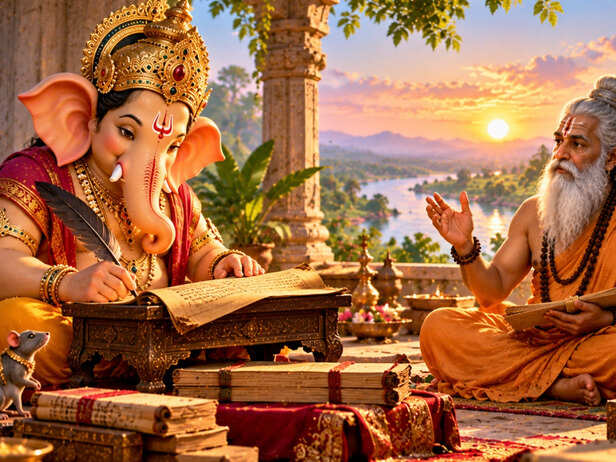
Why does Lord Ganesha have one broken tusk? The answer lies in one of the most memorable stories associated with the Mahabharata. According to Hindu tradition, Sage Ved Vyasa wanted someone capable of writing down the epic as he recited its verses. Lord Ganesha agreed, but he placed one condition: Vyasa must not stop dictating. The writing continued until Ganesha’s writing instrument broke. Instead of stopping the work, Ganesha is said to have broken one of his own tusks and used it to continue writing. This is one of the stories behind his name Ekdant, meaning “one-tusked.”
Vyasa Needed a Remarkable Scribe
According to the traditional account, Sage Ved Vyasa wanted to record the vast story of the Mahabharata. He approached Lord Ganesha because the task required someone who could write continuously and keep pace with the recitation. Ganesha agreed to become the scribe, but the arrangement came with a condition. Vyasa could not stop his narration once it began. The story sets up a fascinating challenge between the two: Vyasa had to keep composing and reciting, while Ganesha had to keep writing. Their unusual agreement became the beginning of the famous tale of Ganesha’s broken tusk.
One Condition Changed Everything
Ganesha’s condition was simple but demanding: Vyasa must continue speaking without a break. Vyasa accepted, but he is traditionally said to have added his own condition. Ganesha should understand every verse before writing it down. This gave Vyasa time to compose and ensured that Ganesha was not merely copying words without understanding them. The two continued their extraordinary task. The traditional Mahabharata is an enormous Sanskrit epic containing many thousands of verses, and later tradition magnified the image of this divine writing session into one of the best-known stories connected with Ganesha.
Then the Writing Tool Broke
Everything was going according to the plan until the writing instrument Ganesha was using suddenly broke. This could have ended the writing session. Vyasa was still reciting, and the agreement gave Ganesha no room to simply stop. Instead of searching for another reason to pause, the story says that Ganesha immediately found another solution. He broke one of his own tusks and used it as a writing instrument. That dramatic moment explains why Ganesha is traditionally shown with one complete tusk and one broken tusk. The obstacle became part of his identity.
This Is Why He Is Called Ekdant
The name Ekdant comes from the Sanskrit words associated with “one” and “tooth or tusk,” referring to Ganesha’s one-tusked form. The broken-tusk story is one of several traditional explanations connected with this distinctive appearance. In the Mahabharata tradition, his tusk becomes more than a physical feature. It represents his willingness to sacrifice something of himself to complete a difficult task. That is why the image of Ekdant has remained so powerful in Hindu tradition. His broken tusk is not remembered only as damage. It becomes a symbol of determination and commitment.
The Epic Was More Than a Writing Task
The traditional story describes Ganesha writing as Vyasa dictated the Mahabharata, but it should not be read as a documented historical account of how the epic was physically written. The Mahabharata developed through a long oral and literary tradition, with scholars studying its composition and layers over many centuries. Still, the Ganesha-Vyasa story has an important place in Hindu tradition. It turns the creation of the epic into a story about discipline, intelligence and dedication. The focus is not simply on how many verses were written, but on the determination shown when the work became difficult.
The Broken Tusk Carries a Bigger Lesson
The most meaningful part of the story is what happens when the plan fails. Ganesha does not complain that his writing tool is broken. He does not wait for perfect conditions. He sacrifices his own tusk and continues. For a modern reader, the lesson is surprisingly practical. A missed opportunity, failed plan or unexpected problem does not always mean the goal must end. Sometimes the next step is to change the method and continue. The story reminds us that commitment is tested when the easy option disappears, not when everything is going smoothly.
Ekdant Reminds Us to Keep Going
The story of Ganesha and Vyasa survives because the image is easy to remember: an enormous epic is being dictated, the writing instrument breaks, and Ganesha uses his own tusk to continue. Whether approached as sacred tradition, mythology or a cultural story, its message remains relevant. We often stop when circumstances become inconvenient, assuming the right conditions must return before we can continue. Ekdant offers another way to look at obstacles. The problem may not be the end of the journey; it may simply require a different way forward.
The Lesson of Ekdant
The story behind Ganesha’s broken tusk is ultimately a story about commitment over convenience. According to tradition, when the writing instrument failed during the Mahabharata’s narration, Ganesha did not allow the interruption to end his task. He sacrificed one of his tusks and continued writing.
That is why the image of Ekdant carries such emotional power. The broken tusk is a reminder that completing something meaningful can demand patience, sacrifice and the courage to adapt.
The next time you see Lord Ganesha during Ganesh Utsav, his single tusk can be remembered as more than a familiar symbol. It can be a reminder to keep moving when the first solution no longer works.
Unlock insightful tips and inspiration on personal growth, productivity, and well-being. Stay motivated and updated with the latest at My Life XP