
Did Hanuman Really Swallow the Sun? The Hidden Truth
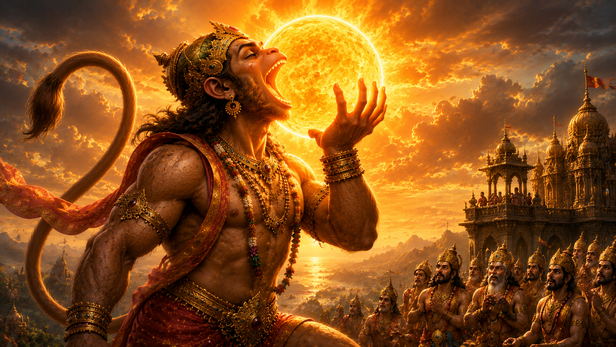
Almost every devotee has heard the famous line from the Hanuman Chalisa: Yug sahasra yojan par bhanu, leelyo tahi madhur phal jaanu.” As children, many of us were told that Hanuman Ji saw the Sun as a sweet fruit and jumped to eat it. It sounds magical, powerful, and unforgettable. But did Tulsidas Ji really mean that Hanuman physically swallowed the Sun? Or is there a deeper spiritual meaning hidden inside this beautiful verse The answer may completely change the way you understand the Hanuman Chalisa.
The Verse That Creates Curiosity
This one line has fascinated devotees for centuries. A child Hanuman leaping across the sky toward the Sun sounds like a story of impossible strength. But saints and spiritual teachers often remind us that the Hanuman Chalisa is not only a collection of miracles. It is also a guide to devotion, wisdom, and inner transformation. Tulsidas Ji frequently used poetic symbols to express spiritual truths that are difficult to explain through ordinary language.
What Does “Bhanu” Really Mean?
In Sanskrit and devotional literature, Bhanu means the Sun. But the Sun is not only a physical object. It is also a symbol of knowledge, awareness, and divine wisdom. Hanuman Ji later became one of the greatest scholars and devotees in the Ramayana. He is described as a master of grammar, scriptures, and spiritual understanding. When the verse says he reached the Sun, many interpreters see it as Hanuman reaching toward the highest knowledge.
The Meaning of “Leelyo Tahi Madhur Phal Jaanu”
The phrase literally means “He took it, considering it a sweet fruit.” A fruit gives nourishment, sweetness, and fulfillment. In spiritual language, knowledge that transforms life is often compared to a sweet fruit. Hanuman did not merely look at wisdom from a distance. He absorbed it, lived it, and expressed it through service to Shri Ram. This interpretation turns the verse from a physical miracle into a powerful lesson about learning and spiritual growth.
Why Is Vibhishan Mentioned First?
The previous line says:
Tumharo mantra Vibhishan maana, Lankeshwar bhaye sab jag jaana.”
This is important. Vibhishan accepted the path shown by Hanuman and surrendered to Shri Ram. He moved from the kingdom of ego to the kingdom of dharma. Tulsidas Ji places this transformation before the Sun verse, suggesting a journey from right guidance to higher wisdom. First comes surrender, then comes knowledge. This sequence is deeply spiritual and often overlooked.
Literal Story or Spiritual Metaphor?
Traditional stories do describe child Hanuman leaping toward the Sun, and devotees lovingly accept this divine play. At the same time, many scholars and saints explain that Tulsidas Ji used this story as a metaphor for the soul’s leap toward enlightenment. The two views do not have to fight each other. One inspires faith in Hanuman’s divine power, and the other inspires us to seek wisdom with the same enthusiasm and innocence.
What Can We Learn From This Today?
Ask yourself: What is the “Sun” in my life? It may be truth, wisdom, discipline, devotion, or self-awareness. Hanuman teaches us not to fear the distance. He teaches us to leap toward what is highest and purest. Read the Hanuman Chalisa slowly, reflect on its meaning, and try to bring one teaching into daily life through humility, service, study, and remembrance of Shri Ram.
Unlock insightful tips and inspiration on personal growth, productivity, and well-being. Stay motivated and updated with the latest at My Life XP