
Did Sita Really Kill Ravana? The Hidden Truth of Ramayana
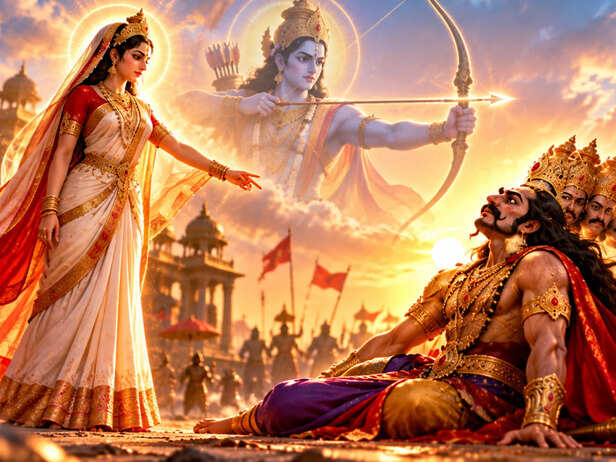
What if the Ramayana you grew up watching is only one version of a much larger story? In one tradition, Rama kills Ravana. In another telling, Sita takes a fierce form and destroys him. Jain literature presents yet another version in which Lakshmana kills Ravana. There are also traditions in which Sita returns from the earth when called upon. So which Ramayana is actually correct? The surprising answer is that Indian tradition does not always treat these differences as contradictions. It sees the Ramayana as a vast living tradition, retold across texts, regions and cosmic ages.
Did Sita Really Kill Ravana?
Most people know the familiar story: Rama defeats Ravana after the great battle in Lanka. But some lesser-known Ramayana traditions tell a very different episode. In certain retellings, Sita takes a fierce divine form associated with the goddess and becomes the one who destroys Ravana. This version can completely change the way we understand Sita. She is no longer presented only as the abducted queen waiting for Rama's victory. Instead, she becomes a powerful force capable of defeating the demon king herself. Such variations show how different Indian traditions explored the same characters through different spiritual ideas.
Even Ravana’s Death Changes
The differences do not stop with Sita. In the Jain Ramayana tradition, particularly the Prakrit work Paumacariya, Ravana is killed by Lakshmana rather than Rama. For someone familiar only with the popular Ramayana, this can sound shocking. But it reflects a different religious and literary framework. Jain retellings reinterpret familiar characters according to Jain ideas and values. This is why asking, “Which version is the real Ramayana?” can sometimes be too narrow a question. The better question is: What does each tradition reveal about the characters, values and worldview through which it tells the story?
Why Are There So Many Ramayanas?
The Ramayana travelled across India and beyond through Sanskrit, Prakrit, regional languages, oral traditions, poetry and religious literature. As it travelled, storytellers preserved its central themes while developing different details. This is why scholars often speak of Ramayana traditions rather than treating the epic as a single uniform text. Rama, Sita, Ravana, Hanuman and Lakshmana remain central, but their roles can shift from one retelling to another. Regional Ramayanas, Jain Ramayana stories and devotional versions all contributed to this enormous literary tradition. The result is not one small story, but a vast cultural universe built around the Ramayana.
Indian Time Works Differently
The idea becomes even more fascinating when viewed through the traditional Indian understanding of time. Hindu cosmology describes time as cyclical rather than simply moving from one beginning to one end. Four yugas form a Mahayuga, while larger cycles are described through concepts such as Manvantara and Kalpa. Within this worldview, the story of Rama is not necessarily understood as an event that happened only once in the entire existence of the universe. Traditional texts and interpretations can place the Ramayana in recurring cosmic cycles, with the essential truth remaining while certain details differ.
Nana Bhanti Ram Avatara”
A famous passage from the Ramcharitmanas captures this expansive idea with the words, “Nana bhanti Ram avatara.” The broader passage speaks of Rama's story being described in many ways across different cosmic circumstances. This gives a fascinating way to understand the many Ramayanas. If different sages are believed to have witnessed or remembered different manifestations and cycles, variations in the narrative are not necessarily surprising within that worldview. The story can remain recognisably the Ramayana while details shift. That is very different from the modern assumption that every retelling must match word for word.
A Story Can Have Many Forms
Think about how one family story can change when it is told by grandparents, parents and children. The central event remains, but each storyteller remembers different details and focuses on different emotions. The Ramayana became something much larger because it was carried through centuries of storytelling and interpretation. Valmiki's Ramayana holds a foundational place in the tradition, but later works did not simply disappear because they differed from it. They added new perspectives. That is why the story has inspired Sanskrit epics, Jain literature, regional Ramayanas, folk traditions and devotional retellings across generations.
So Which Ramayana Is “Correct”?
Perhaps the biggest mistake is assuming that one version must completely cancel out every other version. Valmiki Ramayana is foundational and immensely important, but Indian literary tradition also contains many later retellings with their own theological and cultural contexts. A Jain Ramayana can tell the story differently without needing to erase Valmiki. A regional tradition can emphasise Sita differently without making Rama's story meaningless. The real richness lies in understanding why these versions developed. Instead of asking only which story is “right,” we can ask what each tradition is trying to teach about dharma, devotion, courage, sacrifice and the nature of good and evil.
The Ramayana Is Bigger Than One Version
The next time someone says, “But that is not how the Ramayana happened,” there is a fascinating question worth asking: Which Ramayana are we talking about?
The story of Rama has travelled through countless generations, languages, regions and religious traditions. Some versions change Ravana's killer. Some give Sita a dramatically different role. Others place the story within a larger cosmic cycle of time.
That does not make the Ramayana weaker. It reveals just how deeply the story has lived in Indian civilisation.
Perhaps the most powerful lesson is not that there is only one way to tell the Ramayana, but that its central questions about dharma, truth, duty and human character have been powerful enough to inspire countless tellings.