
Did the Gods Treat Gayasur Unfairly? The Ramayana?
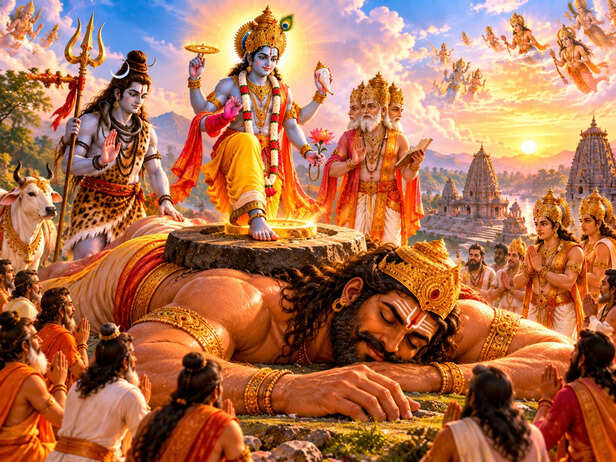
What if an Asura became so devoted to Lord Vishnu that even death rituals lost their purpose because everyone could reach Vishnuloka? According to a traditional Hindu legend, this was the extraordinary story of Gayasur. His devotion became so powerful that the gods faced an unexpected problem. When Lord Brahma asked for his body for a sacred yajna, Gayasur agreed. But the story took a surprising turn when his body would not remain still. The legend is associated with Gaya in Bihar, one of Hinduism's most important pilgrimage sites for ancestral rites.
The Asura Whose Devotion Changed Everything
Gayasur's story begins with an unusual contrast: he was an Asura, yet he was a devoted follower of Lord Vishnu. According to the legend, his spiritual power became so great that anyone who touched him could attain Vishnuloka, the abode of Vishnu. As a result, people no longer needed to pass through the usual cycle of judgment associated with Yama, the god of death. The legend describes how this created a problem for the gods. Gayasur had not sought power for himself, but his devotion had produced consequences that even the divine world had to address.
Why the Gods Approached Gayasur
According to the story, the gods needed a way to restore the balance that Gayasur's extraordinary spiritual power had disturbed. Lord Brahma approached him and requested his body for a sacred yajna. Gayasur agreed to the request, accepting that his body would serve a religious purpose. This part of the Gayasur legend is striking because he does not bargain for rewards or demand recognition. His willingness to give what was asked of him becomes central to the story. The episode also raises a question that runs through many Hindu tales: what happens when a sincere act of devotion leads to an unexpected outcome?
Why a Sacred Stone Was Placed on Him
The story takes another turn when Gayasur's body continues to move, making it difficult to complete the yajna. A sacred stone, known in the tradition as the Dharmashila, is placed on his head to keep him still. Yet the problem remains, and the legend eventually brings Lord Vishnu into the scene. The stone becomes an important part of the story associated with Gaya. Rather than focusing only on the gods' difficulty, this moment invites readers to consider Gayasur's position: he had agreed to help, but the request placed a great burden on him.
Lord Vishnu's Unexpected Action
In the traditional account, Lord Vishnu uses his gada, or divine mace, to press the sacred stone into place and stop Gayasur from moving. This is the moment that gives the story its emotional weight. Gayasur had already agreed to offer his body for the yajna, so the final action raises a difficult question about trust and communication. The legend recalls Gayasur saying, in essence, that Vishnu could have simply asked him to remain still. This sentiment gives the tale a human dimension: even when a goal is sacred, the way it is achieved matters.
How Gayasur Became Linked to Gaya.
The legend is closely associated with Gaya in Bihar, where the Vishnupad Temple is an important pilgrimage site. The temple is revered for the footprint of Lord Vishnu enshrined there, and local religious traditions connect the sacred landscape with the story of Gayasur. Some retellings describe his body as extending across different regions, with his head associated with Gaya. Details vary across versions, so geographical descriptions should be understood as elements of religious tradition rather than established physical history. What remains central is Gaya's place in Hindu pilgrimage and its long-standing association with rites performed for departed ancestors.
Why Pind Daan Is Performed in Gaya
Gaya is widely known for Pind Daan, a Hindu ancestral rite in which offerings, often made from rice and other traditional ingredients, are presented in memory of departed family members. Devotees perform these rituals to honour their ancestors and pray for their well-being in the afterlife. The Gayasur legend gives this practice a sacred setting by connecting the land with divine intervention and spiritual merit. Many families travel to Gaya because of its religious importance. For them, Pind Daan is not merely a ritual; it is also an expression of remembrance, gratitude and responsibility towards previous generations.
Was Gayasur Treated Fairly?
Perhaps the most interesting part of Gayasur's story is not the sacred stone or the origin of a pilgrimage site, but the question it leaves behind. Gayasur willingly offered his body for a religious purpose. His final response, as remembered in some retellings, asks why he was not simply requested to remain still. Was the outcome necessary to restore divine order, or could it have been handled differently? Hindu mythology often encourages reflection rather than a single easy answer. Gayasur's story reminds us that devotion and sacrifice deserve respect, and that even a seemingly righteous goal can raise questions about fairness.
Unlock insightful tips and inspiration on personal growth, productivity, and well-being. Stay motivated and updated with the latest at My Life XP