
Why Vaisakhi Means Something Deeper in Sikh Tradition Than a Harvest Celebration
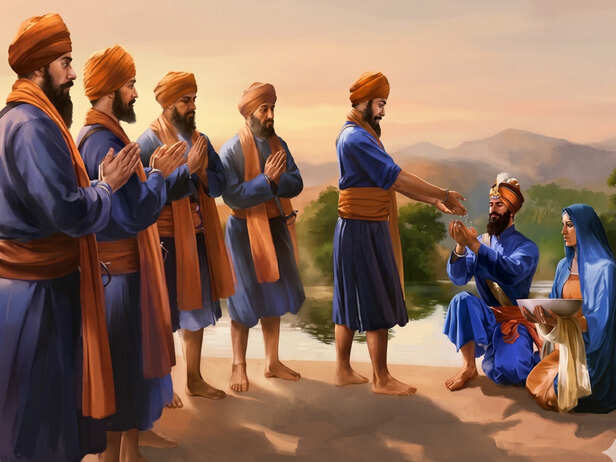
Vaisakhi arrives every year in the middle of April, when the wheat in Punjab stands ready and the air still holds some of the cool that winter left behind. For most of north India, it is a harvest marker, a reason to eat well and gather. In Sikh tradition, it is all of that and then something else entirely, a day that carries the memory of a single afternoon in 1699 when a community was asked to become something it had never been before.
What Happened in Anandpur Sahib in 1699
The tenth Sikh Guru, Guru Gobind Singh, called a large assembly at Anandpur Sahib on Vaisakhi of 1699. The gathering was not unusual; Vaisakhi had long been a time when Sikhs came together. What happened inside it was. Guru Gobind Singh emerged before the crowd holding a drawn sword and asked for a volunteer willing to give his head. The question was not rhetorical. He asked it five times. Five men stepped forward, each from a different part of the subcontinent and a different social background. They went in with him one by one. Each time, Guru Gobind Singh returned alone. The crowd assumed the worst. Then all five emerged together, dressed in a new way, carrying a new name. They had not been killed. They had been transformed. These five, the Panj Pyare, the Beloved Five, became the first members of the Khalsa, the community of initiated Sikhs that Guru Gobind Singh formally established that day.
What the Khalsa Was Founded to Be
The Khalsa in Sikh thought was not simply a military order, though the tradition was born in a time of real political pressure. The Guru Granth Sahib describes the Khalsa as those in whose hearts the divine light shines without obstruction. The founding brought with it the Amrit Sanchar, the initiation ceremony, and the five articles of faith, the five Ks, that initiated Sikhs wear as a commitment: kesh, kangha, kara, kachera, kirpan. Each has a meaning the tradition has explained across centuries. Together they mark a person as someone who has made a deliberate choice to live within the discipline the Khalsa requires. What Guru Gobind Singh also did that day was take Amrit himself from the Panj Pyare, the teacher receiving initiation from those he had just initiated. In Sikh tradition, that moment is read as a statement about equality and about the nature of the Guru's relationship with the community. The Khalsa was not a hierarchy with the Guru above it. It was a body the Guru chose to be part of.
Why the Harvest and the Founding Sit Together
The fact that the founding happened on Vaisakhi was not incidental. Guru Gobind Singh chose the day because it already drew Sikhs from across the region to Anandpur Sahib. A harvest festival that brought people together became the occasion for asking them to consider what they were gathering as. In popular Sikh memory, the two meanings do not compete. The harvest is real, Punjab's relationship with the land is not decorative, and the founding is real. Vaisakhi holds both without one diminishing the other. Some scholars of Sikh history have noted that the choice of a public festival day also carried a message: the founding of the Khalsa was not a private or esoteric event. It was meant to be witnessed, questioned, and joined.
How Vaisakhi Is Marked in Sikh Practice
In gurdwaras, Vaisakhi is observed with an Akhand Path, the continuous reading of the Guru Granth Sahib, completed to coincide with the day. Nagar Kirtans, processions through the streets with the Guru Granth Sahib carried in front and kirtan sung throughout, move through Sikh communities in Punjab and wherever large Sikh populations have settled. The Amrit Sanchar ceremony is often held on Vaisakhi, and many Sikhs choose this day to take initiation into the Khalsa. The Nishan Sahib, the triangular flag that flies at every gurdwara, is traditionally changed on Vaisakhi, the flagpole cleaned, the flag replaced, the ceremony marking continuity and renewal at once.
What the Day Asks of Those Who Know Its History
In Sikh thought, the Panj Pyare are not historical figures to admire from a distance. They are a recurring presence: whenever five initiated Sikhs gather, they are understood to embody the Panj Pyare. The Khalsa is not a closed chapter. The founding in 1699 is understood as a living institution, not a commemorated event. Vaisakhi, then, is less a birthday party for something finished and more a yearly return to the question Guru Gobind Singh put to that crowd: what are you willing to step forward for? The harvest answers one kind of question about abundance and gratitude. The founding answers another kind entirely, about identity, commitment, and what a community decides it stands for when it is asked directly.
Unlock insightful tips and inspiration on personal growth, productivity, and well-being. Stay motivated and updated with the latest at My Life XP.