
Why Varanasi's Lanes Lead to the River, Not to a Road
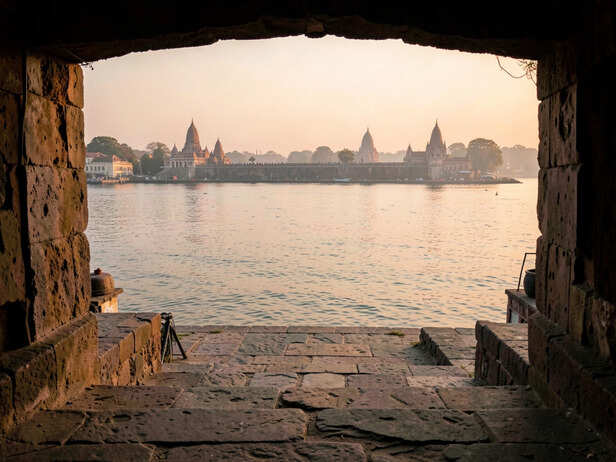
Stand at the edge of any gali in Varanasi and walk in any direction that feels like it leads somewhere. Within a few minutes, you will arrive at the river. This is not coincidence. It is the entire logic of the city.
Most ancient cities organised themselves around a fort, a market, or a road. Varanasi organised itself around a tirtha, a crossing point between the human world and the sacred one. In Hindu devotional thought, a tirtha is literally a ford, a place where the boundary between the living and the divine grows thin enough to step across. The Ganga at Varanasi is considered among the most powerful tirthas in the tradition. Everything else, the streets, the temples, the neighbourhoods, the life of the city, grew around that point of crossing, not away from it.
The Ganga Is the Spine, Not the Edge
In most river cities, the river is a boundary. You live on one side or the other. The river marks where the city stops. Varanasi inverts this completely. The Ganga is not the city's edge. It is its spine. The ghats that line the western bank are not a waterfront district tacked onto a city behind it. They are the city's front, its face, the place it turns toward every morning.
The galis radiate inward from the ghats the way ribs extend from a spine. They do not run parallel to the river. They run perpendicular to it, or at angles that keep pulling you back toward it. A lane that seems to be heading north will bend. Another that seems to go nowhere will open suddenly onto a ghat you did not expect. The disorientation that visitors describe, the sense that Varanasi's streets refuse to behave like streets, is the experience of a city whose geometry serves a sacred axis, not a civic one.
Why the Lanes Are Narrow and Why That Is Intentional
The galis of Varanasi are among the narrowest inhabited lanes in any functioning city. Some are wide enough for two people to pass if one turns sideways. Some are roofed by the floors of houses above them, so that you walk through a kind of inhabited tunnel. This narrowness is not poverty of planning. It is a deliberate spatial logic.
In the theology that shaped the city, the approach to a sacred site should not be easy or wide. A processional approach, broad, straight, visible from a distance, is the grammar of civic power. The grammar of a tirtha is different. You arrive at it through compression and disorientation. The lane disorients you. It strips away your sense of where you are in the ordinary world. By the time the gali opens onto the ghat and the river appears, the effect is not just visual. The sudden expansion of space after the compression of the lane is part of the experience the city was built to produce.
This is also why the lanes are filled with temples rather than shops at their origin points. The deeper you go into a gali, the older the shrines tend to be. The commercial layer, the chai stalls, the silk vendors, the flower sellers, sits at the outer edges. The sacred core is at the end that opens onto the water.
The Panchatirthi and the Shape of Pilgrimage
Varanasi's layout is not random even at the scale of the whole city. In popular tradition, the city holds five principal tirthas arranged in a rough crescent that mirrors the curve of the Ganga itself. A traditional pilgrimage circuit, the Panchatirthi, moves between these five points, tracing a path that follows the river's own shape rather than any road.
This means the city's sacred geography is literally mapped onto the river's geography. The bend of the Ganga at Varanasi is considered particularly auspicious in the tradition because it faces east, toward the rising sun, rather than the direction most rivers in the region flow. The ghats catch the morning light directly. The city was built so that the maximum number of lanes would deliver a person to the water at the moment the sun rises over it.
The layout is, in this sense, a piece of astronomical and theological design. The galis are not streets that happened to lead to the river. They are the final approach of a pilgrimage route that begins the moment you enter the city.
How Neighbourhoods Formed Along the Lanes
Because the lanes are sacred corridors, the neighbourhoods that grew along them organised themselves by the function they served in relation to the ghats. Communities of priests settled closest to the water, at the ghat's edge. Weavers, whose silk is used in temple offerings and ritual dress, settled in the lanes just behind them. Flower sellers and garland makers occupied the mid-lanes where foot traffic from multiple ghats converged. Farther back, the residential quarters of merchants and traders who supplied the pilgrimage economy filled the outer galis.
This is why walking a single lane in Varanasi can feel like moving through several distinct worlds in a short distance. The spatial layers are not accidental. They reflect a hierarchy of proximity to the sacred centre, with every community positioned according to its role in the ritual life of the ghats.
What the River Decides That the Road Cannot
The Ganga at Varanasi does not stay still. The river shifts seasonally. The ghats flood. The lower steps disappear under water for months and reappear. A city built around a road can fix its geometry permanently. A city built around a river has to hold its orientation loosely, because the river will move.
Varanasi accommodates this by treating the water's edge as sacred rather than as infrastructure. The ghats are steps, not a quay. They are designed to be submerged and to re-emerge. The lanes behind them do not depend on the ghats being accessible. They lead to the river whether the steps are above water or below it. The orientation is toward the water itself, not toward a fixed platform above it.
This is perhaps the deepest structural fact about the city. It was not built to control the river or to use it. It was built to face it. Every lane, every temple doorway, every rooftop that looks west toward the water is a small act of orientation, the city turning, again and again, toward the thing it considers the source of everything else.
The galis do not lead to the river because the river is convenient. They lead to it because, in the tradition that built Varanasi, the river is the reason the city exists at all. The streets are not infrastructure. They are the last steps of a journey that, in the tradition's understanding, began long before anyone arrived at the city gates.
Unlock insightful tips and inspiration on personal growth, productivity, and well-being. Stay motivated and updated with the latest at My Life XP.