
Feeling Spiritually Drained During Diwali? Here Is How to Rejuvenate Your Spirit
Why a Festival of Light Can Leave You Feeling Dark Inside
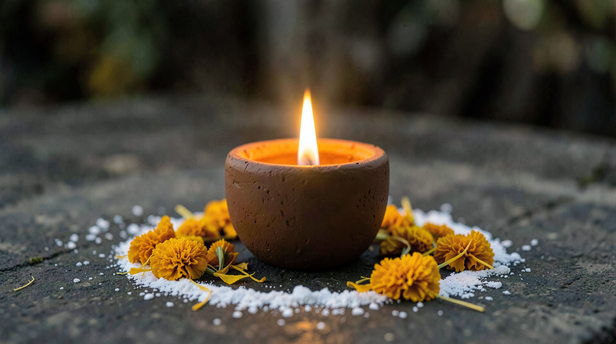
Diwali is built around a single image: a small clay lamp holding its flame steady in the open air. The tradition did not choose that image by accident. A diya is not a floodlight. It does not illuminate a room. It holds one flame, and it asks you to tend it. Every ritual in the festival, the cleaning, the rangoli, the puja, the lighting, was designed to bring a person back to that scale. One lamp. One breath. One moment of stillness before the next thing begins.
When the festival tips into obligation, into performance, into the pressure of a perfect home and a full guest list, the lamp is still there but nobody is tending it. The outer Diwali runs at full volume while the inner one goes quiet. That gap, between the brightness outside and the flatness inside, is what people mean when they say the season has left them drained.
What the Tradition Actually Prescribes for This Feeling
In Hindu devotional thought, Diwali is not one night but a five-day arc, and each day carries a distinct quality of attention. Dhanteras is for gratitude, not for wealth as an end, but for the recognition that what sustains a household is worth honouring. Naraka Chaturdashi is for release, the ritual oil bath before dawn understood in the tradition as a washing away of what has accumulated. Lakshmi Puja on the main night is not a transaction but an invitation, the lamps are lit to welcome, not to demand.
The tradition knew that restoration requires a sequence, not a single gesture. You cannot skip the release and arrive at the welcome. When the five-day arc collapses into a single evening of fireworks and sweets, the sequence breaks, and the body carries what was never put down.
The Practice of the Oil Bath and What It Is Actually For
The pre-dawn oil bath on Naraka Chaturdashi is one of the oldest Diwali practices and one of the least observed in cities. In popular tradition, it is the one ritual said to carry the merit of bathing at a sacred tirtha. The reasoning is not mystical in the way people assume. Sesame oil, applied warm and left to absorb before bathing, was understood in Ayurvedic practice as something that settles the nervous system, what the tradition calls vata, the quality of wind and movement that accumulates when a person has been doing too much for too long.
You do not need to believe in the cosmology to notice that warmth, stillness, and deliberate slowness before a bath feel different from rushing through one. The practice asks you to sit with yourself before the day begins. That is the restoration. The oil is the occasion for it.
Lighting a Lamp Alone, Without an Audience
The communal lighting of diyas is visible and joyful and belongs to the festival. What is less spoken about is the practice of lighting one lamp alone, before the guests arrive, or after they leave, or on a morning of the five-day arc when nobody is watching.
In devotional practice, the lamp lit in private is understood as the one offered to the self, not to the occasion. Vastu shastra holds that a lamp in the northeast corner of a home carries a quality of clarity; whether or not a person holds that view, the act of sitting alone with a small flame, without noise or obligation, produces something that the louder parts of the festival cannot. It is a pause that the tradition built in and that the season tends to remove.
What Rangoli Was Before It Became a Competition
In its oldest form, rangoli was not decorative. It was meditative. The act of drawing a continuous pattern from a single starting point, the kolam of Tamil Nadu, the alpana of Bengal, the rangoli of Maharashtra and Rajasthan, required a quality of attention that could not be maintained while thinking about something else. The pattern demanded presence.
That quality is still available. A rangoli drawn slowly, without a photograph in mind, without a template followed at speed, returns the maker to the same state the tradition intended. The pattern does not need to be elaborate. A circle of marigold petals around a lamp is enough. The point is the making, not the made thing.
The Lakshmi Puja as a Practice of Attention, Not Petition
In popular tradition, the Lakshmi Puja on the main night of Diwali is understood as an invitation: the goddess of abundance enters a home that is clean, lit, and open. The theological point is less about material reward than about a quality of receptivity, the idea that abundance, in its deeper sense, cannot enter a closed or cluttered space.
The puja, done slowly and without distraction, asks a person to name what they are grateful for, to acknowledge what the year has brought, and to sit with both without immediately moving to the next thing. That act, naming, acknowledging, sitting, is the restoration the ritual was designed to produce. The incense, the flowers, the lamp, the chant are not decoration. They are the structure that holds the attention in place long enough for something to settle.
After the Festival: The Practice of Quiet Return
The five-day arc ends with Bhai Dooj, a day oriented toward relationship rather than ritual. In the tradition, it is the day Yama, the god of death, visited his sister Yami, and she fed him and marked his forehead, and he promised that any brother who received his sister's blessing on this day would be protected. The story underneath the story is about love that survives separation, about the thread that holds between people who do not see each other often enough.
The quietest restoration Diwali offers may be this one: the moment after the noise, when the lamps have burned down and the guests have gone, and the person you called or visited or sat with for an hour is still with you in some way that the rest of the year does not always make room for. The tradition built that moment into the arc deliberately. It is worth staying in it a little longer before the ordinary week begins again.
Diwali's light was never meant to come from outside. The lamps, the oil bath, the slow-drawn pattern, the puja held with full attention, each one is a different way of returning to the same place: the part of a person that the season's noise cannot reach, and that the tradition has always known is there, waiting to be tended.
Unlock insightful tips and inspiration on personal growth, productivity, and well-being. Stay motivated and updated with the latest at My Life XP.