So why does Goddess Durga appear so different from one day to the next?
The answer lies in the fascinating mythology surrounding the forms of the Divine Mother. From the terrifying appearance of Kalaratri to the luminous form of Mahagauri, this transition offers a deeper message about transformation, courage, renewal and the balance between fierce strength and peaceful wisdom.
Why Does Maa Durga Have Nine Different Forms?
![Maa Kalaratri to Maa Mahagauri]()
Maa Kalaratri to Maa Mahagauri
Image credit : AI
Navratri celebrates the nine manifestations of Goddess Durga, collectively known as the Navadurga, with each form representing a different aspect of the Divine Mother. Some embody nurturing and protection, while others represent fierce power, peace and spiritual renewal. Among them, Maa Kalaratri and Maa Mahagauri create a striking contrast. While Kalaratri is depicted as dark and fearsome, Mahagauri is radiant and serene. But what does this dramatic difference reveal about the deeper meaning of the Goddess's nine forms?
Who Is Maa Kalaratri, the Seventh Form of Durga?
Maa Kalaratri, worshipped on the seventh day of Navratri, is traditionally depicted with a dark complexion, dishevelled hair, three eyes and four arms, riding a donkey. Though her appearance may seem frightening, she represents the fierce, protective power of the Divine Mother that confronts darkness and destructive forces. Her name combines
Kala, associated with time or darkness, and
Ratri, meaning night. Her form reminds devotees to face fear with courage. But on Day 8, the Goddess takes a dramatically different form:
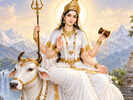
Maa Mahagauri, radiant, serene and peaceful.Who Is Maa Mahagauri, the Eighth Form?
![Maa Mahagauri in Divine Mountain Radiance]()
Maa Mahagauri in Divine Mountain Radiance
Image credit : AI
Worshipped on the eighth day of Navratri, Maa Mahagauri is depicted in white garments, with a radiant complexion, a serene expression and four arms, riding a white bull. Her name is commonly interpreted as “the supremely radiant one,” symbolising purity, peace and spiritual renewal. But how can Maa Mahagauri’s calm appearance contrast so sharply with Maa Kalaratri’s fierce form? The answer lies in the mythology and symbolism surrounding Goddess Parvati.
The Story Behind Maa Kalaratri and Maa Mahagauri
Different Hindu texts and devotional traditions offer varied accounts of the Goddess’s forms. In one popular Navadurga tradition, Maa Mahagauri is connected with Goddess Parvati’s intense penance to attain Lord Shiva. Her prolonged austerities are said to have darkened her complexion, while a sacred transformation later restored her radiance. This story creates a powerful connection between darkness and light, suggesting that darkness need not represent evil but can symbolise a difficult journey of transformation, while Mahagauri’s radiance represents renewal and spiritual fulfilment.
Is Maa Kalaratri Actually Becoming Maa Mahagauri?
The transition from Maa Kalaratri to Maa Mahagauri does not mean that one goddess physically transforms into another overnight. Instead, the Navadurga tradition presents them as two distinct aspects of divine power. Maa Kalaratri represents the fierce energy that confronts darkness, while Maa Mahagauri symbolises peace, purity and renewal. Together, they reflect the different dimensions of Shakti: one protects by confronting challenges, while the other restores through serenity.
Why Is the Contrast Between Them So Important?
During difficult periods, we may need the courage to confront problems, set boundaries, leave harmful situations or stand up for ourselves, reflecting Maa Kalaratri’s fierce strength. But once the struggle passes, healing, peace and rebuilding become equally important, reflecting Maa Mahagauri’s serenity. The transition between these two forms can be understood as a spiritual journey of confronting challenges, transforming through them and embracing renewal. It reminds us that strength and serenity are not opposites; sometimes, courage creates the space for peace to flourish.
What Can We Learn From Maa Kalaratri to Maa Mahagauri?
Maa Kalaratri’s association with darkness reminds us that difficult periods do not define the end of our journey. Sometimes, finding peace requires courage, difficult decisions and the willingness to confront uncomfortable truths. Her fierce form symbolises the strength needed to face challenges, while Maa Mahagauri’s story represents transformation, patience and renewal. Together, their contrasting forms remind us that strength can be fierce or calm, depending on what a situation demands. The transition from Kalaratri to Mahagauri can therefore be understood as a movement from confrontation to restoration, showing that overcoming difficulties is only one part of growth. Just as courage helps us face darkness, peace allows us to heal and begin again.
The Deeper Meaning of This Navratri Transformation
![Navratri mythology]()
Navratri mythology
Image credit : AI
The transition from Maa Kalaratri to Maa Mahagauri is not a literal overnight transformation but a progression between two distinct manifestations of the Divine Mother within the Navadurga tradition. Maa Kalaratri represents fierce protection and the courage to confront darkness, while Maa Mahagauri symbolises purity, serenity and renewal. Together, they reflect the different dimensions of Shakti and remind devotees that life requires both courage and calm, action and reflection, and the strength to confront challenges alongside the wisdom to heal.
Conclusion
The journey from Maa Kalaratri to Maa Mahagauri is about more than a dramatic contrast in appearance. It highlights two complementary aspects of divine power: confronting darkness and embracing renewal. While we cannot always control the challenges life brings, we can learn to face them with courage and gradually move towards peace. Perhaps the deeper message is that sometimes, the path to radiance begins with the courage to face the darkness.
Unlock insightful tips and inspiration on personal growth, productivity, and well-being. Stay motivated and updated with the latest at
My Life XP.