
How Did Humans, Vanaras and Birds Understand Ram?
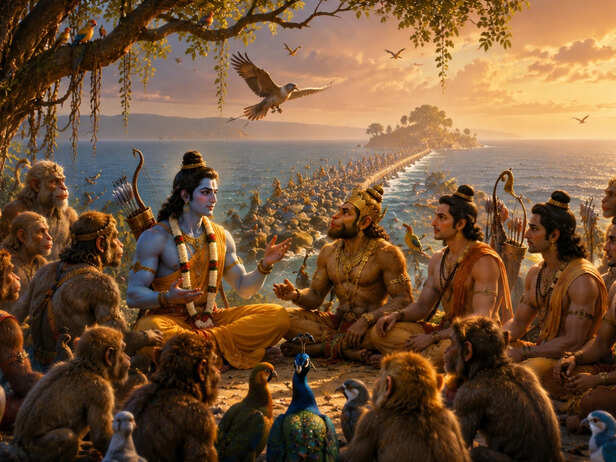
Imagine a meeting between Lord Rama from Ayodhya, Sugriva from Kishkindha, Ravana from Lanka and Jatayu, a divine bird. They came from different places and, according to the epic tradition, belonged to very different worlds. Yet the Ramayana describes them communicating, negotiating, warning one another and sharing deeply important thoughts.
So a fascinating question naturally arises: what language were they actually speaking?
The answer is not as simple as saying that everyone spoke one modern regional language. The Ramayana belongs to an ancient literary and religious tradition, and its descriptions of speech do not map neatly onto today's idea of countries, states and separate mother tongues. Sanskrit has an important place in the epic tradition, but the larger answer involves context, literary convention and the way ancient texts portray communication.
The Question Is More Complex Than It Seems
Today, language is closely connected with geography. Someone from one region may speak a different language from someone hundreds of kilometres away. But applying that modern framework directly to the Treta Yuga can be misleading. The Ramayana does not provide a linguistic map showing every character's mother tongue or regional dialect. Instead, the epic presents conversations in a literary language that readers can understand. Therefore, the question is less about finding one exact spoken language and more about understanding how communication is represented within the ancient epic tradition.
Sanskrit Has A Major Role
Sanskrit is central to the classical Ramayana tradition, especially the Valmiki Ramayana, which is composed in Sanskrit. Many important conversations, speeches and descriptions are therefore presented to readers in Sanskrit. However, this does not necessarily prove that every character spoke exactly the same form of Sanskrit in every private conversation. Ancient Sanskrit literature can represent speech through a refined literary medium. The distinction matters because a text recording a conversation in Sanskrit is not automatically the same as having historical evidence that every participant used identical everyday speech.
Sugriva Was Not A Modern Regional Speaker
A common modern question is whether Sugriva could have spoken a language associated with present-day Kerala or another Indian region. But this comparison is historically uncertain. Kishkindha, traditionally associated with the region around present-day Hampi in Karnataka, is the setting connected with Sugriva and the Vanara kingdom in many traditional accounts. Modern linguistic boundaries cannot simply be projected onto the Treta Yuga. The epic's geography, mythology and modern political geography belong to different frameworks. This is why saying “Sugriva spoke modern Malayalam” or another present-day language would go beyond what the text establishes.
Ravana's Lanka Was Also Different
Ravana is traditionally described as the king of Lanka, while Rama belongs to the royal house of Ayodhya. Their worlds are presented as culturally distinct, yet the Ramayana portrays communication between them without making language confusion a central obstacle. This is an important clue about the epic's storytelling style. Characters from distant kingdoms can communicate because the narrative assumes meaningful dialogue is possible. Rather than interrupting the story with explanations about translation, the epic focuses on what the characters are saying, what they intend and how their choices shape the events that follow.
Even Jatayu Could Communicate
The story of Jatayu makes the question even more fascinating. Jatayu is described as a divine bird who plays an important role in Rama's search for Sita. He communicates with Rama and provides crucial information about her abduction. From a modern scientific perspective, birds do not speak human languages. But the Ramayana operates within a mythological world where extraordinary beings can communicate with humans. Therefore, Jatayu's ability to speak should be understood within the epic's religious and literary framework rather than measured against ordinary biological expectations.
Was There A Deeper Language?
There is also a spiritual interpretation that makes this question especially beautiful. In the epic tradition, communication is not portrayed only as exchanging vocabulary. Characters understand loyalty, fear, friendship, duty and devotion through their actions and expressions as well. This does not mean the Ramayana literally teaches that everyone communicated through telepathy or a supernatural language. Rather, it reflects how ancient storytelling can place emotional and spiritual understanding above linguistic barriers. Rama's bond with Sugriva, Hanuman's devotion and Jatayu's sacrifice all communicate meanings that go far beyond ordinary words.
The Real Answer Lies In The Epic's World
So, did Rama, Sugriva, Ravana and Jatayu speak exactly the same language? The surviving epic tradition does not give us enough evidence to make that claim with certainty. Sanskrit is the language of the classical Valmiki Ramayana, but that is different from proving that every character historically spoke Sanskrit as their everyday language. The safest interpretation is that the epic presents their conversations in a shared literary medium so that their story can be understood. What makes the encounters powerful is not the language itself, but the shared ideas of dharma, loyalty, courage, friendship and devotion.
Unlock insightful tips and inspiration on personal growth, productivity, and well-being. Stay motivated and updated with the latest at My Life XP.