
How One Sage Stopped a Mountain Without Using Force
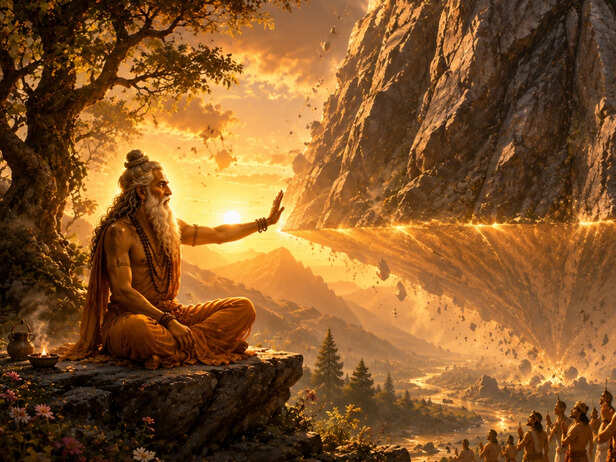
What could make a mountain so powerful that even the Sun God’s chariot could no longer pass over it? According to a famous Hindu tradition, the Vindhya mountain once grew so enormous that it obstructed the path of Surya Dev. The gods were unable to solve the crisis through force. The answer came from an unexpected source: Maharishi Agastya, who did not challenge the mountain with strength, but with wisdom. Yet this is only the beginning. The same sacred region later became associated with Maa Vindhyavasini, a powerful form of the Goddess whose story is connected with Krishna, Yashoda and Kansa.
Narada’s Words Awakened Vindhya’s Pride
According to the traditional story, Narada Muni once approached Vindhya and mentioned the greatness of Mount Meru, which was regarded in Hindu cosmology as a central cosmic mountain. He described how celestial bodies were associated with its cosmic order. Vindhya began comparing itself with Meru. Pride slowly turned into determination. The mountain started growing higher and higher, wanting to prove its greatness. What began as a feeling of comparison soon created a problem for the entire world. The story offers an early warning about what happens when comparison and pride are allowed to grow without limits.
Vindhya Blocked the Sun
Vindhya's growth eventually became so immense that it obstructed the path traditionally associated with Surya Dev's chariot. The cosmic order was disturbed. The traditional narrative describes the eastern region falling into darkness while the western region remained without its normal cycle of light. The gods became deeply concerned and sought a solution. They first approached Shiva and later Vishnu. Instead of suggesting a battle against the mountain, Vishnu pointed them toward a sage whose presence commanded exceptional respect. His name was Maharishi Agastya. The solution would come not through greater strength, but through wisdom.
Agastya Chose Wisdom Over Force
The gods approached Agastya and explained the crisis. Agastya then began travelling south with his wife, Lopamudra. When Vindhya saw the revered sage approaching, something remarkable happened. The mountain that had risen high enough to obstruct the Sun humbled itself and bowed before him. Agastya did not fight Vindhya or attempt to overpower it. Instead, he calmly asked the mountain to remain bowed until his return from the south. Vindhya accepted the sage's request. Agastya continued his journey, and according to the legend, he never returned. Vindhya therefore remained bowed, bound by its own promise.
The Mountain Never Rose Again
There is a deeper lesson hidden inside this unusual ending. Vindhya had immense power, yet its greatest weakness was pride. Agastya understood that the mountain did not need to be defeated. It needed to be reminded of humility. His approach changed the situation without violence. The story therefore presents wisdom as a force that can accomplish what physical strength cannot. It also shows why promises matter. Vindhya willingly accepted Agastya's request and remained committed to it. Sometimes the strongest person in a difficult situation is not the one who fights, but the one who knows exactly what to say.
Then Came Maa Vindhyavasini
The story does not end with Agastya. According to Hindu tradition, the Goddess worshipped by Agastya came to be associated permanently with the Vindhya region. She became known as Vindhyavasini, meaning the Goddess who resides in Vindhya. This gives the mountain a second layer of sacred importance. It is not remembered only for the story of Surya Dev and Agastya. It is also revered as a divine abode of the Goddess. Over time, Vindhyavasini became an important form of Shakti worship, drawing devotees to the sacred region.
The Goddess Who Escaped Kansa
Another fascinating part of the tradition connects Vindhyavasini with Yogmaya, the divine girl associated with Krishna's birth story. According to the Bhagavata tradition, Kansa believed the eighth child of Devaki would be the one destined to defeat him. When he tried to kill the baby girl who had been exchanged with Krishna, she slipped from his hands and manifested as a divine Goddess. She warned Kansa that the one who would destroy him had already been born elsewhere. Tradition later associates this Goddess with the Vindhya region, where she is revered as Vindhyavasini.
Why This Story Still Matters
The story of Vindhya carries more than mythology. It speaks about something deeply human: pride can make us grow in the wrong direction. Vindhya wanted to become greater than another mountain, but its desire eventually created darkness. Agastya did not destroy it. He simply reminded it to bow. Then the same sacred mountain became associated with the presence of the Goddess.
Unlock insightful tips and inspiration on personal growth, productivity, and well-being. Stay motivated and updated with the latest at My Life XP.