
How Ved Vyasa Became the Grandfather of Two Rival Clans
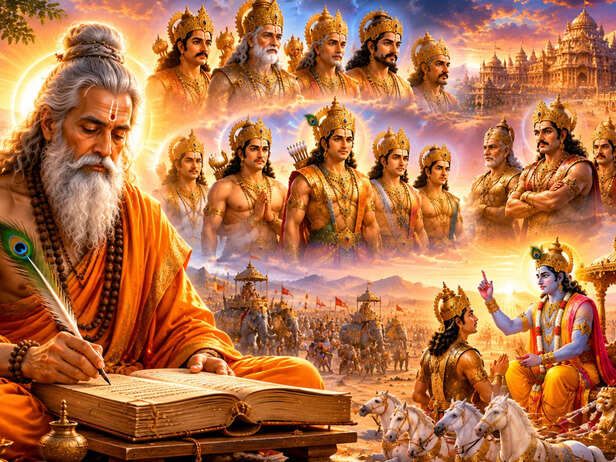
When people think of the Mahabharata, names like Krishna, Arjuna, Bhishma and Duryodhana usually come first. But there was one extraordinary figure connected to almost every major turn in the epic: Ved Vyasa. He was not merely remembered as the traditional composer of the Mahabharata. He was also deeply connected to the Kuru dynasty itself. Through his mother Satyavati, Vyasa became part of the royal family, and according to the epic tradition, he fathered Dhritarashtra, Pandu and Vidura through niyoga. His role becomes even more fascinating when he later appears repeatedly to guide characters and warn them about the consequences of their choices.
Vyasa Was Born Into the Story
Ved Vyasa’s connection to the Mahabharata begins with his birth. Traditional accounts identify him as the son of Sage Parashara and Satyavati. Satyavati later became the wife of King Shantanu and entered the Kuru royal family. This made Vyasa closely connected to the dynasty that would eventually produce the Pandavas and Kauravas. His role was therefore not that of a distant storyteller watching events from outside. He was already connected to the family at the heart of the epic. This unusual position helps explain why Vyasa repeatedly appears at important moments throughout the Mahabharata.
He Preserved the Kuru Line
A major turning point came after the death of King Vichitravirya, who left no heirs. Satyavati feared that the Kuru lineage could come to an end. According to the traditional account, she therefore asked Vyasa to perform niyoga, an ancient practice described in the epic tradition for preserving a family line. Through this arrangement, Vyasa became the father of Dhritarashtra, Pandu and Vidura. Their lives would later shape the entire course of the Mahabharata. Dhritarashtra became the father of the Kauravas, while Pandu became the father of the Pandavas. Vidura became one of the epic’s greatest voices of wisdom.
One Birth Changed Everything
The birth of Dhritarashtra, Pandu and Vidura created the family branches that would eventually collide at Kurukshetra. Dhritarashtra was born blind and later became king, while Pandu became the father of the Pandavas through divine blessings. Vidura, although not a king, became renowned for his wisdom and understanding of dharma. Their different positions within the royal family created a complicated succession story. From this point, the future conflict was already taking shape. Vyasa therefore stands at a remarkable point in the family tree. Through him, the line leading to both the Pandavas and Kauravas remained connected.
Vyasa Kept Appearing at Crises
Vyasa was not simply present at the beginning of the family story. He continued to appear when characters faced difficult decisions. He advised Satyavati, guided members of the Kuru family and warned them about the consequences of destructive choices. His presence often arrives when the story reaches a moral crossroads. This makes him different from a typical narrator. He seems to understand the larger consequences of events while the characters are still struggling to understand their immediate problems. Through these appearances, Vyasa becomes a bridge between knowledge and action, reminding the characters that every decision can carry consequences far beyond the present moment.
The Epic Was Written With Ganesha
One of the most famous traditions surrounding the Mahabharata tells of Vyasa seeking someone capable of writing down the vast epic. He approached Lord Ganesha, who agreed under one condition: Vyasa’s narration could not stop. Vyasa accepted, but added his own condition that Ganesha should write only after understanding every verse. According to the legend, Vyasa then deliberately composed difficult verses with deep and complex meanings. While Ganesha paused to understand them, Vyasa gained time to mentally prepare the next portion. Whether viewed literally or symbolically, the story highlights the extraordinary scale of the Mahabharata and Vyasa’s legendary intellectual ability.
He Was Both Witness and Guide
Few figures in the Mahabharata occupy a position like Vyasa. He was connected by blood to the Kuru family, yet he also stood apart from its political struggles. This allowed him to speak with unusual authority. He could warn kings, advise elders and guide those facing difficult choices without becoming completely consumed by their rivalries. His role also gives the epic a deeper layer. The person traditionally credited with preserving the story was himself connected to the people whose choices created it. In that sense, Vyasa was both a participant in the dynasty’s history and a witness to the consequences of its actions.
His Greatest Lesson Is About Choices
The most powerful part of Vyasa’s story may not be his connection to the royal family or even the legendary writing of the Mahabharata. It is the wisdom he represents. Again and again, the epic shows people receiving advice but failing to act upon it. Warnings are ignored, pride takes control and personal desires become more important than duty. Vyasa’s presence reminds us that knowledge has value only when it influences our choices. His story also shows why the Mahabharata remains relevant. Its central questions are not only about ancient kings and warriors. They are about how human beings respond when duty, desire, family and morality collide.
Unlock insightful tips and inspiration on personal growth, productivity, and well-being. Stay motivated and updated with the latest at My Life XP.