
What a Family Carries Home from the River After the Last Rites
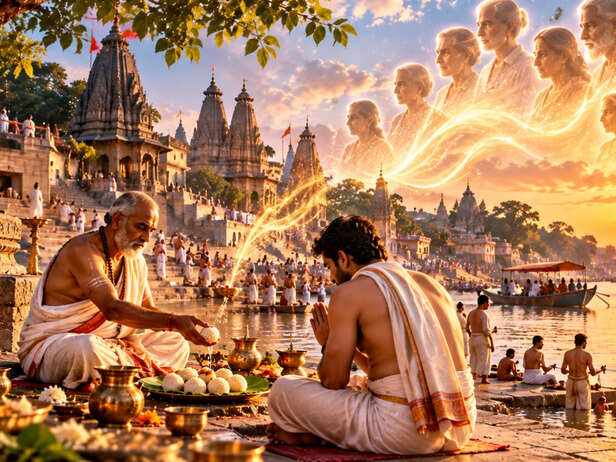
The walk back from the river is one of the quietest a family will ever take together. The body has been given to the fire and the water. What remains is everything the living carry forward, in their hands, on their skin, in the structure of the days ahead.
The Pot That Must Not Look Back
In most Hindu traditions across northern and central India, the chief mourner carries a clay pot filled with water from the river on the walk away from the ghat. The pot rests on the shoulder, a small hole pierced in its base so the water drains as the mourner walks. At a marked point, sometimes the ghat steps, sometimes the road that turns from the river, the pot is dropped without looking back.
The gesture is not carelessness. Popular tradition holds that the soul, newly freed, needs a clear path forward. A backward glance, a moment of hesitation, is understood as a call that could pull it back toward the living. The draining water is the life that has fully left. The breaking pot is the vessel that held it. Both are released at once.
Regional practice varies considerably. In some communities the pot is not broken but placed at the base of a peepal tree. In others, a coconut serves in its place. What holds across most versions is the direction: forward, without turning.
Why the Family Does Not Cook That Day
The household that returns from the cremation ground does not light its own hearth. Neighbours bring food. This is among the most widely observed customs in Hindu funerary practice, and it carries two meanings that sit alongside each other without cancelling either out.
The first is practical in origin and still practically true: the family is in no state to cook. Grief of this kind is physically exhausting. The custom removes a decision from people who have no capacity left for decisions.
The second is ritual. The household fire is considered extinguished, metaphorically, and in some traditions literally, when a death occurs within it. The hearth is the centre of the living home. It is relit, in the symbolic sense, only after the period of mourning has been formally observed. Until then, the family eats from other fires, from the community that surrounds them.
This is also why neighbours and relatives bring food rather than the family going out to fetch it. The threshold matters. The family is between two states, the life that included the person who has died, and the life that will go on without them. The community holds the threshold open from the outside.
The Threshold Itself
Returning mourners in many traditions do not enter the house directly. They wash, feet, hands, sometimes the whole body, before crossing the doorstep. In some communities a leaf of neem or a branch of a specific plant is touched before entering. In others, a lamp is lit at the door and each person passes beside it.
These are not superstitions about contamination in a medical sense. They are boundary rituals. The cremation ground and the ghat are liminal spaces, places where the boundary between the living and the dead is understood to be thin. The washing and the lamp mark the re-entry into the space of the living. They say, in gesture rather than words: we have been where the dead go, and now we are back.
The neem leaf appears in several regional traditions as a purifying element, its bitterness understood as a counterweight to the heaviness of the space the mourners have passed through. The lamp is fire, which in Hindu thought is both transformer and witness.
The Asthi: What Is Collected from the Pyre
On the day after cremation, or after the pyre has fully cooled, the timing varies by region and community, the family returns to collect what the fire has left. These are the asthi: the bone fragments and ash that remain.
The collection is done with care, often with a specific implement, and the fragments are gathered into a new clay pot or a cloth. They are not treated as remains in the clinical sense. In devotional thought, the asthi carry something of the person, not the soul, which has moved on, but the physical trace that the family must now return to water.
The immersion of the asthi in a sacred river, most famously the Ganga at Haridwar or Varanasi, though many rivers hold this significance in their own regions, is called asthi visarjan. Popular tradition holds that this immersion completes the release. The body came from the elements; the last fragment of it returns.
For families who cannot travel immediately, the asthi may be kept in the home for a period, wrapped and placed in a clean, elevated space. This waiting is understood as holding the person close for a little longer before the final letting go.
The Days That Are Counted
The mourning period is not shapeless. It is structured, most commonly into three days, ten days, or thirteen days depending on regional custom and community practice. The structure is deliberate. Grief that has no edges can swallow a family. The tradition gives it a container.
During this period the family observes restrictions that vary widely: some abstain from certain foods, some do not attend celebrations, some keep the household quiet. On the final day, the tenth or thirteenth, depending on the tradition, a ceremony marks the formal close of the acute mourning period. This is sometimes called the pagdi ceremony in northern India, where a turban is placed on the head of the eldest son or the new head of the family. It is a transfer of responsibility, made visible.
The shraddha ceremonies that follow, on the eleventh and twelfth days in some traditions, and then annually, are understood as offerings that nourish the ancestor in whatever form they now inhabit. In popular Hindu devotional thought, the relationship between the living and the dead does not end at the river. It changes form.
What the River Gives Back
The family goes to the river to give something. They give the body, the ash, the pot, the water. What comes back is harder to describe but real in its effect: a structure for the days ahead, a set of gestures that carry meaning even when the person performing them cannot articulate what the meaning is, and a sense, older than any individual grief, that this has been done before, by other families, at other rivers, across a very long time.
The rituals do not resolve the loss. They hold it in a shape the living can carry. That is what they were always for.
Unlock insightful tips and inspiration on personal growth, productivity, and well-being. Stay motivated and updated with the latest at My Life XP.