
Radha Ashtami Beyond Romance: What Radha’s Story Really Represents About Devotion
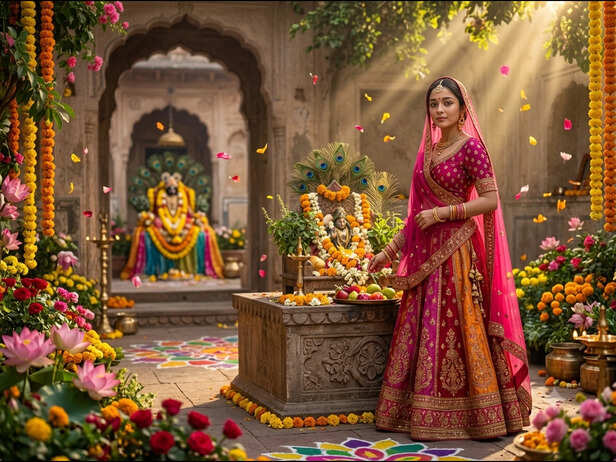
What if loving someone deeply did not mean having to have them? That question sits quietly at the heart of Radha’s story. Every year, Radha Ashtami brings back the familiar imagery of Radha and Krishna, flowers, temple celebrations, bhajans and stories of Vrindavan. But behind the romantic picture is a much more interesting idea. Radha’s devotion is not traditionally celebrated because she “got” Krishna. In fact, much of the emotional power of her story comes from longing and separation. Radha Ashtami, observed on the eighth day of the bright fortnight of Bhadrapada, celebrates the appearance of Radha and falls fifteen days after Krishna Janmashtami. In several Vaishnava traditions, Radha is regarded as the embodiment of the highest form of devotional love, or bhakti. And that makes her story much bigger than romance.
Radha's Love Was Never Really About Possession
Modern relationships often come with an unspoken equation: If you love me, you should be mine. Radha's story offers a very different idea. In devotional interpretations, her love for Krishna is not defined by ownership. She does not love him because he belongs to her. Her devotion is valued precisely because it is directed towards Krishna's happiness and divine purpose rather than personal gain. This is why Radha is often described as the ideal of prema-bhakti, or selfless devotional love. That distinction is important. Loving someone and possessing someone are not the same thing. Radha's story suggests that genuine love can exist without control, conditions or constant reassurance.
Separation Becomes Part Of The Devotion
Here is where Radha's story becomes surprisingly relatable. A major part of Radha-Krishna tradition revolves around viraha, or the pain of separation. Krishna eventually leaves Vrindavan, creating a separation that becomes one of the most emotionally powerful themes in devotional literature. Yet separation does not erase Radha's devotion. Instead, it intensifies it. This is one reason Radha's longing is spiritually significant. Devotion, in this interpretation, is not dependent on physically having the beloved nearby. The connection survives absence. It is a powerful idea even outside spirituality. Sometimes love is tested not when someone is beside us, but when we have to accept that we cannot control their presence.
Radha Represents The Soul Longing For Something Beyond Itself
Radha can also be understood symbolically rather than simply as a romantic heroine. In several Vaishnava traditions, she represents the devotee's deepest longing for the divine, while Krishna represents the divine itself. She becomes an image of the soul constantly reaching towards something greater than its own ego and desires. This makes her story less about “Will Radha get Krishna?” and more about “What happens when love transforms the person who loves?” That shift completely changes the way her story can be read. Her devotion is not measured by what she receives. It is measured by what she becomes through loving.
The Silence Around Radha Is Part Of Her Fascinating History
There is also an interesting literary detail that often gets overlooked. The Bhagavata Purana, one of the most influential texts surrounding Krishna's Vrindavan narratives, does not explicitly name Radha in its account of the rasa-lila. At one point, however, the gopis refer to one particular woman whom Krishna has taken away with him, describing her as someone who had worshipped him exceptionally well. Later Vaishnava commentators have interpreted this passage as a veiled reference to Radha. Radha's prominence becomes much clearer in later devotional literature, including Jayadeva's Gita Govinda and later Puranic traditions. So the Radha we know today is the result of centuries of religious thought, poetry, storytelling and devotion, not simply one straightforward romantic narrative.
What Radha Can Teach Us About Love Today
Perhaps the most contemporary lesson from Radha is that love does not have to equal control. Her story can be read as a reminder that caring deeply for someone does not automatically give us the right to possess them, dictate their choices or demand that they constantly prove their love. That does not mean accepting unhealthy relationships or ignoring one's own needs. It means understanding the difference between love and attachment. Attachment says, “I need you to stay because I cannot be okay without you.” Radha's devotional ideal asks something different: “Can I love without making my love a demand?” That is a difficult question, especially in a world where relationships are often measured through constant texts, instant replies and visible reassurance.
Perhaps Radha's Greatest Lesson Is Letting Go
Radha Ashtami is therefore not simply a celebration of an eternal romance. It is a celebration of devotion that survives without possession. Radha's story reminds us that love can be intense without becoming controlling, emotional without becoming selfish and deeply attached without turning into ownership. Perhaps that is why her story has survived for centuries. We see romance in Radha and Krishna, but underneath it lies something much more universal: the courage to love, to long, to surrender and sometimes, to let go. And maybe that is the part of Radha's story we need to remember the most.
Unlock insightful tips and inspiration on personal growth, productivity, and well-being. Stay motivated and updated with the latest atMy Life XP.