
Shiva vs Sadashiva: What Is the Difference? The Truth Explained
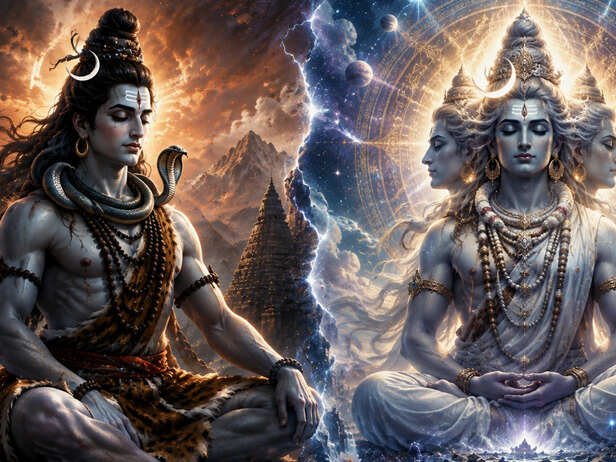
Before creation, before time and space, what could have existed? Hindu philosophical traditions describe Sadashiva as a supreme, formless reality beyond ordinary ideas of beginning and end. In Shaiva traditions, Sadashiva is associated with the highest consciousness from which the processes of creation, preservation, dissolution, concealment and grace are understood. The image of Sadashiva with five faces and ten arms gives this profound philosophy a symbolic form. Each face represents a different cosmic function, offering a fascinating way to understand how ancient Shaiva thought described the relationship between the universe, divine consciousness and liberation.
Who Is Sadashiva?
Sadashiva is described in Shaiva traditions as a profound manifestation of the supreme divine reality. Rather than being understood only as a deity with a physical form, Sadashiva represents a level of consciousness beyond ordinary limitations. This makes the concept difficult to describe through everyday language. The idea points toward a reality that existed before the familiar processes of creation and continues beyond them. In this philosophical understanding, creation does not mark the beginning of Sadashiva. Instead, the universe is viewed as arising within a greater reality that cannot be confined by time, space or physical form.
The Five Faces of Sadashiva
The five faces of Sadashiva provide a symbolic map of cosmic existence. They are traditionally known as Sadyojata, Vamadeva, Aghora, Tatpurusha and Ishana. Each represents a distinct divine function. Sadyojata is associated with creation, Vamadeva with preservation, Aghora with dissolution, Tatpurusha with concealment and Ishana with grace or liberation. Together, they describe a continuous cycle rather than five unrelated powers. Creation brings existence forth, preservation sustains it, dissolution transforms it, concealment allows the cosmic play to continue, and grace provides the possibility of spiritual release. This makes the five faces deeply philosophical symbols.
Sadyojata Represents Creation
Sadyojata is traditionally associated with the western direction and the creative function. The name is connected with the idea of something coming into existence or being born. In the five-faced form of Sadashiva, this aspect represents the beginning of manifestation. Creation here does not simply mean the physical formation of the universe. It can also be understood as the emergence of names, forms and experiences from an unmanifest state. The symbolism reminds devotees that everything visible has a source beyond its visible appearance. What we experience as creation is therefore presented as one part of a much larger divine process.
Vamadeva Sustains Creation
Vamadeva is traditionally associated with the northern direction and the preserving aspect of the divine. This function is often connected with Vishnu in the broader symbolic framework of the five cosmic activities. Preservation is essential because creation alone cannot sustain the universe. Every living system requires balance, continuity and order. Vamadeva therefore represents the power that maintains what has come into existence. On a personal level, the symbolism can also remind us that growth requires care. Creating something is only the beginning. Protecting, nurturing and maintaining it are equally important parts of existence.
Aghora Represents Dissolution
Aghora is associated with the southern direction and the power of dissolution. This aspect is connected with Rudra and represents the transformation through which existing forms come to an end. In Shaiva philosophy, destruction does not necessarily mean something negative. An ending can create the conditions for something new to emerge. Seasons change, bodies age and circumstances transform. Aghora symbolises this unavoidable movement. The teaching can therefore change how we view endings. Instead of seeing every conclusion as a failure, we can recognise that dissolution is also a natural part of the larger cycle of existence.
Tatpurusha and the Veil of Maya
Tatpurusha, traditionally associated with the eastern direction, represents tirobhava, or concealment. This concept suggests that the ultimate nature of reality is not always directly visible to ordinary human awareness. Maya, in this philosophical context, can be understood as part of the cosmic process through which the world of distinctions and experiences appears. Without this veil, the cosmic play or lila would be understood differently. The symbolism invites a deeper question: how much of reality do we actually perceive? What appears to be the complete truth may represent only one level of a much larger existence.
Ishana Represents Grace and Liberation
Ishana is traditionally associated with the upward direction and is regarded as the highest of the five faces. Its cosmic function is anugraha, or divine grace. While the other functions describe processes within existence, grace points toward liberation from limitation. In spiritual thought, liberation is not simply escaping the world. It is the awakening to a deeper understanding of reality. Ishana therefore represents the possibility that the individual can move beyond ignorance and recognise the divine truth within existence. This makes the fifth face especially significant in Shaiva philosophy, as it completes the cycle with the promise of spiritual freedom.
Sadashiva and Shiva: What Is the Difference?
The distinction between Sadashiva and Shiva can be understood as a difference in philosophical presentation rather than two completely separate realities. Sadashiva represents a transcendent and highly philosophical conception of the divine, while Shiva is also worshipped through personal, accessible forms such as Mahadeva, Shankara and Bholenath.
A simple analogy is that of light and a lamp. The lamp gives us a form through which we can experience the light, while the light itself can spread beyond the lamp. In a similar symbolic sense, Sadashiva can represent the supreme consciousness, while the familiar form of Shiva allows devotees to approach that reality through prayer, devotion and personal connection.
The Deeper Meaning of the Five Faces
The five faces of Sadashiva are not merely an artistic representation. They offer a complete philosophical picture of existence.
Creation gives us experience. Preservation sustains it. Dissolution transforms it. Concealment makes the cosmic play possible. Grace points toward liberation.
This makes the symbolism surprisingly relevant even today. Every life contains beginnings, periods of stability, endings, moments of confusion and opportunities for awakening. The five functions can therefore be understood not only as cosmic principles but also as a way of reflecting on our own journey.
Perhaps the deepest message is that creation and destruction are not opposites fighting against each other. They are parts of one greater reality.
Har Har Mahadev.