
Why a Kolam Is Drawn in Rice Flour and Meant to Be Walked Over
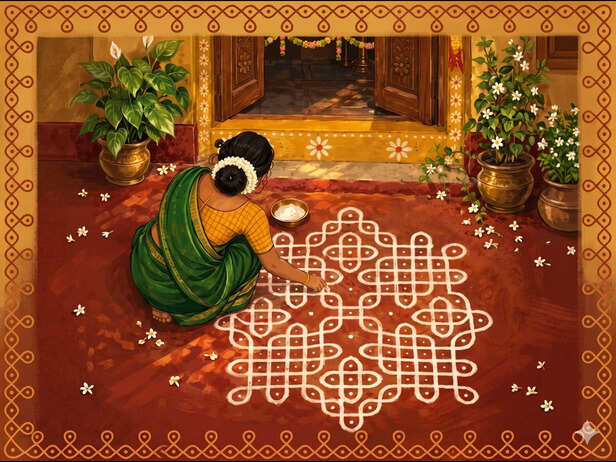
The kolam appears before sunrise, drawn freehand on a swept threshold, and by mid-morning it is gone, pressed into the earth by feet, scattered by wind, eaten by ants. A visitor who does not know the tradition might assume the disappearance is a failure. In the tradition itself, the disappearance is the whole practice.
Rice Flour Was Chosen for a Reason
The kolam is almost always drawn in white rice flour rather than chalk, stone powder, or paint. In popular practice across Tamil Nadu, Andhra Pradesh, Karnataka, and parts of Kerala, the explanation given is ecological and devotional at once: rice flour feeds. Ants, birds, and small insects cross the threshold before any human does, and the kolam offers them the first meal of the household's day. The act of drawing it is also, quietly, an act of feeding.
In some regional tellings, the white colour carries its own meaning, white being associated in Hindu devotional thought with purity and with the absence of ego. The floor is not decorated; it is offered. The distinction matters to the people who draw it.
Coloured kolams, drawn with dyed rice flour or stone powder, appear at festivals and at thresholds where a longer-lasting mark is intended. But the daily kolam in plain white rice flour is understood, in most of the traditions that practise it, as something that should not last.
The Grid Beneath the Pattern
What looks like a flowing, spontaneous design is usually built on a grid of dots called pulli. The dots are placed first, in rows that vary by the day, the occasion, and the practitioner's tradition. The lines of the kolam then loop around or between the dots, never lifting the hand where the design is continuous, threading the negative space into the pattern.
Learning to draw a kolam means learning to hold the grid in the mind while the hand moves. Grandmothers teach granddaughters the dot counts for each pattern the way a musician teaches scales, not as decoration but as a discipline that becomes invisible once it is learned. In this sense the kolam is a form of geometry practised daily on the ground, passed through women's hands across generations without a written manual.
The complexity of the pattern drawn is not status or competition, though neighbourhoods sometimes develop their own aesthetic. It is closer to a measure of attention, of how much of herself the practitioner brought to the threshold that morning.
The Threshold as the Right Place
The kolam belongs at the threshold rather than inside the home or in the street. In Hindu devotional thought, the threshold is a liminal space, neither fully inside nor fully outside, neither fully protected nor fully exposed. Lakshmi, the goddess associated with abundance and with the prosperity of the household, is understood in popular tradition to enter through the threshold. The kolam is drawn to welcome her and to signal that the household is awake, swept, and ready.
In the same tradition, inauspicious presences are understood to hesitate at a threshold that is marked and tended. The daily renewal of the kolam, always fresh, never yesterday's, is part of what keeps the threshold active rather than merely decorated.
The threshold placement also means the kolam is drawn where it will be walked over. This is not incidental. A kolam on a wall or a shelf would last. A kolam on the threshold is walked over by everyone who enters, which is precisely the point the tradition is making.
Why It Is Meant to Disappear
The impermanence of the kolam is not a practical limitation that the tradition has made peace with. It is, in the understanding of the women who draw it, the teaching the practice carries.
In popular devotional thought in South India, the kolam is an offering made without attachment to its survival. The labour is real, rising before dawn, sweeping the threshold, placing the dots, drawing the pattern. The result is gone by noon. The practice asks the practitioner to offer something real and then release it entirely, not because it was not worth making, but because the making was the point rather than the having.
This sits within a broader current in Hindu devotional practice: the sand mandala destroyed after completion, the rangoli swept after Diwali, the clay idol immersed in water. The form is made carefully and released completely. The kolam is the daily, domestic version of that same understanding, practised on a threshold instead of in a temple.
Where the Practice Is Strongest and How It Varies
The kolam is most deeply rooted in Tamil Nadu, where it is drawn daily by millions of households and where the tradition of competitive and elaborate festival kolams, sometimes covering entire streets, is centuries old. In Andhra Pradesh and Telangana, the equivalent practice is called muggulu, and the dot grids tend toward different proportions. In Karnataka, rangoli overlaps with kolam in urban practice, and the two traditions have influenced each other's vocabulary of pattern.
In Tamil diaspora communities across Malaysia, Singapore, and Sri Lanka, the kolam continues to be drawn at thresholds, sometimes on paper when the floor does not permit rice flour. The medium changes; the logic of the threshold and the daily renewal does not.
What is consistent across these regional forms is the morning timing, the threshold placement, and the understanding that the drawing is an act of care directed outward, toward those who cross the threshold, toward the small creatures who will eat the flour, and toward the household's own sense of beginning the day with intention rather than habit.
The kolam disappears by mid-morning. It will be drawn again tomorrow. That rhythm, the daily making and the daily release, is what the practice has always been teaching, one threshold at a time.
Unlock insightful tips and inspiration on personal growth, productivity, and well-being. Stay motivated and updated with the latest at My Life XP.