
Why Chhath Families Return to the Same Riverbank Every Year
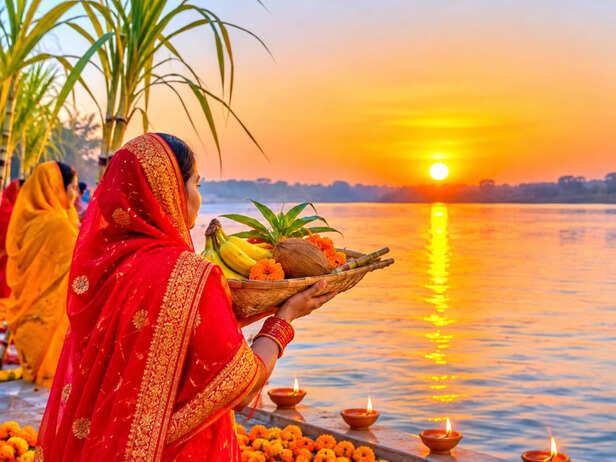
Most festivals move inward, into the home, the puja room, the kitchen. Chhath moves outward, all the way to the edge of water. And then it stays there, in one place, for two days and two nights, until the sun has been offered to twice and the family has done what families before them did at this same bend in the river.
The Ghat Is Not Chosen, It Is Inherited
A family's ghat is rarely a decision anyone living made. It was decided by a grandmother, or her mother, at some point when the family first came to this city or this town and needed a place to stand. Once chosen, it holds. Children grow up knowing which stretch of steps is theirs, which tree marks the boundary, which neighbour's family sets up to the left. The spot becomes a coordinate in family memory as fixed as a home address.
In Vedic devotional tradition, the act of returning to a consecrated place is itself a form of offering. The river does not change; the family changes. Coming back to the same water is a way of measuring that change against something that stays.
What the Riverbank Holds That a Temple Cannot
Chhath is addressed to Surya, the sun, and to Chhathi Maiya, the sixth-day goddess associated in popular tradition with the protection of children and the continuation of family. Neither is worshipped inside a building. The sun requires open sky, and open sky requires open water, because water gives the sun a second surface, the reflection, and the ritual moves between the two.
The riverbank is where the arghya is offered: the devotee standing in the water, arms raised, holding a bamboo supa filled with fruit and sugarcane and thekua, turning toward the setting sun and then the rising one. The water is not a backdrop. It is part of the ritual geometry. A temple cannot hold this. A rooftop can approximate it but loses the standing-in-water, which is where the body and the offering and the sky meet.
The Vrat and What It Asks of the Body
The fast kept for Chhath is among the most physically demanding in popular Hindu practice. The primary devotee, most often a woman, though men keep it too, goes without water for the final thirty-six hours. No food, no water, while standing in a river at dawn. The tradition holds that this severity is what gives the vrat its weight. Chhathi Maiya, in popular belief, is moved by what the fast costs.
The physical difficulty is also why the ghat matters. A devotee who has not eaten or drunk for a day and a half needs the people around her. At a family's own ghat, those people are already there, extended family, neighbours whose families have stood at the adjacent stretch for as long as anyone can remember. The community that forms at the water is not assembled for the occasion. It reassembles.
What Is Carried to the Water
The bamboo supa and the bamboo basket, the daura, are made specifically for Chhath and are not used for anything else. Inside them: seasonal fruit, sugarcane with its leaves, coconut, thekua made from wheat flour and jaggery, and in some regional traditions, a small clay elephant. The particular contents vary by family and by region, but the bamboo vessel is constant. It is the offering's container and also its carrier, balanced on the head from home to ghat.
In popular tradition, the basket is assembled by the women of the household the day before. What goes into it reflects the harvest, what is in season, what the family can offer. The thekua is made at home, not bought, and its preparation the night before is its own ritual, with the kitchen kept clean and the cook in a state of ritual purity. By the time the basket reaches the water, it has already been through two days of preparation.
Why the Same Spot, Every Time
There is a practical reason and a devotional one, and in Chhath they are not easily separated. The practical reason: a family's ghat is where their things are, where their mat is unrolled, where the clay lamps will be set in a line along the step they always use. Logistics are easier when the territory is known.
The devotional reason runs deeper. In popular tradition, a vrat gains strength across generations. A grandmother who kept Chhath at this ghat for forty years, a mother who kept it for thirty, a daughter now keeping it for the first time, the accumulated devotion is understood to reside partly in the place. Returning is not repetition. It is continuation. The river receives what has been offered to it before and recognises the family that is offering again.
This is why, when a family moves cities, one of the early questions is: where is the ghat here? And why, when a ghat is disrupted, by construction, by flooding, by a change in the river's course, it registers as a loss that is more than logistical.
The riverbank at Chhath is a place where time is not linear. A daughter standing in the water at dawn is standing where her mother stood, and her mother's mother. The sun rises over the same river. The offering is made again. The family holds.
Unlock insightful tips and inspiration on personal growth, productivity, and well-being. Stay motivated and updated with the latest at My Life XP.