
Why Shiva Drank Poison and Held It in His Throat
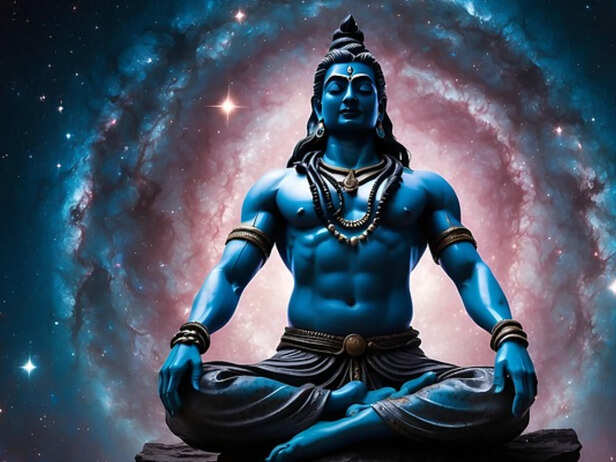
The image is immediately recognisable: a blue-throated god, seated in stillness, while the world around him continues. In Hindu devotional thought, the name Neelakantha, the blue-throated one, is among Shiva's most beloved epithets, and it comes entirely from one moment in the Puranic narrative of the samudra manthan, the churning of the cosmic ocean.
What the Churning Was and Why It Went Wrong
The samudra manthan appears across several Puranas, most fully in the Bhagavata Purana and the Vishnu Purana. The devas and the asuras, rivals by nature, agreed to a temporary truce. Together they would churn the cosmic ocean to draw out amrita, the nectar of immortality. Mount Mandara became the churning rod. Vasuki, the great serpent, became the rope. The churning began.
What the churning released first was not amrita. Before the nectar came the halahala, a poison so extreme that the Puranas describe it as capable of destroying all three worlds. The devas and asuras both recoiled. Neither could hold it, contain it, or absorb it. The cosmos itself was at risk of ending before the churning had produced what it was meant to produce.
Why Shiva and Not Another
In the telling, the devas approached Vishnu first. In some versions, Vishnu points toward Shiva; in others, the devas go directly to him. The reasoning the tradition gives is particular to Shiva's nature. He is described as standing outside the order that the poison would destroy. He is not sustained by the world the halahala would end. He is, in the language of the tradition, the one who transcends the three gunas, the qualities that structure existence. What can unmake the world cannot unmake him in the same way.
Parvati, in many tellings, is present. When Shiva takes the poison into his hands, she reaches forward and holds his throat, preventing the halahala from descending further into his body. The poison stays where it is, not destroyed, not expelled, but held. His throat darkens. He becomes Neelakantha.
What the Tradition Says About the Holding
This is the detail that most retellings pass over quickly, and it is the one the tradition dwells on. Shiva does not destroy the poison. He does not transform it into something harmless. He contains it, completely, permanently, at cost to his own body, so that the world can continue.
In Shaiva philosophy, this is read as a description of Shiva's role rather than a single historical act. The halahala is understood as the poison that is always present in creation: destruction, dissolution, the forces that unmake. Shiva holds them. Not away from the world, but within himself, so they do not overwhelm it. The blue throat is not a wound. It is a mark of what he carries so others do not have to.
Some commentators within the tradition read the story alongside Shiva's role as Mahakala, the great time, the force of dissolution. He is not separate from destruction. He is the one who can hold it without being consumed by it, which is precisely why he can hold it at all.
Why the Throat, Specifically
The throat as the site of the holding is not incidental in the tradition. In the framework of the body that runs through both Shaiva and yogic thought, the throat is the seat of speech, of sound, of what passes between the inner world and the outer one. Shiva is also understood as the source of the primordial sound from which creation unfolds. The poison held at the throat sits precisely at the boundary between what is inside and what moves outward into the world.
Some teachers within the tradition have pointed to this: the poison is real, it is present, and it is held exactly where sound originates, which means the world continues to receive what comes from Shiva without receiving the poison along with it. The containment is complete and the creation continues uninterrupted.
How the Story Lives in Devotional Practice
Neelakantha remains one of the most commonly used names for Shiva in prayer and in song across India, particularly in Maharashtra, Uttar Pradesh, and parts of South India. The image of the blue throat appears in temple iconography, in the abhisheka poured over the Shivalinga, and in the bilva leaves offered with the understanding that they are cooling, a small, symbolic gesture toward the heat of what is held.
The Maha Mrityunjaya mantra, widely recited in Shaiva devotion, is sometimes linked to this story, addressed to the three-eyed one who sustains and liberates, who is fragrant and nourishing even while holding what would destroy. The connection is not textual in a strict sense, but in popular tradition the two are felt together: the god who holds the poison is also the god who holds death itself at a distance from those who call on him.
The story of the halahala does not end with a resolution in the usual sense. The poison is not gone. The blue throat is permanent. What the tradition offers instead is a different kind of resolution: the thing that could end everything is being held, and has been held, and will continue to be held, and the one holding it chose to.
Unlock insightful tips and inspiration on personal growth, productivity, and well-being. Stay motivated and updated with the latest at My Life XP.