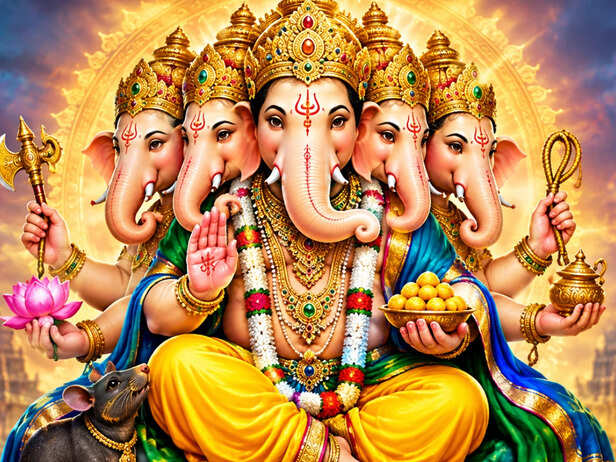
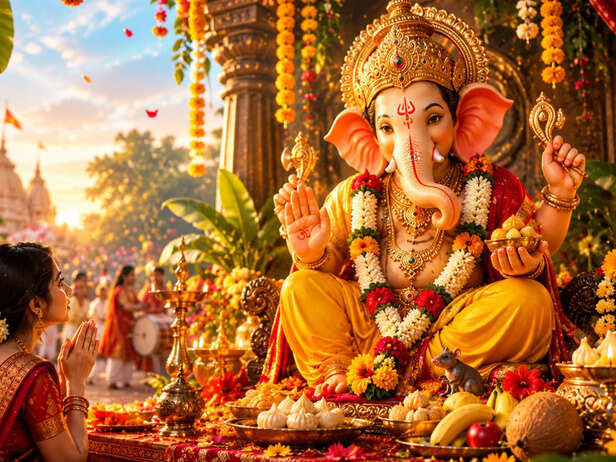
Every Ganesh Chaturthi, kitchens across Maharashtra, Karnataka, Tamil Nadu and Goa fill with the smell of fresh coconut and jaggery wrapped in steamed rice dough. The modak is not just a sweet made for the occasion, in devotional tradition, it is the sweet, the one offering so closely tied to Ganesha that he is often depicted holding one in his hand and reaching for another with his trunk. Before the first modak is eaten, it belongs to him.
What the Tradition Says About Modak and Ganesha
![Morya Gosavi is known to be a devout follower of Lord Ganesha and has lived]()
Morya Gosavi is known to be a devout follower of Lord Ganesha and has lived
Image credit : CHATGPT(AI)
In Puranic lore, Ganesha's fondness for modak is not incidental. Several regional tellings describe the sweet as a gift from Parvati, made to reward her son after he completed a task no other deity could. In popular devotional thought, the modak represents the sweetness of spiritual knowledge, the outer shell being the material world, the filling being the bliss that lies within it. The tradition holds that offering modak to Ganesha is offering him what he already loves most, and that an offering given from genuine understanding carries more weight than one given from habit.
The Two Forms: Ukadiche and Talniche
![Ganesh Chaturthi 2026]()
Ganesh Chaturthi 2026
Image credit : CHATGPT(AI)
Ukadiche modak, steamed, is the form most closely associated with the puja. The dough is made from rice flour worked with hot water until it is smooth and pliable, then shaped by hand into a small cup. The filling is freshly grated coconut cooked with jaggery, sometimes with a pinch of cardamom and a scraping of nutmeg. The pleating at the top, where the dough is gathered and pinched into a peak, is the part that takes practice. A well-pleated modak has eleven folds, a number that appears in several regional traditions without a single agreed explanation for why eleven specifically, some connect it to the eleven Rudras, others treat it as a craft convention that became sacred through repetition.
Talniche modak, fried, uses a similar filling inside a maida or wheat dough shell and is deep-fried until golden. It keeps longer and travels better, which is why it appears more often in regions where the festival is celebrated away from a home kitchen. Both forms are offered; the steamed version is considered the more traditional of the two in Maharashtra, where the festival takes its most elaborate public form.
How the Offering Is Made
The modaks prepared for the puja are counted, twenty-one is the number most commonly cited across regional traditions, though the actual number varies by family custom and by the scale of the celebration. They are arranged on a banana leaf or a silver plate and placed before the murti as part of the naivedya, the food offering made during the aarti. The priest or the head of the household recites the offering while the plate is presented. After the puja, the modaks are distributed as prasad, they have passed through the ritual and carry that quality with them when they are eaten.
In many households, the making of modak is itself treated as part of the devotion. The kitchen is cleaned before the work begins. The person making them may have bathed and changed. The conversation in the room tends to be quieter than usual. None of this is formally prescribed in most texts; it is the accumulated practice of families who understand that the preparation is not separate from the offering.
Regional Variations Worth Knowing
Tamil Nadu's version, called kozhukattai, uses a similar steamed rice dough but the filling and shape vary, some are filled with a dal and jaggery mixture, others with sesame. In coastal Karnataka and Goa, the coconut filling is sometimes mixed with cashew. In Bengal, modak appears during Durga Puja as well, with a filling that can include khoya. Each of these is its own tradition, and it would be a flattening to treat them all as the same sweet with minor differences. What they share is the logic of the offering: something made carefully, by hand, with ingredients that are themselves considered auspicious, coconut, jaggery, rice.
Why the Shape Carries Meaning
The peaked form of the modak, wider at the base, gathered at the top, appears in some devotional interpretations as a representation of Mount Kailash, or as a visual echo of the flame of a lamp. Others read the shape as the form of a bindu, the point from which sound and creation are said to emerge in certain schools of thought. These interpretations are not uniform across all traditions, and it would be wrong to present any one of them as the definitive meaning. What the shape does, practically, is hold the filling completely enclosed, nothing escapes, nothing is visible from the outside. The sweetness is entirely interior. That containment is the image the tradition keeps returning to.
The modak is made, offered, and then shared. The making is an act of attention. The offering is an act of acknowledgment. The sharing is what completes it, the prasad moving from the deity's plate to every person in the room, the sweetness distributed rather than kept.
Unlock insightful tips and inspiration on personal growth, productivity, and well-being. Stay motivated and updated with the latest at
My Life XP.