
The Mystery Behind Lord Jagannath's Unfinished Idols
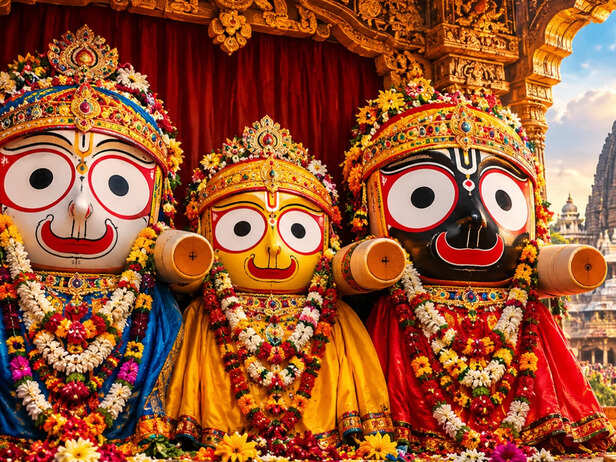
The idols of Hindu gods are often beautifully sculpted, with detailed faces, hands, feet and ornaments. But when devotees enter the famous Jagannath Temple in Puri, Odisha, they encounter something unusual. Lord Jagannath has no clearly carved fingers or complete hands and feet. His brother, Lord Balabhadra, and sister, Goddess Subhadra, also have distinctive forms that look different from conventional deity sculptures.
Yet, these idols are among the most revered forms of Lord Vishnu in Hindu tradition.Why would a divine idol remain unfinished? Was it an accident, a broken promise or part of a mysterious divine plan?According to a popular legend associated with the origin of the Jagannath idols, their unusual appearance is connected to a secret condition set by a divine craftsman and a king who could not control his curiosity
Why would a divine idol remain unfinished? Was it an accident, a broken promise or part of a mysterious divine plan?According to a popular legend associated with the origin of the Jagannath idols, their unusual appearance is connected to a secret condition set by a divine craftsman and a king who could not control his curiosity.
The Story of King Indradyumna and the Mysterious Carpenter
Long ago, there lived a devoted king named Indradyumna, who wished to establish a magnificent temple dedicated to Lord Vishnu. He had heard about a mysterious form of the Lord known as Neel Madhava, worshipped in the forests of Odisha.Determined to find this divine form, the king sent his priest Vidyapati in search of the deity. After several difficulties, Vidyapati discovered Neel Madhava, who was being worshipped by a tribal chief named Vishvavasu.However, by the time King Indradyumna reached the place, the deity had disappeared. The disappointed king continued his prayers and devotion, hoping to receive another opportunity to worship the Lord.
According to the legend, he eventually received a divine indication that a sacred wooden log would emerge from the sea. This wood, known as Daru Brahma, would be used to create the idols of the Lord.When the sacred log appeared, the king arranged for it to be brought to the temple. However, despite inviting skilled craftsmen, nobody could successfully carve the divine figures from it.Just when the king was losing hope, an elderly carpenter appeared.He offered to create the idols of Lord Jagannath, Lord Balabhadra and Goddess Subhadra. But he placed one unusual condition before the king.
The One Condition That Changed Everything
The mysterious carpenter agreed to work inside a closed room for 21 days. During this period, nobody was allowed to enter, disturb him or open the door.King Indradyumna accepted the condition and allowed the carpenter to begin his work.For several days, the sound of tools and carving could be heard coming from inside the room. The king and queen waited patiently, believing that something extraordinary was being created.
However, after some time, the sounds suddenly stopped.Days passed without any movement or noise from inside. Queen Gundicha became increasingly worried. She feared that the elderly carpenter might have fallen ill or even died while working.Unable to control her anxiety, she urged the king to open the door.Despite remembering the carpenter's warning, the king eventually agreed.When they opened the door, they were shocked by what they saw.The mysterious carpenter had disappeared. Inside the room were the wooden idols of Lord Jagannath, Lord Balabhadra and Goddess Subhadra, but their hands and feet were not fully carved.The king was heartbroken. He believed that his impatience had interrupted the divine work and that the idols had been left unfinished because he had broken his promise.
Who Was the Mysterious Carpenter?
Many popular retellings identify the elderly carpenter as Vishwakarma, the divine architect and craftsman of the gods.According to another devotional interpretation, the carpenter was none other than Lord Vishnu himself, who had appeared in disguise to create his own divine form.His disappearance after the door was opened was not considered an ordinary departure. Devotees believe that the Lord had deliberately revealed himself in this distinctive form.The king eventually understood that what appeared to be incomplete to human eyes was actually the form chosen by the divine.The idols were therefore not replaced with conventionally carved figures. They were accepted and worshipped in the very form in which they had appeared.
Why Did Lord Jagannath Choose to Remain Without Complete Limbs?
The unusual appearance of Lord Jagannath is often understood through a deeper spiritual idea.In Hindu philosophy, the Supreme Being is not limited by a physical body. God does not need human hands to accept prayers or human feet to reach devotees.A verse from the Shvetashvatara Upanishad describes the Supreme Being as having no ordinary hands or feet, yet possessing the power to grasp and move.This teaching is often associated with the distinctive form of Lord Jagannath.His incomplete-looking limbs remind devotees that divine power does not depend on physical appearance. The Lord can bless, protect and guide his devotees without needing a conventional human form.It also conveys a beautiful message: God's greatness cannot be measured by outward appearance.
Why Are the Three Idols Made of Wood?
Another fascinating aspect of Jagannath worship is that the deities are made of sacred wood rather than stone or metal.The wooden idols are associated with the tradition of Daru Brahma, which represents the divine presence within sacred wood.Unlike many other Hindu temple idols, the wooden forms of Lord Jagannath, Lord Balabhadra and Goddess Subhadra are periodically replaced through a special ritual known as Nabakalebara.During this ceremony, new wooden idols are created from specially selected neem trees, following prescribed religious traditions. The sacred ritual symbolises the renewal of the deities' physical forms while their divine presence continues.This tradition makes Jagannath worship particularly distinctive.
What Makes Lord Jagannath's Appearance So Special?
The three deities have distinct appearances and symbolic associations.
- Lord Jagannath: The central deity is recognised by his dark face, large round eyes and distinctive rounded form.
- Lord Balabhadra: His elder brother is traditionally depicted with a white face and a different set of facial features.
- Goddess Subhadra: Their sister occupies the middle position between the two brothers and is recognised by her yellow appearance.
Their unusual shapes are not considered imperfections by devotees. Instead, they represent a sacred form that has been worshipped for generations.The three deities are also central to the famous Rath Yatra, during which they are taken out of the Jagannath Temple in grandly decorated chariots. Thousands of devotees gather to witness this annual procession in Puri.
The Deeper Message Behind the Unfinished Idols
The story of Lord Jagannath's incomplete hands and feet carries a powerful spiritual message.Human beings often judge beauty through physical appearance, perfection and outward form. However, the Jagannath tradition encourages devotees to look beyond these limitations.His form reminds people that divinity does not need to follow human ideas of perfection. The Lord's presence is believed to extend everywhere, and his blessings are not restricted by physical boundaries.
Perhaps that is what makes the idols of Jagannath so fascinating. What looks unfinished to the human eye is considered completely divine by his devotees.The next time you see Lord Jagannath's large eyes and distinctive wooden form, remember the legend of King Indradyumna and the mysterious carpenter. It is a reminder that sometimes what appears incomplete may hold a much deeper meaning.
Unlock insightful tips and inspiration on personal growth, productivity, and well-being. Stay motivated and updated with the latest at My Life XP.