
What Ik Onkar at the Opening of the Guru Granth Sahib Actually States
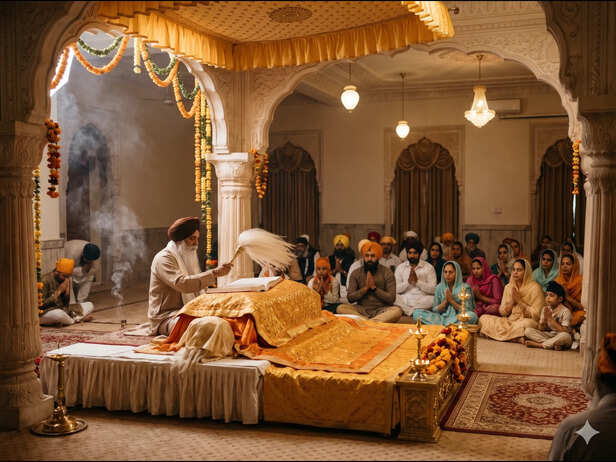
The Guru Granth Sahib opens before the first word of the first hymn. What precedes everything else is a string of thirteen Gurmukhi characters known as the Mool Mantar, and the first two of those characters, Ik Onkar, stand apart from the rest. They are not an invocation asking for something. They are a statement asserting something. That distinction matters more than it first appears.
What the Two Characters Say
Ik means one. Onkar, drawn from the Sanskrit Omkara, refers to the primal sound or the universal creative principle. Together, the phrase is rendered in the Sikh tradition as: the divine is one. Not one among many, not the greatest of several, but singular in a way that leaves no category beside it. The Guru Granth Sahib does not open with a name for the divine. It opens with a number, and that number is its own argument.
Why a Number Rather Than a Name
Guru Nanak, to whom the Mool Mantar is attributed, was speaking into a world thick with names. The tradition holds that he had encountered the names used in Hindu devotion and in Islamic practice, and that he found each of them carrying the weight of a particular community's claim. Ik Onkar sidesteps that entirely. A number belongs to no sect. It cannot be owned by a temple or a mosque. It cannot be translated into a ritual. It simply states a condition: oneness. In the Sikh understanding, this is why the phrase precedes every other word in the scripture, because every other word in the scripture is trying to describe what Ik Onkar has already declared.
The Mool Mantar That Follows
The thirteen characters of the Mool Mantar continue past Ik Onkar to describe the qualities of that one: Sat Nam, whose name is truth. Karta Purakh, the creator being. Nirbhau, without fear. Nirvair, without enmity. Akal Murat, beyond time in form. Ajoni, unborn. Saibhang, self-existent. Gurprasad, known through the grace of the Guru. Each quality is an elaboration of what the opening number implied. The one that exists cannot fear, because there is nothing outside it to threaten it. It cannot hold enmity, because there is no other to hold it against. Ik Onkar is the premise; the Mool Mantar is the argument that follows from it.
Where Ik Onkar Appears Beyond the Opening
The symbol does not stay at the beginning of the scripture. It appears at the head of each of the thirty-one ragas, the musical modes, under which the hymns of the Guru Granth Sahib are organised. It appears at the start of compositions by the Sikh Gurus and by the bhagats, the saints from other traditions whose writings were included in the scripture. In the Sikh understanding, this repetition is deliberate: each section of the text begins again from the same premise, as if to say that whatever follows, whether it is a hymn of longing, a hymn of praise, or a hymn of instruction, rests on the same ground.
What the Tradition Holds It to Mean for Practice
In Sikh devotional thought, Ik Onkar is not only a theological statement. It is also understood as a lived orientation. If the divine is one and without enmity, then the divisions human beings construct, between communities, between the worthy and the unworthy, between those who pray in one way and those who pray in another, are not supported by the nature of things. The langar, the community kitchen in which everyone eats together regardless of background, is sometimes described as the practical expression of Ik Onkar: not a symbol of charity, but a practice that takes the opening statement of the scripture seriously. The one who feeds and the one who eats are, in the tradition's view, expressions of the same one.
Ik Onkar is two characters that carry a whole position. It does not ask the reader to feel a particular way about the divine. It states what the divine is, and then the rest of the Guru Granth Sahib spends 1,430 pages living inside that statement, approaching it from every angle of human experience, in thirty-one ragas, across centuries of voices, without ever needing to revise the opening two characters that made the whole thing possible.
Unlock insightful tips and inspiration on personal growth, productivity, and well-being. Stay motivated and updated with the latest at My Life XP.