
The Hour Before the Temple Opens: What Waits in the Dark
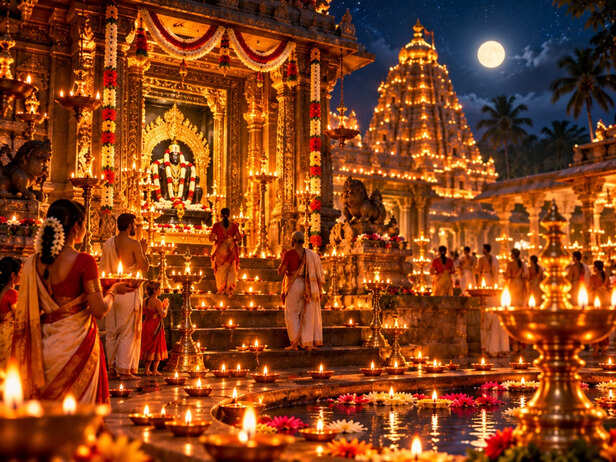
The gate is still shut. The street behind you has not woken yet. Somewhere inside, a single lamp may already be burning, or nothing, just stone and dark and the smell of yesterday's marigolds drying on the threshold. You arrived early because you wanted to, or because you could not sleep, or because someone told you once that the hour before the temple opens is the truest hour, and you have never quite stopped testing whether that is so.
A handful of others are already here. Nobody organised this. Nobody announced a gathering. And yet here you all are, standing a little apart from one another in the way that people do when they share something they have not agreed to name.
The Quality of That Particular Dark
The dark before a temple opens is not the dark of an empty street. It has a different weight. Pilgrims and devotees who keep this habit often say the same thing in different words: that the hour feels charged without being tense, still without being empty. The Sanskrit concept of brahma muhurta, the period roughly ninety minutes before sunrise, is held in many traditions to be the time when the mind is most permeable, when the distance between the ordinary and the sacred is at its thinnest. Whether or not a person arrives knowing that concept, the body seems to register something in the hour itself.
The silence is part of it. Most of the sounds that fill a day, traffic, conversation, the percussion of domestic life, are not yet running. What remains is wind, occasionally a dog, the distant sound of water from a tap someone has opened in a house nearby. In that reduced soundscape, the mind stops performing. It does not have an audience yet.
What the Waiting Does
Waiting in that hour is different from waiting in a queue, different from waiting for news. There is no urgency in it. The temple will open when it opens. The priest will come when he comes. The bell will ring and the curtain will part and the lamp will be raised, and all of that is as certain as anything in a day can be. The waiting here has no anxiety in it because there is nothing to lose.
That particular kind of waiting, purposeful, patient, without an outcome to manage, is rarer than it sounds. Most waiting in a life is waiting for something uncertain. This is waiting for something that will absolutely arrive. Devotees who return to this hour again and again often describe it as the only part of their day when they are not trying to make anything happen. The gate will open. They do not need to push it.
There is also the matter of the body cooling down. You walked here, or you came by autorickshaw and stepped out into air that is several degrees colder than the afternoon. The cold focuses attention in a way that warmth does not. You become aware of your feet on the stone, of the shawl at your shoulders, of your own breath. This is not meditation in the formal sense. It is simply what happens when the body is slightly uncomfortable and the mind has nothing to plan.
The People Who Keep This Hour
Those who gather before the gates open are not all the same kind of devotee. Some are elderly and have kept this habit for decades, arriving at the same time they always have, wearing the same kind of shawl. Some are younger, passing through a difficult season and looking for something they cannot quite name. Some are there because a parent brought them as children and the body still knows the way. Some are travellers, at a temple that is not their own, drawn by something they read or heard or felt when they walked past the previous evening.
They do not usually speak much. When they do, it is quietly and briefly, a remark about the cold, a question about which day of the week brings the longest queue, an observation about the flower seller who has already set up her basket on the far side of the road. These are not conversations about faith. They are the small exchanges that happen when strangers share a space with a common purpose and no competition between them.
What they share, without discussing it, is the choice to be here before they had to be. The temple does not require this of anyone. The deity does not demand an audience in the dark. The early arrival is entirely voluntary, and that voluntariness is its own kind of offering, not of money or flowers or time in the formal sense, but of the particular hour when most of the world is still asleep and you could have been too.
When the Bell Rings
The first bell, when it comes, does something to the air. It is not a loud bell, usually. It is the bell that tells the priests inside that the preparations are beginning, the bell that says the day is about to start in this particular way. The people outside hear it and something shifts, a straightening of posture, a pulling of the shawl, a quiet exhale.
The wait is nearly over. And here is the strange thing that devotees describe: a small reluctance. Not a wish that the temple would stay closed, but a recognition that the hour before the opening had its own completeness. The dark, the cold, the silence, the handful of strangers standing apart from one another, it was its own kind of gathering, its own kind of prayer, conducted without words or form or the structure that begins the moment the gate swings in.
The curtain will part. The lamp will be raised. The fragrance of camphor and incense will move through the air. All of that is coming, and it is what you came for.
But the hour that preceded it was not nothing. It was, perhaps, the part of the visit that belonged entirely to you, before the ritual began, before the crowd filled in, before the day took over. Just you and the dark and the shut gate and the absolute certainty that it would open.
Unlock insightful tips and inspiration on personal growth, productivity, and well-being. Stay motivated and updated with the latest at My Life XP.