
Why the Yamuna Is Remembered Through Krishna's Childhood
Rivers in the Hindu tradition are rarely just water. They carry memory, they mark crossings, and they appear at the moments that change everything. The Yamuna is the river most closely woven into the stories of Krishna's childhood, and the reason is not simply that Mathura and Vrindavan sit on its banks. The river appears in those stories as something closer to a character, present at the birth, present at the play, present at the departure. Understanding why means following the stories themselves.
The Night the River Made Way
The story of Krishna's birth is set in a prison cell in Mathura, where his parents Devaki and Vasudeva are held by the king Kamsa. When the child is born at midnight, Vasudeva is told in a vision to carry him across the Yamuna to the village of Gokul, where a cowherd family will raise him safely. The Yamuna at midnight, in the monsoon, would have been swollen and fast. The story says the river parted, or rose to touch the infant's feet and then subsided, or lay calm and passable, the telling varies by region and by text. What every version holds is that the river recognised the child and gave way. This is the image devotional tradition returns to most often: Vasudeva crossing with the baby held above his head, the Yamuna below them, the night around them. The river's cooperation is not described as a miracle performed on the river from outside. It is described as the river's own response, as if it already knew who was being carried across it.
The Banks Where Childhood Happened
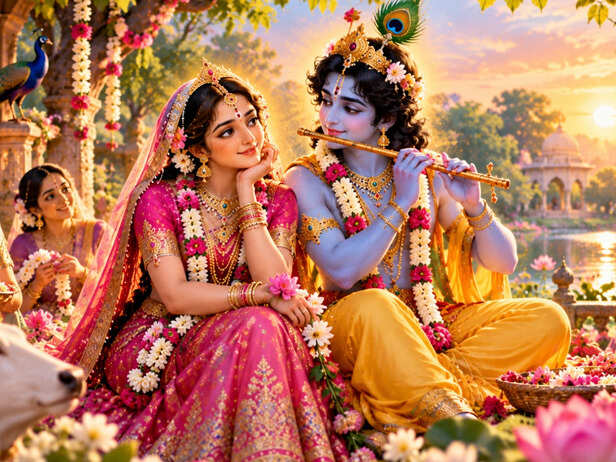
Gokul and Vrindavan are both Yamuna towns. The years Krishna spent there, tending cattle, stealing butter, playing with the cowherd children, and eventually defeating the serpent Kaliya in the river itself, are set against its banks and its water. The Bhagavata Purana describes the Yamuna's banks as the landscape of his lila, a Sanskrit word that means divine play but carries the sense that the play is also the purpose, not a distraction from it. The river is where the children swam. It is where the gopis, the cowherd women, would gather. It is the backdrop to the rasleela, the circular dance in the moonlight that is one of the most painted and sung moments in all of devotional art. The Yamuna in these stories is not a symbol of danger or purification in the way that the Ganga often is. It is a place of ordinariness made sacred by what happened there, which is a different kind of holiness.
Kaliya and the River's Shadow Side
Not all the Yamuna stories are gentle. In one of the most well-known episodes from the Bhagavata Purana, a great many-hooded serpent named Kaliya has taken up residence in a deep pool of the Yamuna and poisoned the water around it. Birds fall from the sky above it. Cattle that drink from it die. The cowherd community cannot use that stretch of the river. Krishna, as a boy, dives into the pool and dances on Kaliya's hoods until the serpent submits. The story ends with Kaliya and his family being sent away unharmed, to the ocean, and the river running clear again. The episode matters to the tradition for more than one reason. It shows the river as a place that can be corrupted and then restored. It places the restoration in the hands of a child. And it gives the Yamuna a quality that rivers in devotional literature often carry: they are not simply beautiful or benevolent, they are alive to what lives in them and what is done to them.
Why Yamuna and Not the Ganga
The Ganga holds the larger place in pan-Indian pilgrimage and in ideas about moksha and ritual purification. The Yamuna's particular devotional weight comes almost entirely from the Braj region, the stretch of land around Mathura and Vrindavan in what is now western Uttar Pradesh, and from the Vaishnava traditions centred on Krishna. In the Braj tradition, the Yamuna is sometimes addressed as Yamunaji and described as a companion rather than a purifier. The devotional poetry of the Ashtachhap poets, who were associated with the Pushti Marg tradition founded by Vallabhacharya, returns again and again to the river as a presence that was there during the childhood and therefore carries something no other river carries. The Yamuna's holiness in this tradition is not about the water's power to wash away sin. It is about the water's memory of what it witnessed.
What the Stories Are Doing
Devotional traditions often work by attaching the sacred to the particular and the local. The Yamuna is a real river. Mathura is a real town. Vrindavan is a real place where pilgrims walk the parikrama path around the town and stop at the ghats at the river's edge. The stories of Krishna's childhood give all of it a meaning that is not geographical. A pilgrim standing at a Vrindavan ghat is not simply standing at a river. In the logic of the tradition, they are standing somewhere the stories happened, and the stories, in devotional thought, did not stop happening simply because the childhood ended. The Yamuna is remembered through Krishna's childhood because the childhood is the frame through which the river is seen, and has been seen, for a very long time. The river did not make the stories sacred. The stories made the river impossible to look at without them.
Unlock insightful tips and inspiration on personal growth, productivity, and well-being. Stay motivated and updated with the latest at My Life XP.