
Why Lakshmi Stands on a Lotus That Grows From Mud
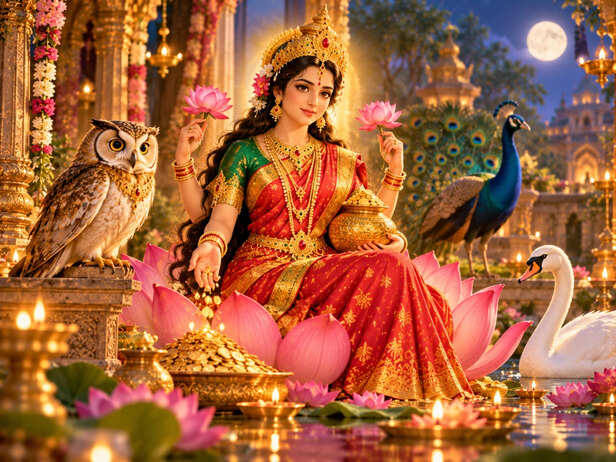
Every home that keeps a small image of Lakshmi has seen this: the goddess standing, palms open, on a pink lotus that floats on dark water. The flower is so familiar it becomes wallpaper. But the tradition that chose it was making a precise argument, not decorating a frame.
The Lotus Does Not Belong to Still Ponds
Nelumbo nucifera, the sacred lotus, roots in the silt at the bottom of ponds, lakes, and slow rivers. The mud it grows from is not clean. It is decomposing organic matter, the residue of things that have lived and fallen. The plant draws everything it needs from that floor and sends a stem upward through water that may be murky, warm, and full of algae. The flower that opens at the surface carries none of it. The petals are dry. Water beads off them. Mud does not cling. In Sanskrit this quality is called alepya, which means non-attachment or non-staining. The lotus is in the water and of the water and untouched by it at the same time.
What the Puranas Say About the Pairing
In several Puranic tellings, Lakshmi emerges during the churning of the cosmic ocean, Samudra Manthan, seated on a lotus. The ocean being churned is not clean water; it is the primordial sea from which both poison and nectar arise together. The tradition places her origin inside that ambiguity. She does not appear after the good things have been separated out. She rises from the churning itself. The Srimad Bhagavatam describes her as Padma, the lotus-born, and the Vishnu Purana names her Padmavasa, she who dwells in the lotus. The epithets are not ornamental. They locate her in a specific relationship with the world: present within it, not withdrawn from it, and not contaminated by it.
Abundance Without Grasping
Lakshmi is the goddess of wealth, harvest, beauty, and good fortune, and the lotus image carries a teaching about how those things move. The flower does not hold water. It sheds it. In the iconographic tradition, Lakshmi's open palms face downward or outward, gold coins falling from them. She does not cup her hands to keep. The lotus and the gesture together say the same thing: abundance flows through, it does not pool. The devotional logic is that wealth clings to those who do not cling to it, the same way water stays longest on a surface that does not try to absorb it.
Why Mud Was Not Left Out of the Story
A tradition that wanted only a symbol of purity would have placed Lakshmi on still, clear water, or on a cloud. The mud is deliberate. In Vedic and Puranic thought, the material world is not a mistake to be escaped. It is the ground from which something real can grow. The mud is not the enemy of the lotus; it is its condition. Removing it from the image would change the argument entirely. What the goddess stands on is not purity achieved by avoiding difficulty. It is purity that passes through difficulty and is not altered by it. That is a different claim, and the lotus makes it visible in a way that words in a text cannot.
The Lotus Across Other Traditions
The lotus carries similar weight in Buddhist iconography, where the Buddha is often depicted seated on one for the same reason: the flower as a figure for enlightenment that arises from the conditions of ordinary, impure life rather than despite them. In Jain tradition, the lotus appears in descriptions of the tirthankara's birth. The image travels across these traditions not because one borrowed from another carelessly, but because the plant's actual biology makes the same argument wherever it grows. A tradition looking for a figure of untouched emergence in a world of difficulty did not have to invent one. It was already there in the water.
What the Devotee Sees When She Looks
In popular devotional practice, the lotus at Lakshmi's feet is sometimes read as an instruction rather than a description. The person who wants what she represents is being shown the posture required: to be fully in the world, rooted in its difficulty, and to let none of it stick. This is not a passive reading. Several commentators in the Vaishnava tradition describe the lotus as the model for how a householder, someone managing money, family, loss, and ordinary failure, might move through those things without being defined by them. The flower does not avoid the mud. It uses it. That is the whole image, and it was never meant to be decoration.
The lotus was not chosen because it is beautiful, though it is. It was chosen because its biology enacts a precise idea that the tradition wanted to keep visible in every home that placed her image on a shelf. The mud is the starting point. The surface is where you arrive. What happens in between is the story.
Unlock insightful tips and inspiration on personal growth, productivity, and well-being. Stay motivated and updated with the latest at My Life XP.