
Why the Brass Temple Lamp Is Always Cleaned by Hand
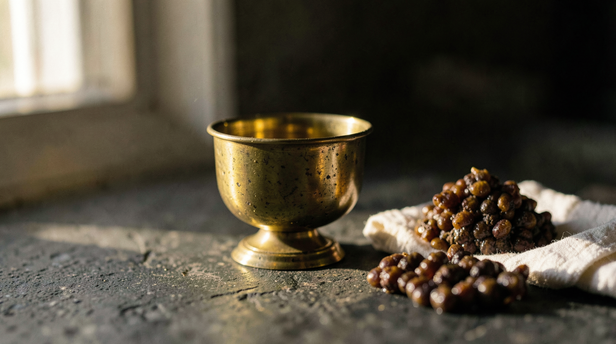
A brass lamp tarnishes the moment it is set down. The metal reacts with air, with the oils left by a flame, with the residue of camphor and ghee, and within a day or two the surface that caught the light turns dull and dark. Cleaning it is not occasional maintenance. It is a rhythm that runs alongside the lamp's use, and in most households that keep one, the rhythm has never been written down anywhere.
What Brass Does in the Presence of a Flame
Brass is an alloy of copper and zinc. Both metals oxidise when exposed to air and heat, which is exactly what a burning lamp produces. The soot from a ghee or oil flame settles into the surface, and the camphor residue left after aarti hardens into a grey-white crust if it is not lifted while still soft. Ghee itself, when it burns incompletely, leaves a thin oily film that traps everything that settles on top of it.The result is a lamp that looks neglected even when it is used every day. The tarnish is not a sign of disrespect. It is chemistry. What removes it is also chemistry: the mild acid in tamarind or lemon juice breaks the copper oxide layer at the surface, and the fine abrasive in ash or wet clay lifts the soot without scratching the metal underneath. These are the materials most households reach for because they have always worked, and they continue to work for the same reason they always did.
Why the Work Is Done with the Hands
A cloth wrapped around a brush or a sponge held at a distance changes the pressure in ways the hand cannot feel. The hand notices the texture of the metal as it cleans, the difference between a crusted rim and a smooth panel, the moment when the surface begins to come clear. Brass lamps are rarely flat objects. They have curves, joints, a base that collects residue differently from the neck, a wick-holder that needs particular attention. The fingers reach where a tool cannot, and they adjust without being told to.The tradition says something additional. In devotional practice across several Hindu lineages, the preparation of the lamp, filling it, trimming the wick, cleaning the body, is considered seva, which translates roughly as service or attendance. Seva is understood as an act directed toward the deity, not a task directed toward an object. The hand that cleans the lamp is the same hand that will light it. The continuity is considered part of the offering. Using a machine or a hired hand for this work is not technically prohibited, but in households where the lamp has been kept for generations, the cleaning tends to stay personal for reasons people find difficult to articulate and do not usually try to.
The Materials That Have Been Used for Generations
Tamarind is the most common cleaning agent for brass across South India and parts of Maharashtra. A small piece of wet tamarind pressed against the surface and worked in circles with the fingertip removes tarnish without any additional abrasive. The acidity does the chemical work; the soft pulp provides just enough friction.In North Indian households, a paste of ash and water is more common, sometimes with a few drops of lemon juice added. Wood ash is mildly alkaline and acts as a gentle abrasive. Lemon juice is acidic and cuts the oxide layer. Together they cover what neither does alone.Some families use a mixture of salt and flour moistened into a paste, or a cut lemon dipped directly in salt. Others use the water in which rice has been washed, which is mildly acidic from the starch. None of these is a recipe handed down in a text. They are observations that were made, passed on, and refined across enough generations that they stopped needing justification.Commercial metal polishes exist and some households use them. The traditional materials remain in use not out of sentiment alone but because they are available, inexpensive, and genuinely effective on the scale of a single lamp cleaned by hand.
When the Cleaning Happens and What Determines the Rhythm
In households where the lamp is lit morning and evening, cleaning typically happens once a week, before the morning lighting on a day considered auspicious for the household's practice, often a Monday, a Friday, or the day associated with the family deity. In temples, the cleaning of the deepam happens more frequently, sometimes daily, as part of the sequence of preparations before the first puja of the day.The timing is not arbitrary. A lamp cleaned just before it is lit is a lamp that has been attended to. The brightness it gives in the first minutes after lighting is noticeably different from a lamp cleaned days earlier and allowed to sit. The surface that has just been polished reflects the flame more completely, and the wick, if it has also been trimmed and repositioned, burns more evenly. The cleaning and the lighting are not separate events that happen to follow each other. They are one continuous act of preparation.
What the Lamp Carries Beyond Its Function
In Hindu devotional thought, the lamp is among the oldest symbols of the divine presence. The Rigveda speaks of fire as both illumination and offering. The deepa is understood in several traditions as a form of the deity itself, not merely as a way of seeing the deity. Cleaning it is therefore not analogous to polishing a candlestick. It is closer to attending to something that is considered alive in a particular sense.This is why the work is done with a certain quality of attention that is difficult to describe to someone who has not grown up around it. The hands move carefully. The lamp is not set down carelessly between passes. The water used to rinse it is clean. When the work is finished, the lamp is dried completely before oil is added, because water in the reservoir can cause the flame to sputter and go out, and a lamp that goes out during puja is considered inauspicious in most traditions.The care taken over the object is inseparable from what the object means. That is not a spiritual claim about the metal. It is an observation about how attention shapes practice, and how practice shapes the objects at its centre over time.A brass lamp kept and cleaned across decades develops a patina that no new lamp has. The surface holds the record of every cleaning, every flame, every hand. That is not something a machine produces, and it is not something the tradition has ever tried to replicate by other means.