
Why Draupadi's Question in the Mahabharata Court Is Still Quoted
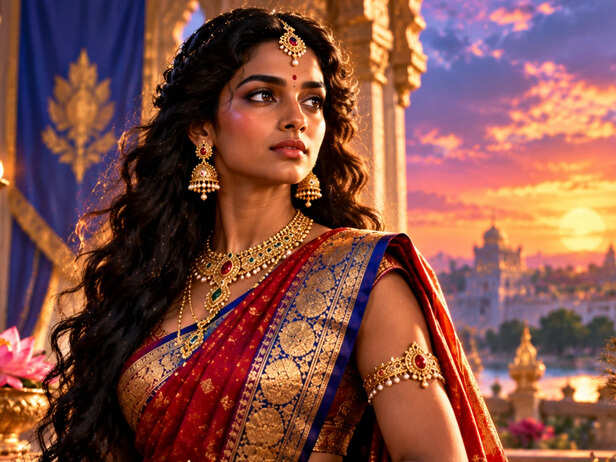
The Mahabharata is full of arguments, but most of them get resolved. A war is fought, a lesson is drawn, a god appears and explains. Draupadi's question in the Kuru court is different. It was asked in front of every elder and warrior the epic had assembled, and not one of them answered it. The silence that followed is the reason the question is still quoted.
What She Actually Asked
Yudhishthira had staked and lost everything at dice, his kingdom, his brothers, himself. Then he staked Draupadi. The messenger Pratikami was sent to bring her to the hall. She sent back one question: had Yudhishthira lost himself first, before he staked her? If he had already become a slave, did he still hold the right to wager another person?
The question was not a protest. It was a legal and philosophical challenge, precise enough that the court could not dismiss it without answering it. Pratikami came back. Vikarna, the youngest Kaurava brother, tried to answer and said she had not been fairly won. Karna argued the opposite. Bhishma, the grandfather whose word carried the most weight in that hall, said the matter was too subtle for him to resolve. Nobody actually answered her.
Why the Silence Matters More Than Any Reply Would Have
If someone had answered Draupadi's question, the scene would have become a ruling. It would have settled something. The silence turned it into a question that the epic itself refuses to close. Bhishma's admission, that dharma is subtle, that he cannot see clearly here, is not a failure of one old man. It is the Mahabharata saying, through its most authoritative voice, that the question is genuinely hard.
The tradition that grew around this scene has never stopped arguing about it. Some readings hold that Yudhishthira had no right to stake her once he had already lost himself, making the wager void from the start. Others hold that the rules of the dice game gave Shakuni's side a legitimate claim regardless. A third reading says the question was never really about the dice at all, it was about whether any system of rules can survive contact with a situation it was not designed to handle.
What the Question Was Really About
Draupadi was not asking to be freed by pointing to a technicality. She was asking something older: at what point does authority over another person require that person's consent? Yudhishthira had authority over many things. The question was whether that authority extended to her, and whether it survived the moment he lost authority over himself.
This is why the question travels. It does not belong to the dice game. It belongs to any situation where one person's claim over another rests on a transfer of power that the second person did not agree to. The Mahabharata stages it in a court full of men who knew the law, and shows every one of them going quiet. That is not an accident of the narrative. It is the point.
How Different Traditions Have Read It
The Mahabharata exists in many regional versions, and the court scene is handled differently across them. In some tellings, Draupadi's question is longer and more formal. In others, she asks it while being dragged into the hall, which changes its character, it becomes resistance rather than legal argument. In the critical edition compiled at the Bhandarkar Oriental Research Institute, the scene is preserved in the form most scholars now treat as closest to the oldest available text, but even within that version, commentators across centuries have disagreed about what the correct answer would have been.
The Bhagavata Purana and later devotional traditions read the scene differently again. In those readings, Draupadi's question is less important than what follows it, her surrender to Krishna, the cloth that would not end. The devotional tradition is interested in her faith under the worst possible pressure. The philosophical tradition is interested in the question she asked before that moment arrived. Both readings are old, and neither cancels the other.
Why It Keeps Being Quoted
A question gets quoted when it names something people keep running into. Draupadi's question names the gap between formal authority and actual right, the gap between what the rules permit and what is just. It names it in a setting where everyone present was supposed to know the answer and nobody did.
The quoting is not always precise. The question gets attached to arguments about consent, about the limits of institutional power, about what it means to be a witness to something wrong and say nothing. Not all of those uses are faithful to the text. But the reason the question survives to be misquoted is that the original is genuinely unresolved. The Mahabharata did not forget to answer it. It looked at the question and decided that the silence was the honest response.
Every elder in that court had spent a lifetime learning how authority worked. Draupadi asked them one question about its edge, and the hall went quiet. That quiet is what the tradition has been sitting with ever since.
Unlock insightful tips and inspiration on personal growth, productivity, and well-being. Stay motivated and updated with the latest at My Life XP.