
Why a Rudraksha Mala Has 108 Beads and What That Number Holds
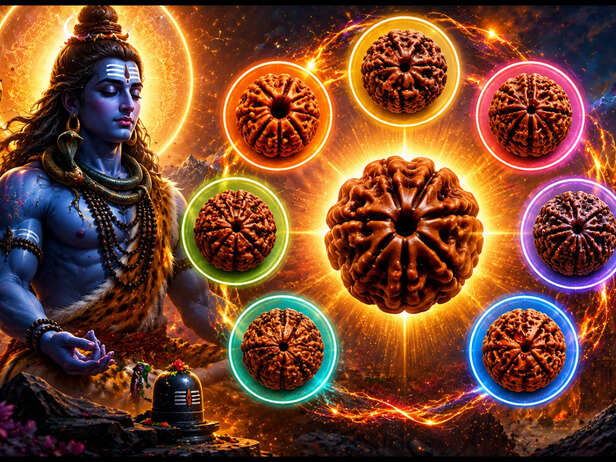
Pick up a rudraksha mala and count the beads. There are 108, plus one, the sumeru, the larger bead that marks the beginning and the end of a cycle. The 108 is not a round number chosen for convenience. It appears in too many unrelated places within the Vedic tradition for that to be true, and the mala holds all of them in a single loop of knotted thread.
What the Sumeru Bead Is For
The sumeru sits outside the count. It is the bead you do not cross during japa. When the fingers reach it, the mala is turned and the count begins again in the opposite direction. The word sumeru refers to the mythic mountain at the centre of the cosmos in Hindu and Buddhist cosmology, the axis around which everything else turns. The mala's sumeru does the same thing in miniature: it marks the centre, the still point between one cycle and the next. Crossing it is considered inauspicious in most traditions, not because of a rule imposed from outside, but because the sumeru represents a threshold. You complete a cycle; you do not barrel through it.
The Astronomy Behind the Number
In Vedic astronomy, the distance between the earth and the sun is held to be approximately 108 times the sun's own diameter. The same ratio appears between the earth and the moon: the moon's distance from the earth is roughly 108 times the moon's diameter. Whether these figures were arrived at through observation or through cosmological reasoning, the tradition took them as confirmation that 108 describes a fundamental proportion in the structure of the visible sky. The mala, strung to 108, places the person holding it inside that proportion, not symbolically, but as a lived count the fingers move through.
The Sanskrit Alphabet and the 108 Upanishads
Sanskrit has 54 letters in its alphabet. Each letter is held to carry two aspects, a solar quality and a lunar quality, or in some accounts, a masculine and a feminine principle. Fifty-four multiplied by two gives 108. The tradition also counts 108 Upanishads, the texts that carry the philosophical core of the Vedas. Whether the count of Upanishads was fixed to match 108 or arrived there independently is a question scholars debate. What the tradition holds is that the number marks completeness, the full range of what can be known or spoken.
The Body and the Number
Ayurveda and the older anatomical texts identify 108 marma points in the human body, junctions of flesh, bone, vein, tendon, and joint where vital energy is held to concentrate. These are not the same as acupressure points in Chinese medicine, though the parallel is often drawn. The marma count places 108 inside the body itself, so a mala of 108 beads is not only a cosmological map but a map of the person holding it. Some practitioners of pranayama also note that a healthy breath cycle at rest runs close to 108 breaths in a given span, the number surfacing again in the body's own rhythm.
How the Mala Is Strung
A traditional rudraksha mala is knotted between each bead. The knot serves two purposes. It keeps the beads from grinding against each other and wearing down the mukhis, the lines that run from cap to cap on each bead, and it gives the fingers a clean point of contact during japa, so the count stays accurate without looking down. The thread is traditionally silk or cotton, in colours that vary by tradition and by the deity the mala is associated with. A mala strung for Shiva is often red thread; one strung for use in general japa may be white or saffron. The sumeru is fixed so that it cannot slide, and the two ends of the thread pass through it and are knotted below, leaving a short tail that hangs free. That tail is sometimes called the brahma knot.
Why the Count Matters in Japa
In japa practice, one bead moves through the fingers for each repetition of a mantra. One full mala, 108 beads, completes one round. The tradition recommends multiples: three rounds, seven rounds, or 108 full rounds for a longer sadhana. The count is not a target imposed on the practice; it is a container that holds the practice together. A fixed number means the mind has one less thing to manage. The fingers count; the mind stays with the mantra. The mala does the arithmetic so the person does not have to.
The number 108 keeps appearing because the tradition built it into many independent systems, the sky, the body, the alphabet, the philosophical canon, and then strung them together on one cord. A rudraksha mala is, in this sense, a piece of cosmology you can hold in both hands. Unlock insightful tips and inspiration on personal growth, productivity, and well-being. Stay motivated and updated with the latest at My Life XP.