
How Tulsi Vivah Is Performed in a Hindu Household
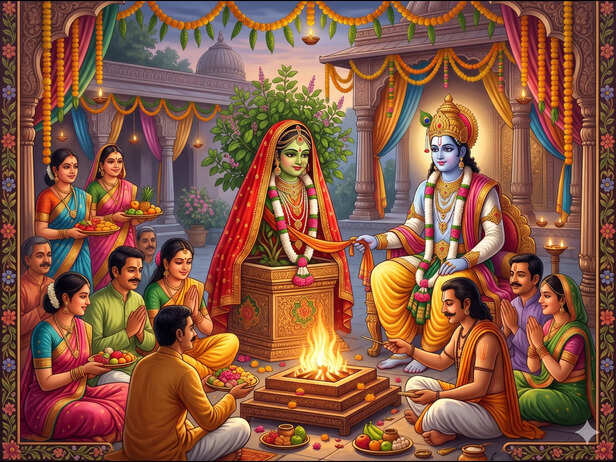
In many Hindu homes, the eleventh or twelfth day of the bright fortnight in Kartik month is the day the courtyard fills with the scent of marigold and the sound of conch shells. Tulsi Vivah is not a festival in the spectacular sense, no fair, no procession, no public gathering is required. It is a household ceremony, intimate by design, performed by whoever in the family keeps it. What follows is how it is typically observed, with the understanding that regional and family customs shape every detail.
The Preparation That Begins the Day Before
The tulsi plant, usually a tall, well-established one that has been tended through the year, is bathed and dressed the evening before the ceremony. The base of the plant and its raised platform, the tulsi chaura, are cleaned and freshly coated with a paste of cow dung and red clay in many North Indian homes, or simply washed and decorated with rangoli in others. The plant is adorned with a small red dupatta or a piece of red cloth tied around it, and sugarcane stalks are sometimes placed on either side to form a canopy, the way a wedding mandap is built for a bride. A Shaligram stone, the aniconic form of Vishnu, is cleaned and placed on a separate small platform or in a brass vessel nearby. In homes that do not keep a Shaligram, a small image or idol of Vishnu serves the same purpose. The evening before, some families light a diya and offer a preliminary prayer, treating it as the eve of a wedding in the household.
The Morning Rituals on the Day of the Ceremony
The ceremony itself is performed at dusk in most traditions, but the morning begins with the household taking a bath before sunrise and the woman of the house, typically the one who tends the tulsi daily, observing a partial or full fast through the day. The tulsi plant is given a fresh bath of water, sometimes with a few drops of milk or rosewater added. Turmeric and kumkum are applied to the base. Fresh flowers, particularly marigold, are offered. The Shaligram is also bathed and anointed. In some families, the preparation includes drawing a small wedding scene in chalk or rangoli around the tulsi chaura, two figures facing each other, a fire between them. This is the visual grammar of a Hindu wedding, miniaturised and placed at the base of the plant.
The Ceremony at Dusk
As the sun goes down, the family gathers. A lamp is lit, in many homes, a large earthen diya that will stay burning through the evening. The woman leading the ceremony circles the tulsi with the lamp, the same pradakshina gesture used in temple worship and in wedding rituals. She ties a sacred thread, typically red or yellow cotton, around the tulsi plant and the Shaligram or Vishnu image, linking them the way a couple is bound during a wedding. Garlands of marigold or tulsi leaves are exchanged between the two, placed on the plant and on the stone. The Vishnu Sahasranama or a shorter Vishnu stotram is recited, or simply the names of Vishnu chanted in repetition. In some households, a priest conducts this portion; in others, the eldest woman of the house leads it from memory. The five offerings of panchamrit, milk, curd, honey, sugar, and ghee, are made to the Shaligram. Prasad, typically a piece of amla, a tulsi leaf, and something sweet, is distributed to everyone present.
What the Ceremony Means Within the Tradition
Tulsi Vivah is rooted in the Puranic story of Vrinda, a devoted woman whose story is told differently across regional traditions but whose transformation into the tulsi plant is the common thread. In the most widely known telling, she is a great devotee whose purity protected her husband, and after her death she became the tulsi, a plant so sacred that no Vishnu worship is considered complete without a leaf from it. The ceremony of her marriage to Vishnu is understood as both a commemoration of that story and an act of devotion in itself. In Hindu devotional thought, performing a deity's marriage is considered a meritorious act, equivalent in some traditions to the merit earned by performing a daughter's wedding. For families that observe it, Tulsi Vivah also marks the formal end of Chaturmas, the four-month period during which auspicious events like weddings and thread ceremonies are traditionally not held. The day after Tulsi Vivah, the wedding season begins.
Regional Variations Worth Knowing
In Maharashtra, Tulsi Vivah is observed with particular elaboration. The ceremony spans two days, the eleventh and twelfth of Kartik shukla paksha, and the tulsi chaura is decorated as a full wedding venue. Women wear their wedding sarees and jewellery. The singing of traditional wedding songs, ovya and mangalashtakas, is part of the ceremony, not an addition to it. In Goa, the ceremony is called Tulshi Lagna and follows a similar pattern with some distinct local elements in the puja sequence. In parts of Uttar Pradesh and Bihar, the ceremony is simpler, a lamp, a thread, a prayer, and the distribution of amla and sugar, but the intention is the same. In South Indian Vaishnava households, the ceremony is observed but the ritual vocabulary draws from a different textual tradition, with specific slokas from Vaishnava sampradayas. The core, a lamp, a union, a prayer to Vishnu, holds across all of them.
The Objects That Appear in Every Version
Whatever the regional variation, certain objects appear in every household observance of Tulsi Vivah. The lamp is always present, it is the witness and the warmth of the ceremony. The sacred thread is always present, it is the act of binding. The garland is always present, it is the exchange that marks a marriage. And the tulsi leaf itself is always present, offered to Vishnu and then returned as prasad, completing the gesture of devotion the ceremony is built around. These objects are not decoration. In the logic of Hindu ritual, each one performs a function: the lamp purifies and witnesses, the thread binds, the garland honours, the leaf consecrates. A household that keeps only these four and nothing else has kept the ceremony.
Tulsi Vivah is one of those rituals that looks like a small domestic act from the outside, a woman circling a plant with a lamp at dusk, and carries, for the family performing it, the weight of a wedding, a prayer, and a year's devotion completing itself in a single evening. The ceremony does not require a priest, a crowd, or an elaborate setup. It requires attention, and the lamp already lit in the courtyard.
.