
Why Saraswati Holds a Veena and Not Just a Book
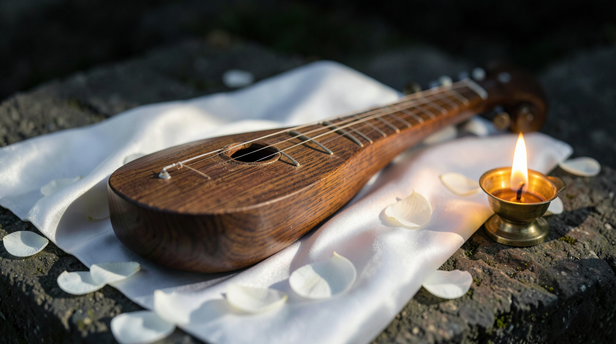
Every element placed in a deity's hands in Hindu iconography is a statement, not an ornament. The lotus signals purity emerging from difficulty. The conch carries the sound of creation. The veena in Saraswati's hands makes a claim about the nature of knowledge itself, and it is a more demanding claim than a book alone would make.
What the Veena Says That a Book Cannot
A book holds knowledge in a fixed state. It can be stored, copied, set aside. A veena produces nothing without a player who has absorbed the practice so completely that the body knows what the mind has learned. You cannot open a veena to the right page. You cannot skim it. The instrument only gives back what has been genuinely internalised.
In the tradition that shaped Saraswati's iconography, this distinction mattered deeply. Rote memorisation and true understanding were considered separate things. A student who could recite a text without understanding its meaning was said to carry a load, not a lamp. The veena in Saraswati's hands insists that the goddess of learning presides over the second kind.
The Concept of Nada and Why It Belongs Here
Vedic thought holds that sound, nada, is the substrate from which the material world arises. The Vedas were heard before they were written; the tradition calls them shruti, meaning that which is listened to. In this framework, a veena is not a metaphor for learning. It is closer to a cosmological instrument: something that participates in the same vibrational order that underlies existence.
Saraswati is described in the Rigveda as a river, flowing, continuous, impossible to step in at the same point twice. Later texts and the iconographic tradition that developed around them placed the veena in her hands as an extension of that same idea. Knowledge, like a river, like sound, moves. It does not sit still between covers.
Why She Carries the Book Too
The full iconographic form of Saraswati holds both. The veena occupies two of her four hands; the others carry a book and a rosary, or sometimes a water pot. The book is not absent, it is subordinate. In popular tradition, this ordering is read as a commentary on the relationship between recorded knowledge and living understanding. The text is the starting point. The veena is where learning arrives.
Regional traditions vary in how they weight the two. In some eastern Indian forms, particularly those associated with Saraswati Puja as it is observed in Bengal and Odisha, the book is prominently displayed and the veena is large and elaborately carved. In southern iconographic traditions, the veena is often the dominant object and the instrument itself is sometimes named, the Saraswati veena, a long-necked instrument associated specifically with the goddess, is still used in Carnatic classical music and carries her name.
What the White Swan Adds to the Argument
Saraswati is almost always shown with a white swan, the hamsa. In Hindu philosophical thought, the hamsa is associated with the capacity to distinguish, specifically, the ability to separate milk from water when the two are mixed. This is not a random metaphor. It describes the quality of discernment: the ability to tell what is true from what merely resembles truth, what is essential from what is incidental.
The swan sitting beside the veena-holding goddess completes a picture of what learning is supposed to produce. Not the accumulation of information, but the ability to move through it with discrimination. The veena requires a trained ear. The swan represents the ear that training produces.
The Colour White and the Absence of Gold
Lakshmi, the goddess of wealth and abundance, is shown in gold and red. Saraswati is shown almost entirely in white, white garments, white lotus, white swan. In popular tradition, this contrast is deliberate and sometimes made explicit: Saraswati and Lakshmi are said to rarely occupy the same house. Devotion to one is said to require a certain indifference to the other.
The white of Saraswati's iconography signals the same thing the veena signals: the kind of knowledge she governs has no market price. It cannot be accumulated like grain or gold. The veena in a musician's hands is worth nothing unless the musician can play it. The knowledge Saraswati holds is only real in the moment it is expressed.
The veena, then, is not an instrument chosen because the goddess happens to enjoy music. It is the most precise object the tradition could have placed in her hands to describe what it believed learning actually was, not a possession, but a practice; not a text to be stored, but a sound that only exists while it is being made. The book beside it does not contradict this. It marks where the practice begins.