
Was Asura Music Really the Sound of Power and Rudra?
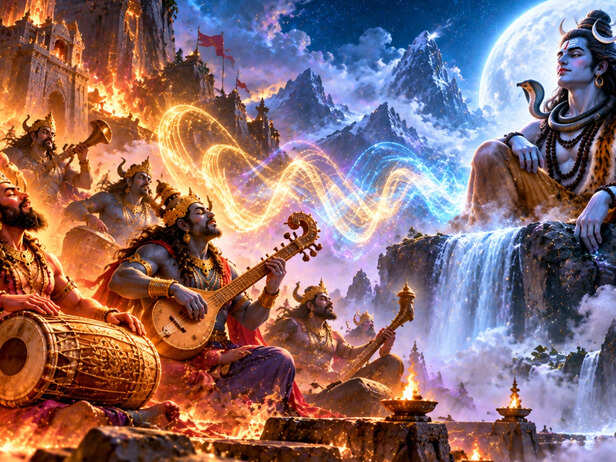
We often imagine Deva music through Krishna’s flute, celestial melodies and the gentle beauty of devotional sounds. But what about the music associated with the Asura tradition? Did it have a different character?
Indian mythology gives us fascinating examples of Asuras and other figures who were deeply connected with music, devotion and instruments. Ravana is traditionally associated with the Ravana-hattha, Prahlada was known for his devotion to Narayana, and Banasura is remembered in tradition as a devotee of Shiva. Their stories raise an intriguing question: if divine music can express love and devotion, could powerful sounds represent the fierce Rudra aspect of the divine?
Asuras Were Not Only Warriors
When we hear the word Asura, we often imagine a powerful enemy from Hindu mythology. But these stories contain more complex characters. Ravana, for example, is traditionally associated with music, devotion and the Ravana-hattha, while Prahlada is remembered for his deep devotion to Lord Vishnu. Banasura is also described in traditional stories as a devoted worshipper of Shiva. These examples show that the world of Asura mythology cannot simply be reduced to battles and destruction. Music, devotion, knowledge and spiritual practices also appear in the stories surrounding several important Asura figures.
The Sound of Rudra Is Different
The key to understanding this idea may lie in Rudra, one of the fierce and powerful aspects associated with Shiva. Here, sound is imagined not merely as a pleasant melody but as Naad, a deeper vibration carrying force and intensity. The damaru becomes a powerful symbol of this idea. Unlike a soft melody designed to soothe the mind, intense percussion can feel physical. You do not simply hear a heavy drumbeat. You can feel its rhythm through your body. This contrast creates an interesting way to imagine the difference between gentle devotional music and powerful Rudra Naad.
Ravana’s Musical Side
Ravana is one of the most fascinating figures in Hindu mythology because his character combines scholarship, power, devotion and ambition. Traditional accounts connect him with music and the Ravana-hattha, a bowed string instrument associated with his name in popular tradition. Whether every later musical attribution can be historically established is another question, but the cultural image remains powerful. Ravana was not simply portrayed as a warrior. His association with music reminds us that mythology often gives its characters multiple dimensions. The same figure can represent extraordinary talent while also becoming part of a larger moral story.
From Melody to Powerful Naad
Think about the difference between a soft flute melody and a powerful drum performance. A flute may immediately create a sense of calm, longing or devotion. Heavy percussion can create excitement, movement and physical energy. This does not prove that modern heavy drums or metal music originated from an ancient Asura tradition. Instead, it offers an interesting comparison of how humans experience sound. Deep bass, strong percussion and repeated rhythms can create a powerful bodily response. That experience can remind us of the traditional idea of Rudra Naad, where sound is imagined as vibration, energy and force rather than simply entertainment.
Krishna’s Flute or Shiva’s Damaru?
The contrast becomes especially interesting when we place Krishna’s flute beside Shiva’s damaru. Krishna’s flute is traditionally associated with love, devotion, attraction and the enchanting power of divine music. The damaru carries a very different visual and symbolic energy, connected with Shiva’s cosmic rhythm and Rudra aspect. Neither needs to be called superior. They simply represent different emotional experiences of sound. One may make you feel peaceful and emotionally connected, while the other may make you want to move, dance or feel charged with energy. That contrast is what makes the mythology of sacred music so fascinating.
Could We Still Hear It Today?
This is where the ancient story meets modern music. When heavy drums, intense percussion or powerful bass suddenly fill a room, the response can feel almost physical. Your heartbeat seems to follow the rhythm, your body wants to move and your energy rises. It would be too strong to claim that this is literally Asura music surviving today. There is no established evidence for that direct connection. But as a cultural interpretation, it is fascinating to compare the experience with the traditional concept of Rudra Naad: sound that feels less like a song and more like raw energy.
The Real Power of Sacred Sound
Perhaps the most interesting lesson is that Hindu mythology does not treat sound as having only one emotional form. Music can express love, devotion, longing, celebration, meditation or tremendous power. The stories of Ravana, Prahlada, Banasura, Krishna and Shiva reflect this wider relationship between spirituality and sound. So the next time you hear a soft flute, a temple bell or a powerful drumbeat, listen to what it makes you feel. Is it peace? Devotion? Energy? Or something more intense? Maybe that is the real mystery of Naad: the same sound can touch different people in completely different ways.
Unlock insightful tips and inspiration on personal growth, productivity, and well-being. Stay motivated and updated with the latest at My Life XP