
Was Karna Once a Demon With 1,000 Armours?
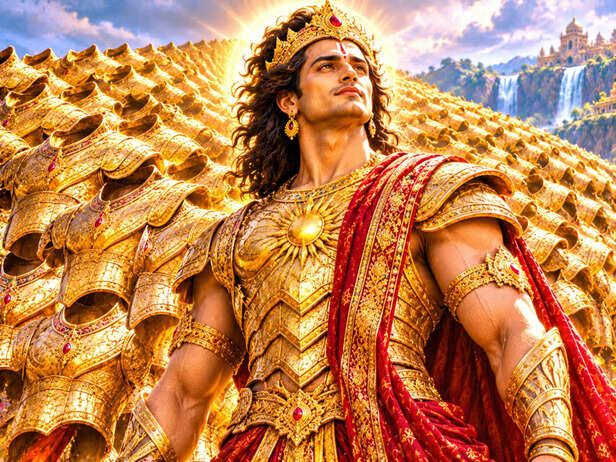
Everyone knows that Karna was born with divine armour and earrings that made him almost impossible to defeat. Most people connect these gifts to his father, Surya Dev. But a fascinating traditional account links Karna's armour to a much older battle involving two divine sages, Nara and Narayana, and an asura known as Sahasrakavacha. According to this later tradition, Karna's birth was connected to the final armour that remained after an extraordinary struggle lasting thousands of years.
The Asura Who Wanted 1,000 Armours
According to a popular Puranic account, an asura named Dambhodbhava performed intense penance to please Surya Dev. He initially wanted immortality, but the Sun God explained that no mortal could receive such a boon. Dambhodbhava then asked for something extraordinary: 1,000 protective armours. Each armour could be broken only by someone who had completed a thousand years of penance and fought for another thousand years. This made him extraordinarily difficult to defeat. In some later tellings, he became known as Sahasrakavacha, meaning the thousand-armoured one.
Nara and Narayana Take Up the Challenge
When the asura's power became a threat, the divine sages Nara and Narayana entered the story. They are traditionally regarded as two forms of divine power, with Narayana associated with Lord Vishnu. Their strategy was unusual. While one performed penance for a thousand years, the other fought the asura for the same period. They would then exchange roles. This allowed them to meet the difficult condition attached to the armours. Rather than relying on strength alone, they used patience, discipline and a carefully planned strategy to overcome the asura's protection.
The Battle That Lasted Thousands of Years
The struggle was unlike an ordinary battle. Every armour required thousands of years of effort to break, and the two sages continued their fight by taking turns. As one fought, the other performed penance and remained ready to restore his companion. According to the traditional account, this process continued until 999 of the asura's armours had been destroyed. Only one remained. The story describes an extraordinary contest in which determination and spiritual discipline gradually weakened an enemy who had seemed almost invincible.
The Asura Seeks Protection from Surya Dev
When only one armour remained, the asura realised that his defeat was near. In a popular version of the story, he became frightened and sought refuge with Surya Dev, the very deity who had granted him the boon. This created a difficult situation because the Sun God had a connection to the asura through his blessing. The final armour had not yet been broken, and the struggle was far from over. Later retellings use this moment to connect the ancient battle with the events of the Mahabharata.
The Connection Between Sahasrakavacha and Karna
Here comes the most intriguing part of the popular tradition. Sahasrakavacha is identified in some later accounts with Karna, who was born to Kunti through the blessing of Surya Dev. Karna entered the world wearing a natural protective armour, known as kavach, and divine earrings called kundal. These made him exceptionally difficult to defeat. The traditional connection suggests that the final unbroken armour of Sahasrakavacha continued through Karna's birth. However, this identification should be understood as a later interpretation, not as an explicit account in the main Mahabharata narrative.
Why Krishna and Arjuna Were Connected to Nara and Narayana
The connection becomes even more interesting when we look at Krishna and Arjuna. Hindu tradition identifies Arjuna with Nara and Krishna with Narayana. Their relationship in the Mahabharata is therefore linked to the ancient bond between the two sages. This association is also discussed in the Mahabharata, where the greatness of Nara and Narayana is recalled through the story of Dambhodbhava. In later interpretations, this connection is used to explain why Krishna and Arjuna would face Karna, who is linked with the remaining armour of Sahasrakavacha.
The Final Armour and Karna's Fate
According to this later interpretation, the ancient struggle between Nara and Narayana found its continuation in the Mahabharata war through Arjuna and Krishna. Karna's natural armour made him a formidable warrior, but he eventually gave it away to Indra in exchange for a powerful weapon. This left him vulnerable during the Kurukshetra war. The story creates a striking link between an ancient asura, a divine boon and Karna's tragic destiny. It is a fascinating traditional explanation, although the connection between Karna and Sahasrakavacha is not stated directly in the main epic.
Unlock insightful tips and inspiration on personal growth, productivity, and well-being. Stay motivated and updated with the latest at My Life XP.