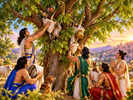
What if the Ramayana was not shaped by warriors alone, but also by the choices, courage, devotion and wisdom of women? We often hear that a woman was responsible for the events that led to the Ramayana. But this familiar claim misses a much deeper truth. From Kaikeyi’s decision to Shabari’s devotion, women influenced the journey of Lord Rama in ways that tested his character, exposed adharma and revealed the meaning of dharma. Their roles were not limited to love or sacrifice. They helped shape the moral heart of the epic.
The Question That Began the Ramayana
![Sages’ Wisdom by the Riverside]()
Sages’ Wisdom by the Riverside
Image credit : CHATGPT(AI)
The Ramayana begins with a profound question. Maharishi Valmiki asks Narada Muni whether there is a man who embodies virtue, courage, truth and righteousness. Narada points to Lord Rama, inspiring the account of his extraordinary life. Yet Rama’s qualities become visible through the people and challenges he encounters. The women of the Ramayana are central to this journey. Their decisions, devotion, wisdom and struggles repeatedly bring his values into focus. Seen through this lens, Shakti is not merely a force in the background. It is woven into the events that reveal what it means to live by dharma.
Ahalya and Sita Reveal the Power of Choice
![Ahalya’s Redemption and Sita’s Swayamvara]()
Ahalya’s Redemption and Sita’s Swayamvara
Image credit : CHATGPT(AI)
Ahalya’s story is associated with restoration and release, while Sita’s swayamvara marks the beginning of her life alongside Rama. In popular retellings, Ahalya’s encounter with Rama represents the possibility of redemption after suffering, while Sita’s role highlights dignity, courage and personal choice. These episodes reveal different dimensions of Shakti. One speaks to the hope of a new beginning; the other introduces a woman whose strength will be tested throughout the epic. Their stories remind us that a person’s worth cannot be understood through a single moment in their life.
Kaikeyi’s Decision Tested Rama’s Dharma
Kaikeyi’s decision to ask for Rama’s exile changes the fate of Ayodhya. Her actions are often remembered as the cause of the royal family’s suffering, but the episode also tests Rama’s commitment to his father’s word and his sense of duty. Rama accepts exile instead of allowing the kingdom to descend into conflict. This does not make Kaikeyi’s choice harmless, nor does it erase the pain it causes. Instead, the episode shows how a difficult decision can expose the values of those affected by it. Rama’s response becomes one of the clearest expressions of his commitment to dharma.
Urmila’s Quiet Sacrifice Supported Lakshmana
When Lakshmana leaves Ayodhya to accompany Rama and Sita, Urmila remains behind. Her sacrifice receives less attention in many popular retellings, yet her separation from her husband forms an important part of the emotional cost of exile. Later traditions often celebrate Urmila’s patience and quiet devotion during those fourteen years. While versions of her story differ, her place in the Ramayana invites us to recognise the people whose contributions happen away from the battlefield. Strength is not always expressed through dramatic action; sometimes it appears in the ability to endure separation while remaining faithful to one’s responsibilities.
Anasuya and Shabari Show Two Forms of Devotion
Anasuya offers Sita guidance during her time in the forest, while Shabari welcomes Rama with deep devotion when he reaches her hermitage. Their roles are different, but both bring spiritual strength into the story. Anasuya represents wisdom and disciplined living; Shabari is remembered for a love that does not depend on status or wealth. Shabari’s meeting with Rama also helps connect his search for Sita with the path ahead. These episodes suggest that spiritual insight can come from unexpected places. In the Ramayana, devotion is not measured by social position but by the sincerity of the heart.
Surpanakha and Mandodari Expose Ravana’s Weakness
Surpanakha’s encounter with Rama and Lakshmana becomes one of the events leading towards the conflict with Lanka. Ravana’s later decision to abduct Sita reveals how desire and pride can overpower judgement. Mandodari, meanwhile, is remembered in the epic tradition for warning Ravana and urging him to act wisely. Her counsel shows that the signs of disaster were not invisible; Ravana chose not to heed them. Together, these episodes highlight a central theme of the Ramayana: power without self-control can become destructive. The women in these events do not all act in the same way, but their roles help expose the consequences of Ravana’s choices.
Tara and Mandodari Reveal the Cost of Ignoring Wisdom
Tara, the wife of Vali, is portrayed as perceptive and politically aware. She warns Vali about the danger of confronting Sugriva, but he does not follow her advice. Mandodari similarly urges Ravana to reconsider his actions. Their stories share a striking pattern: both women recognise the risks ahead, yet the men they advise allow pride to shape their decisions. Tara and Mandodari are also traditionally counted among the Panchakanya, though lists and interpretations can vary across traditions. Their presence in the Ramayana reminds us that wisdom can be ignored when ego becomes more powerful than reason.
The Three Women Who Tested Hanuman
During his journey to Lanka, Hanuman encounters Surasa, Simhika and Lankini. Each presents a different obstacle, and Hanuman responds in a different way. He uses intelligence to pass Surasa’s test, confronts Simhika when she threatens his progress, and overcomes Lankini at the entrance to Lanka. These episodes are not simply tests of physical strength. They show Hanuman adapting to the challenge before him, knowing when to be clever, when to fight and when to keep moving. The women and female figures in these encounters help demonstrate that true strength includes judgement, flexibility and self-control.
The Deeper Meaning of Shakti in the Ramayana
The women of the Ramayana cannot be reduced to a single role. Sita represents dignity and endurance; Urmila is remembered for sacrifice; Shabari embodies devotion; Tara and Mandodari offer counsel; and Kaikeyi’s decision changes the course of the royal family’s life. Their choices do not always lead to peace, and not every action is presented as righteous. That complexity is part of what makes their stories meaningful. Shakti, understood as feminine power in Hindu traditions, can be expressed through compassion, courage, discernment and resistance. The epic becomes richer when these women are seen as individuals who shape its moral and emotional journey.
Ramayana Was Never Just a Story of War
It is easy to remember the Ramayana through its great battles, its heroes and Ravana’s defeat. But the events leading to that ending are shaped by many people, including women whose actions change the direction of the story. Some make wise choices, some act from desire or fear, and others demonstrate extraordinary devotion. Their stories reveal the consequences of pride, the strength of duty and the importance of listening to sound advice. Rather than saying that women caused the Ramayana, a deeper reading recognises that their roles help uncover its central questions about dharma, power and responsibility.
Unlock insightful tips and inspiration on personal growth, productivity, and well-being. Stay motivated and updated with the latest at My Life XP