
Was the Ghoonghat Really Part of Ancient Hindu Culture?
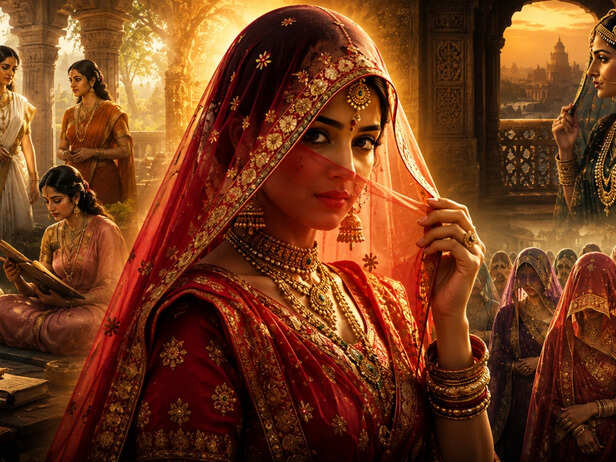
Why do many Indian women cover their heads in some families and religious settings, while others never follow the practice? Is it an ancient religious rule? Or did different social customs develop at different points in Indian history? This question has recently sparked debate after a viral discussion about ghoonghat, purdah, and head covering in Indian culture. One claim says that covering the face or head was mainly introduced as a social response to invasions and concerns about women's safety. Another view points to religious customs where devotees cover their heads as a sign of respect. The truth is more interesting than a simple yes or no. Indian traditions are diverse, and head covering, ghoonghat, and purdah are not necessarily the same practice.
Ghoonghat and Purdah Are Different
The first mistake is treating every form of head covering as the same thing. Ghoonghat traditionally refers to a veil drawn over the head, and sometimes over part of the face. Purdah is a broader social practice involving the seclusion or restricted visibility of women. Head covering can also have a completely different religious meaning. Because India has many communities and traditions, the same action may carry different meanings in different places. Understanding this difference helps us avoid simple conclusions. A religious head covering should not automatically be described as ghoonghat, and ghoonghat should not automatically be treated as complete female seclusion.
What Does Head Covering Mean?
Covering the head during worship is found in different Indian communities and religious traditions. For many devotees, it is a sign of respect, humility, discipline, or reverence before the divine. It is important, however, not to present one practice as a universal rule for every Hindu woman. Customs vary widely between regions and communities. Men may also cover their heads in some religious settings. This shows why the meaning of a head covering depends on the situation. A person may cover their head during prayer because of religious etiquette, while another person may follow a family custom. The action can look similar while the reason is different.
India Has Always Had Regional Differences
India cannot be treated as one single cultural tradition. Clothing customs have always differed across regions. What is common in Rajasthan may be unusual in Tamil Nadu. A practice followed in parts of North India may be less common in parts of South India. Climate, local culture, social structure, religion, and historical contact all influence clothing traditions. This regional diversity is important when discussing ghoonghat in India. The presence or absence of a particular custom in one region cannot by itself prove exactly when or why the custom began. History needs to be studied through multiple forms of evidence rather than one modern comparison.
Did Invasions Change Social Customs?
The idea that invasions influenced some forms of female seclusion is part of a wider historical discussion, but it should not be presented as a proven explanation for every veil tradition in India. Historians have examined how political instability, social status, community identity, ideas of honour, and interaction between different cultures influenced customs over time. Practices can also change gradually rather than appearing suddenly after one event. This is why the statement that “invaders introduced the entire ghoonghat tradition” is too simple. Historical customs usually have multiple causes, and different regions may have experienced those changes in different ways.
South India Offers a Useful Comparison
South India is sometimes used as an example in discussions about the history of purdah and ghoonghat because strict forms of female seclusion have historically varied across communities and regions. But this comparison must be handled carefully. Saying that an area experienced fewer invasions does not automatically prove that its clothing customs developed for one specific reason. South Indian societies also experienced their own political, religious, and cultural changes. The useful lesson is not that one region proves one theory. It is that Indian traditions are diverse, and their history cannot be explained through a single story.
Tradition Can Change With Time
Many customs that feel ancient today have changed over centuries. A practice may begin with one meaning and later gain another. It may be followed by one community but not another. It may also become stronger or weaker depending on social conditions. This is true when studying Indian cultural traditions as well. Instead of asking only, “Was this always done?”, it is often better to ask, “Where was it done, when did it become common, and what meaning did people give it?” These questions create a much clearer picture of history and prevent modern assumptions from being mistaken for ancient facts.
Respect the Tradition, Understand the History
The most balanced way to understand ghoonghat and head covering is to separate religious practice from social custom and then study both carefully. Covering the head during worship can be an expression of respect. Ghoonghat can be a family or community tradition. Purdah can involve broader ideas of privacy and seclusion. None of these meanings should automatically be applied to every Indian woman. Traditions deserve understanding, but history also deserves evidence. The strongest lesson is simple: Indian culture has never been one fixed pattern. It has evolved through centuries of regional, social, religious, and historical influences.
The Real Question Behind the Debate
The debate about ghoonghat and head covering in Hindu culture is not as simple as saying it was either completely ancient or entirely introduced later.
India has always been a land of many traditions.
Some customs are religious.
Some are social.
Some are connected with family identity.
And many have changed with time.
That is why one of the most important questions is not simply “Who introduced this custom?”
It is:
“What did this custom mean to the people who followed it?”
A head covering during worship may express reverence.
A ghoonghat may reflect a regional or family tradition.
Purdah may involve social ideas of privacy and seclusion.
Understanding these differences does not weaken tradition.
It makes our understanding of tradition deeper, more honest, and more meaningful.
Unlock insightful tips and inspiration on personal growth, productivity, and well-being. Stay motivated and updated with the latest at My Life XP