
What Did Ravana Really Ask Lord Shiva For? The Truth
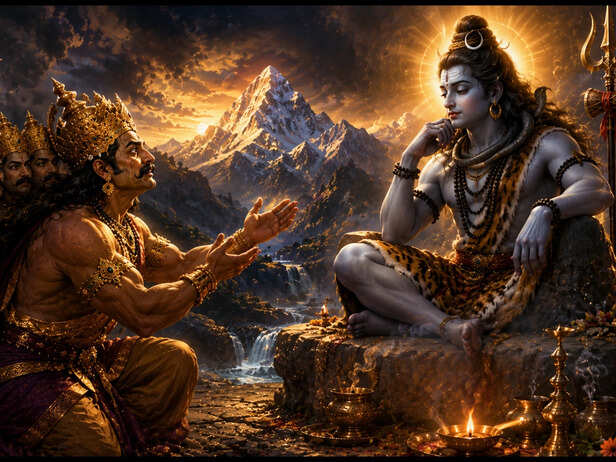
Imagine owning a golden kingdom, immense wealth, unmatched knowledge and extraordinary power. What more could you possibly want?
Yet, in the famous Shiva Tandava Stotram traditionally attributed to Ravana, there is a verse that reveals a surprisingly different desire. Instead of asking Shiva for another kingdom, greater power or victory over his enemies, Ravana speaks about living in a secluded place and becoming free from his own durmati, or misguided thinking. That single idea changes the way we look at Ravana. The man who appeared to have conquered almost everything was still struggling with the one thing he could not easily conquer: his own mind.
The King Who Had Everything
Ravana’s image is almost the opposite of someone searching for more. He was traditionally described as a mighty ruler of Lanka, highly learned and exceptionally powerful. His devotion to Shiva is also central to many popular accounts of his life. Yet power did not automatically give him peace. This is where his story becomes surprisingly relatable. A person can have success, recognition, money and knowledge while still feeling restless inside. Ravana’s story presents a striking reminder that external achievements cannot automatically silence internal conflict. Sometimes, after winning everything outside, the hardest battle remains the one taking place within.
The Verse That Changes Everything
A famous verse traditionally associated with the Shiva Tandava Stotram says: “Kada nilimpa nirjhari nikunja kotare vasan, vimukta durmati sada shirahstham anjalim vahan.” In simple terms, Ravana expresses a desire to live in a secluded forest retreat near the divine presence and remain devoted to Shiva while becoming free from durmati, meaning misguided or troubled thinking. The striking part is not simply where he wants to live. It is what he wants to escape. He is not asking Shiva for more worldly power. He is asking for freedom from the thoughts that disturb and mislead him.
Why Leave Golden Lanka?
This is perhaps the most thought-provoking part of the prayer. Why would someone associated with a magnificent kingdom imagine living in a quiet forest hut? Because the verse shifts attention from what Ravana possessed to what he lacked. A golden palace can surround a person, but it cannot guarantee a peaceful mind. The traditional interpretation of this verse suggests that Ravana understood this struggle at some level. He wanted distance from distractions and the opportunity to remain absorbed in Shiva. The irony is powerful: someone who possessed extraordinary external strength still longed for the inner freedom that wealth and authority could not provide.
The Real Meaning of Durmati
The word durmati is especially important here. It can be understood as wrong, misguided or harmful thinking. Ravana’s prayer therefore becomes more personal than it first appears. He is not simply asking for a change in location. He is asking for a change within himself. This distinction matters even today. People often believe that a new job, new city, more money or greater success will automatically create peace. But if the mind remains restless, fear-driven or consumed by unhealthy thoughts, external changes may not solve the deeper problem. The verse turns Ravana’s prayer into a timeless reflection on the human mind.
Knowledge Cannot Always Save Us
Ravana’s story contains a difficult contradiction. He is remembered in tradition as highly knowledgeable and deeply devoted to Shiva, yet his actions are also portrayed as being driven by ego and desire. This is an important distinction between knowing something and living by it. A person may understand wisdom intellectually while still struggling to apply it when emotions take control. That is why Ravana remains such a compelling character. His story is not simply about an evil king. It also explores what happens when knowledge, power and devotion fail to overcome uncontrolled desire and pride. The mind can remain unconquered even when everything else appears conquered.
The Mind Is the Hardest Victory
The familiar idea “Man jeete jag jeet” expresses a powerful principle: mastering the mind can feel like winning the greatest battle. The thought is especially relevant to Ravana’s prayer. External victories can be measured through kingdoms, possessions or achievements. Inner victory is much harder to see. It requires discipline, awareness and the ability to recognise one's own destructive patterns. Ravana’s traditional story shows that intelligence alone is not enough. Real self-mastery requires control over impulses, ego and desires. That is why the battle within can be far more difficult than any battle fought with weapons.
The Lesson Ravana Leaves Behind
Perhaps the most powerful lesson is hidden in the contradiction itself. Ravana could seek power, victory and possessions, yet the prayer traditionally attributed to him speaks of something much more difficult: freedom from his own misguided mind. For modern readers, this becomes a reminder to look beyond achievement. Before asking, “What more can I get?”, it may be worth asking, “What within me needs to change?” That question can be uncomfortable, but it is often more valuable than chasing another external success. Ravana’s story reminds us that conquering the world means little if we remain unable to understand ourselves.
Unlock insightful tips and inspiration on personal growth, productivity, and well-being. Stay motivated and updated with the latest at My Life XP