
What Shankaracharya Learned From a Woman at Manikarnika
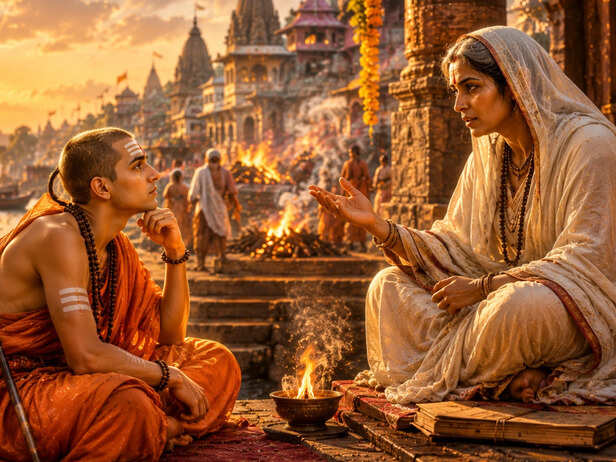
What happens when someone who has spent a lifetime teaching the highest truths suddenly finds himself unable to answer one simple question? According to a popular traditional account, something like this happened to Adi Shankaracharya in Kashi. During his travels, Shankaracharya reached the sacred city with his disciples and passed through the narrow lanes near Manikarnika Ghat. There, they encountered a grieving woman holding the body of her deceased husband. The disciples asked her to move aside. When she did not move, Shankaracharya approached her and spoke about the temporary nature of the body and the immortality of the soul. Then the woman asked a question that completely changed the moment. If the body is only an illusion, which body exactly should be moved? The encounter is traditionally understood as a profound lesson about the difference between intellectual knowledge and lived experience.
The Journey That Brought Him to Kashi
Adi Shankaracharya is traditionally remembered as a remarkable spiritual teacher who travelled extensively across India at a young age. His journeys became associated with debates, teachings and the establishment of spiritual centres. During his time in Kashi, the sacred city on the Ganga, he travelled through narrow lanes with his disciples. The journey eventually brought him toward Manikarnika Ghat, a place deeply connected with Hindu traditions surrounding death and liberation. There, an unexpected encounter with a grieving woman would turn into a spiritual lesson that went far beyond the ordinary rules of philosophical debate.
A Grieving Woman Blocked the Way
According to the popular account, a woman was sitting in the narrow passage with the body of her deceased husband in her lap. Shankaracharya's disciples requested that she move the body so they could pass. She did not respond as they expected. Eventually, Shankaracharya himself approached her. Seeing her grief, he is said to have explained that the physical body is temporary while the Atman, or Self, is not destroyed. From a philosophical perspective, this was consistent with the teaching he followed. But the woman's response transformed the conversation completely.
One Question Changed Everything
The woman asked a deceptively simple question: if the physical world is being described as maya, or appearance, then what exactly should be moved? Which body is blocking the path? Her question turned the teaching back toward the teacher. The issue was no longer whether the body is temporary. It was about how spiritual knowledge should meet a real human experience. A grieving person standing beside a dead loved one is not simply a philosophical example. There is pain, attachment, memory and loss. The story suggests that wisdom must be understood not only intellectually but also through compassion and experience.
Knowledge Is Different From Experience
This is the deeper lesson at the heart of the story. A person can understand a spiritual principle intellectually and still have much more to experience. Knowing that the body changes is different from standing beside someone you love after death. Knowing that attachment can create suffering is different from actually experiencing loss. The story therefore does not necessarily reject philosophical knowledge. Instead, it adds another dimension to it. Wisdom becomes deeper when knowledge meets lived experience. Spiritual teachings are not only ideas to repeat. They are truths that traditions encourage seekers to gradually understand through life itself.
The Woman Is Traditionally Seen as Shakti
A particularly striking part of the tradition comes next. The woman is often identified in later retellings as Goddess Parvati, appearing in human form to teach Shankaracharya a deeper lesson. The encounter is therefore presented not simply as an argument but as a divine teaching. Shankaracharya is said to recognise that existence cannot be discussed only as an abstract illusion. The world of experience also has a powerful dimension. This is where the concept of Shakti becomes important. Shakti represents divine power or energy and, in Shakta traditions, is understood as fundamental to manifestation, life and experience.
From Philosophy to the Power of Shakti
The encounter is traditionally associated with a broader realisation: if consciousness is spoken of as fundamental, the power through which existence manifests cannot simply be ignored. The mountain's strength, the tenderness of a relationship, the pain of loss and the miracle of life can all become part of spiritual inquiry. This is one reason Shakti occupies such an important place in Hindu traditions. The lesson is not that worldly experience should replace spiritual knowledge. Rather, experience itself can become a doorway to deeper understanding. What appears ordinary may reveal something profound when seen with awareness.
The Lesson Lives Beyond the Story
The most memorable part of this story is not the question of who won an argument. It is the change that takes place within the seeker. Spiritual wisdom can become incomplete when it is used without sensitivity to the person standing before us. Someone experiencing grief may need compassion before philosophy. Someone experiencing fear may need presence before advice. The story attributed to Shankaracharya reminds us that knowing the truth and living the truth are different stages of a journey. Real wisdom does not merely make us knowledgeable. Ideally, it makes us more aware, more compassionate and more capable of seeing the sacred within human experience.
The Lesson Was Bigger Than Maya
The traditional story of Shankaracharya in Kashi carries a powerful message.
It is easy to say that the body is temporary.
It is harder to sit beside someone who has just lost a loved one and understand what those words truly mean.
That is where experience enters the spiritual journey.
The story's association with Goddess Shakti adds another layer. The world of emotions, relationships, creation, destruction and life itself can become part of the search for truth.
Perhaps the real lesson is not to choose between knowledge and experience.
It is to understand that knowledge can point toward truth, but experience can transform the way we understand it.
And sometimes, the person who appears to need a lesson may unexpectedly become the teacher.
Unlock insightful tips and inspiration on personal growth, productivity, and well-being. Stay motivated and updated with the latest at My Life XP.