
What Was There Before Brahma Created the Universe?
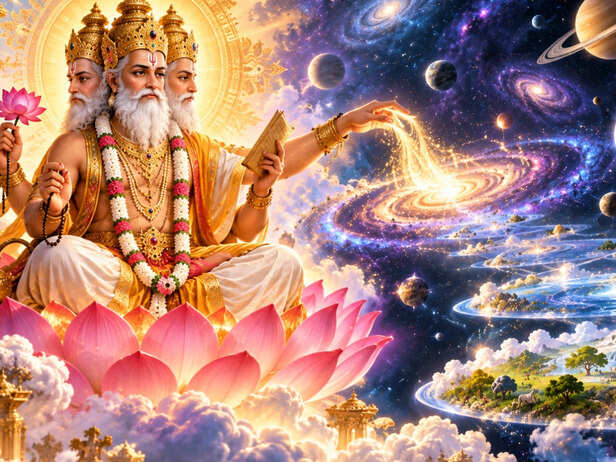
What was there before the Sun, Moon, planets and even the gods appeared?
Indian sacred literature has imagined this question in extraordinary ways. In several Hindu cosmological traditions, creation is not presented as a simple beginning from nothing. Instead, there are cycles of creation and dissolution, with the universe passing through vast periods when the manifest world disappears.
One powerful creation narrative begins in this mysterious stillness. Vishnu rests in cosmic yoga-nidra, Brahma emerges on a lotus, and a single command, “Tapas”, sets the journey toward creation in motion. But before Brahma could create anything, he first had to discover who he was and what he was meant to do.
When the Universe Was Silent
In Hindu cosmological traditions, the universe exists through recurring cycles of creation, preservation and dissolution. During a period of cosmic dissolution, the familiar world is no longer manifest. Traditional imagery describes Vishnu resting upon the cosmic waters in yoga-nidra, with creation yet to unfold again. There is no ordinary landscape, sky or planetary world to observe. This is the dramatic setting in which the creation story begins. Rather than imagining creation as an instant event, the narrative presents it as something that emerges gradually from an immense state of stillness, preparing the stage for Brahma and the next cycle of cosmic creation.
Brahma Appears on the Lotus
According to the familiar Puranic creation narrative, a divine lotus emerges from Vishnu's navel, and Brahma appears upon it. Brahma, depicted with four faces, is associated with the work of creation. But his arrival does not immediately give him all the answers. He finds himself surrounded by an unfamiliar expanse and must understand his identity and purpose. This detail makes the story surprisingly human. Even the creator begins with uncertainty. Before building a universe, Brahma must first seek knowledge. The narrative therefore places discovery before creation, suggesting that understanding one's purpose is the first step toward bringing an idea into reality.
The Mysterious Call to Tapas
The turning point comes when Brahma hears the mysterious word “Tapas”, traditionally understood as austerity, disciplined meditation or spiritual effort. He follows the instruction and performs tapasya for an immense span of divine time. The story is important because Brahma does not receive the complete blueprint instantly. He first has to become still, focused and receptive. In this sense, creation begins with contemplation rather than action. The ancient narrative turns a cosmic mystery into a simple idea: before trying to build something new, there is value in stepping back, becoming focused and seeking clarity about what should come next.
Sound Becomes the First Clue
The sacred syllable Om holds a central place in Hindu spiritual traditions and is often associated with the primordial sound or ultimate reality. Creation stories and later philosophical texts interpret sound, speech and sacred knowledge in deeply symbolic ways. The idea of sound emerging at the beginning of creation gives the story a striking rhythm: silence is followed by vibration, and vibration becomes associated with the unfolding of existence. It should not be confused with a scientific account of the physical universe. Instead, it is a spiritual and philosophical image that expresses how an unmanifest reality becomes ordered and knowable through sacred sound and knowledge.
The Four Vedas Reveal Knowledge
Brahma is traditionally associated with the four Vedas, and his four faces are often symbolically connected with their revelation. The Vedas became foundational sacred texts of Hindu traditions, containing hymns, rituals and philosophical ideas developed across different periods. In the creation narrative, this knowledge functions almost like a cosmic guide. Brahma is not simply handed a physical universe to assemble. He receives knowledge that helps establish order and structure. This is one of the most fascinating ideas in the story: creation is portrayed not merely as making things appear, but as transforming uncertainty into an ordered world through knowledge, consciousness and sacred understanding.
Creation Finally Takes Shape
Once Brahma gains knowledge and insight, the creation process can begin. Puranic texts contain different accounts of how the cosmos, beings and various principles of existence emerge, so there is no single creation sequence shared by every Hindu text. That diversity is important. The stories should be understood within their individual textual and theological traditions rather than treated as one uniform account. Yet the central movement remains compelling: darkness gives way to awareness, uncertainty gives way to knowledge, and knowledge leads toward creation. The universe in this story is therefore not presented as random chaos alone. It gradually becomes an ordered expression of divine intelligence.
The First Mystery Was Not Matter
The most powerful part of this story may not be the appearance of stars or planets. It is what happens before them. Brahma begins with uncertainty, turns toward tapasya and receives the knowledge needed to begin creation. That sequence gives the ancient narrative a lasting philosophical message. Great beginnings do not always start with visible action. Sometimes they begin with silence, reflection and the search for understanding. Hindu cosmology contains many creation narratives across the Vedas, Upanishads and Puranas, each with its own emphasis. But this particular story leaves us with a memorable thought: before the universe became something we could see, creation first existed as a possibility waiting to unfold.
Unlock insightful tips and inspiration on personal growth, productivity, and well-being. Stay motivated and updated with the latest at My Life XP