
Who Was Tulsi Before She Became a Sacred Plant? The Forgotten Story of Vrinda
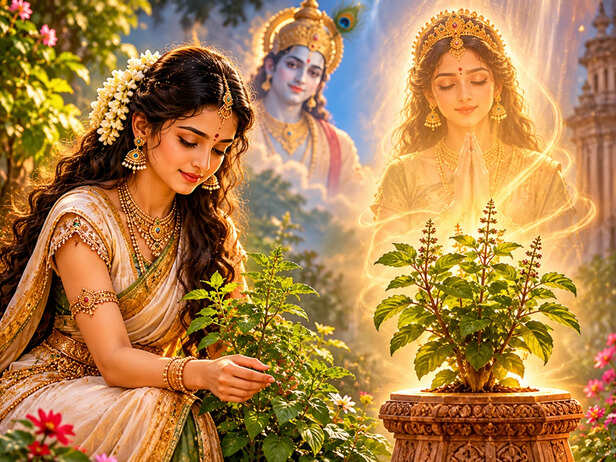
According to a popular Hindu legend, Vrinda was married to Jalandhar, a powerful asura king. She was known for her unwavering devotion and commitment to her husband. Her spiritual strength was believed to protect Jalandhar, making him extremely difficult to defeat.
The woman behind the sacred Tulsi plant
Jalandhar became so powerful that he began challenging the gods. His growing influence worried the celestial beings, who eventually sought help from Lord Shiva and Lord Vishnu.
However, defeating Jalandhar was not easy. As long as Vrinda's devoted vow remained unbroken, her husband was believed to remain protected. The gods realised that his strength was connected to her spiritual power.
How Lord Vishnu became part of Vrinda's story
When the gods struggled to defeat Jalandhar, Lord Vishnu decided to intervene. In the popular version of the story, he assumed Jalandhar's appearance and approached Vrinda.
Believing that the person before her was her husband, Vrinda accepted him. But when she discovered the truth, she realised that Lord Vishnu had deceived her.At that moment, her trust was shattered. Her spiritual vow had been broken, and Jalandhar lost the protection that had made him nearly invincible. Lord Shiva then defeated him in battle.Vrinda was devastated when she learnt what had happened. She had been devoted to her husband, yet her faith had been used as a means to bring about his death.
Why did Vrinda curse Lord Vishnu?
Overcome with grief and anger, Vrinda confronted Lord Vishnu. She cursed him for deceiving her and destroying her marital vow.Some popular retellings say that she cursed Vishnu to become a stone, which is associated with the sacred Shaligram form worshipped by devotees. Other versions describe different consequences of her curse. The stories of Vrinda and Jalandhar and of Tulasi and the demon Shankhachuda are also sometimes blended in later retellings.
Vrinda eventually gave up her mortal life. In the familiar Tulsi Vivah legend, a sacred Tulsi plant grew from her remains or ashes, depending on the version. Lord Vishnu declared the plant especially dear to him and promised that Tulsi would always have a place in his worship.
Why is Tulsi offered to Lord Vishnu?
The connection between Vrinda and Lord Vishnu explains why Tulsi leaves are considered especially sacred in Vaishnava traditions.Devotees commonly offer Tulsi leaves while worshipping Lord Vishnu and his avatars, including Lord Krishna. The leaves are also placed in offerings such as prasad. For many worshippers, offering Tulsi represents sincerity, purity and devotion.
Tulsi is not simply treated as a plant used in rituals. It is revered as a divine presence in the household. This is why many families grow it in a courtyard or near the entrance and offer prayers beside it.The tradition also gives Tulsi a special place in the worship of Shaligram, a sacred stone form associated with Lord Vishnu.
What is the connection between Vrinda and Tulsi Vivah?
The story of Vrinda is closely associated with Tulsi Vivah, a traditional ceremony in which the Tulsi plant is symbolically married to Lord Vishnu, often represented by a Shaligram stone.The ceremony is generally observed during the Hindu month of Kartik, commonly around Dev Uthani Ekadashi or Dwadashi, though the date varies according to regional customs and calendars.
During the ceremony, families decorate the Tulsi plant with flowers, a chunari and ornaments. A small wedding canopy may be prepared, and prayers, wedding songs and traditional rituals are performed.For devotees, Tulsi Vivah represents the sacred bond between Tulsi and Vishnu. It is also associated with the beginning of the Hindu wedding season in many communities.
Are Vrinda and Tulsi the same in every Hindu story?
There is an important detail that often gets missed. Hindu texts contain more than one account of Tulsi's origin.The popular Vrinda-Jalandhar story connects Tulsi with Jalandhar and his defeat. Another well-known narrative describes Tulasi as the wife of the asura Shankhachuda. In that account, Lord Vishnu takes Shankhachuda's appearance, and Tulasi curses him to become a stone. This story is closely connected with the origin of the Shaligram form.
Some traditions also associate Tulsi with Goddess Lakshmi. These accounts have similarities, but they are not identical stories. Their details differ across Puranic texts and regional retellings. This is why the story of Tulsi should not be treated as one single, universally identical account. The different traditions share a common reverence for Tulsi, even when they explain her origin differently.
Why does the story of Vrinda still matter?
The story of Vrinda gives a deeper meaning to a plant that many people see every day. It connects Tulsi with devotion, sacrifice, faith and the power of spiritual commitment.For generations, families have cared for Tulsi plants, offered prayers and included their leaves in religious ceremonies. The familiar morning ritual of lighting a diya near Tulsi carries a much older devotional significance.
Vrinda's story also reminds devotees that Tulsi is not worshipped only because of its place in household traditions. It is revered because of the sacred stories and beliefs associated with it.The next time you see a Tulsi plant in a courtyard, remember the story of Vrinda. Behind its small green leaves lies a legend that has shaped one of the most recognisable traditions in Hindu homes.
Unlock insightful tips and inspiration on personal growth, productivity, and well-being. Stay motivated and updated with the latest at My Life XP.