
Who Watched the Mahabharata War From Start to Finish?
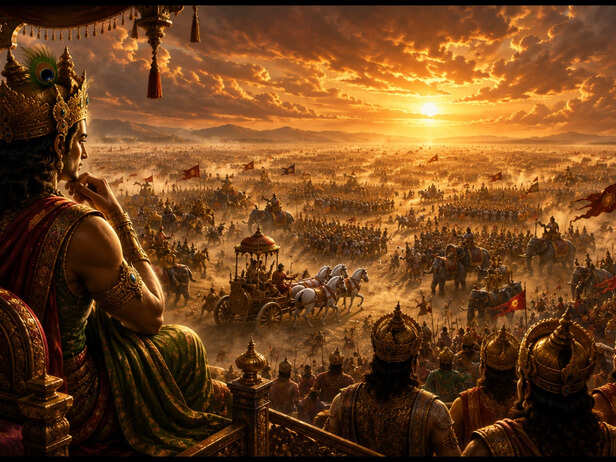
The Mahabharata war is one of the greatest stories in Indian tradition. But here is a question that can stop any mythology lover: Who actually witnessed the great battle of Kurukshetra? A popular belief says that three famous figures had a special connection with the war: Sanjaya, Barbarika and Lord Hanuman. But there is a fascinating twist. They did not all witness the war in exactly the same way. Sanjaya watched the battlefield through divine vision, Barbarika is said in later tradition to have watched the entire battle from a unique position, while Hanuman's connection comes through his presence on Arjuna's chariot flag. So, who were these three figures, and what did they actually see?
Sanjaya Saw the Battle From Afar
Sanjaya is the clearest example of a person who could witness the events of the Mahabharata war from a distance. Sage Vyasa granted him divine vision, allowing him to see what was happening on the battlefield and narrate it to King Dhritarashtra.
This is why the Bhagavad Gita begins with Dhritarashtra asking Sanjaya about the armies gathered at Kurukshetra.
Sanjaya was not physically standing in the middle of the battlefield. Instead, his extraordinary vision allowed him to observe events and describe them to the king.
His role makes him one of the most important witnesses and narrators of the war.
Why Is Barbarika Linked to the War?
Barbarika's story is one of the most fascinating parts of later Mahabharata tradition. He is commonly described as the son of Ghatotkacha and grandson of Bhima.
According to the popular legend, Barbarika possessed three powerful arrows and had made a promise to support the weaker side in the battle.
Krishna realised that his presence could completely change the outcome of the war. He therefore asked Barbarika for his head as a sacrifice.
Barbarika agreed. In the popular tradition, Krishna granted him a special blessing that allowed him to witness the entire war from the top of a hill.
This is why Barbarika is often described as one of the three great witnesses.
The Strange Question After the War
The most interesting part of Barbarika's story comes after the battle.
According to the popular legend, when asked who was responsible for the victory, Barbarika gave an unusual answer. He said that he saw Lord Krishna's divine presence guiding the battle and the Pandavas' victory.
This story carries a deeper message. The battle may have looked like a clash between armies, warriors and weapons, but the legend presents Krishna as the central force behind the outcome.
It also explains why Barbarika's story is still remembered in many parts of India, especially in connection with Khatu Shyam Ji.
Why Was Hanuman on Arjuna's Flag?
The third name often mentioned is Lord Hanuman.
But there is an important distinction. Hanuman was not a human spectator sitting somewhere and watching every event like Sanjaya or Barbarika in the popular traditions.
According to the Mahabharata, Hanuman's presence was connected with Arjuna's chariot flag, known as the Kapidhwaja.
Before the war, Arjuna had encountered Hanuman, and Hanuman agreed to remain on his flag. His presence became a symbol of strength, protection and divine support.
Therefore, when people say Hanuman "witnessed" the Mahabharata war, it is better to understand this as his divine presence on Arjuna's chariot, rather than treating him as an ordinary eyewitness.
Three Names, Three Different Stories
This is where the popular claim becomes truly interesting.
Sanjaya had divine vision and narrated the battlefield events.
Barbarika, according to later tradition, watched the war after Krishna received his head.
Hanuman was present on Arjuna's chariot flag as a divine protector.
So, although all three are popularly connected with witnessing the war, their roles were completely different.
This distinction is important when discussing the Mahabharata. The original epic, later traditions and regional stories do not always tell every detail in exactly the same way.
That makes the story richer, not less interesting.
What Did They Teach Us?
The stories of these three figures reveal three different ideas.
Sanjaya represents knowledge and observation. He could see the battle and communicate what was happening.
Barbarika represents detachment and perspective. From his legendary viewpoint, he saw the larger forces behind the battle rather than simply celebrating individual warriors.
Hanuman represents devotion and divine strength. His presence beside Arjuna became a symbol of courage during one of the greatest battles in Hindu tradition.
Together, these stories remind us that seeing an event and understanding its deeper meaning are not always the same thing.
So, Who Really Saw the War?
So, did exactly three people see the Mahabharata war?
The safest answer is not exactly.
The Mahabharata itself clearly presents Sanjaya as someone who could see and narrate the battlefield events through divine vision. The story of Barbarika as a complete-war witness is strongly rooted in later tradition. Hanuman's connection is through his presence on Arjuna's flag.
That means the popular statement is best understood as a traditional storytelling idea, rather than a precise historical count of every witness.
And perhaps that is what makes the question so fascinating.
The Mahabharata was not just a war between two armies. It was a story about dharma, duty, power, devotion and the mysterious forces behind human actions.
Sometimes, the most interesting question is not simply, "Who saw the war?"
It is:
"What did they understand after seeing it?"