
Why Are Most Devi Temples Built on Mountains?
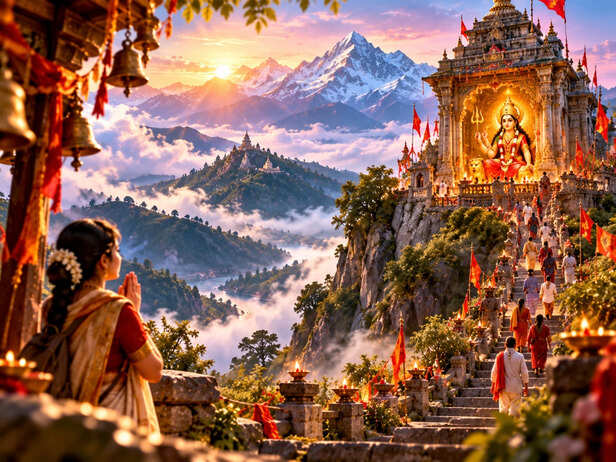
Have you ever wondered why so many famous Devi temples are found on mountains, hills or difficult-to-reach heights? From Maa Vaishno Devi and Maa Kamakhya to Maa Vindhyavasini, Jwala Devi, Naina Devi, Mansa Devi and Saptashrungi Devi, the pattern is hard to miss. But according to Hindu spiritual traditions, this is not simply about choosing a beautiful location. The mountain itself carries a deeper meaning. It represents the meeting point between the human world and the divine, while the climb represents the effort required to move from the ordinary towards the sacred.
The Goddess Appeared on the Himalayan Peak
The idea of the Goddess appearing on a mountain has deep roots in Hindu tradition. In the Devi Bhagavata Purana, the Goddess is described as appearing on the Himalayan heights when the gods praised and invoked her. This carries an important symbolic message: Devi is not only the mother of human beings but also of the gods. Since the divine realms are traditionally imagined above the earthly realm, the mountain peak becomes a natural symbolic meeting point. It rises above the ground while remaining accessible to human beings, making it a powerful image of connection between the earthly and the divine.
Mountains Connect Earth and Heaven
In Hindu cosmology, mountains often represent a connection between different levels of existence. The ideas of Bhu, Bhuvah and Svah describe different realms, and the mountain can be understood symbolically as a central axis connecting them. This is one reason the Devi temple on a hill feels different from an ordinary place of worship. The higher you climb, the farther you move away from the noise of everyday life. The physical height becomes a spiritual metaphor. A mountain is therefore not simply a location for a Shakti temple; it represents the journey from the material world towards a higher state of awareness.
The Climb Is Part of the Worship
Think about what happens when you visit a famous mountain Goddess temple. You may have to walk uphill, climb hundreds of steps or travel through a difficult path before reaching the shrine. That effort has its own spiritual meaning. In Hindu traditions, reaching the divine is rarely presented as something effortless. The climb can represent discipline, patience, surrender and determination. By the time devotees reach the temple, they have physically left behind some of their ordinary routine. The journey itself becomes part of the prayer. In this sense, Devi worship is not only about reaching the destination but also about transforming yourself along the way.
Your Body Is Compared to Mount Meru
The mountain symbolism becomes even more interesting in yoga and Tantra traditions. The human body is sometimes symbolically compared with Mount Meru, the cosmic mountain. At the base lies dormant Kundalini Shakti, traditionally represented as a powerful spiritual energy. Its upward movement towards the higher centres is described as a journey of awakening. This creates a striking parallel with climbing a mountain to reach a Devi shrine. The devotee moves upward physically, while the spiritual seeker moves upward within. The mountain outside can therefore remind us of the sacred journey taking place inside the human body.
Why Devi Is Called Durgama
There is another powerful clue in the names associated with Goddess Durga. The words Durgama and Durgam are connected with something difficult to cross, approach or overcome. This idea fits naturally with the image of a difficult mountain path. The Goddess is not necessarily portrayed as distant, but reaching her can demand effort, courage and perseverance. That is why many Devi temples in India involve long journeys, steep climbs or remote locations. The physical difficulty can remind devotees that spiritual growth also requires determination. The mountain becomes a living symbol of the obstacles we must cross before reaching greater inner strength.
Vaishno Devi and Other Sacred Peaks
The tradition can be seen across India. Maa Vaishno Devi is worshipped in the Trikuta Hills, while Naina Devi stands among the Himalayan landscape. Jwala Devi is associated with the sacred hills of Himachal Pradesh, and Saptashrungi Devi is worshipped amid the Sahyadri ranges. Vindhyavasini Devi is traditionally linked with the Vindhya region. These temples have their own histories, scriptures and local traditions, so their origins should not be reduced to one single explanation. Yet their mountain settings share a powerful spiritual image: the Goddess is associated with height, strength, nature and the difficult journey that brings a devotee closer to the sacred.
The Mountain Is Also an Inner Journey
Perhaps the deepest meaning is not that the Goddess can only be found on a mountain. It is that the mountain teaches us how to approach the Goddess. Every step upward can represent patience, every obstacle can represent an inner weakness, and every pause can become a moment of reflection. This is why the ancient image of the Devi temple on a mountain continues to feel powerful today. Whether you visit Vaishno Devi, Kamakhya, Jwala Devi or another Shakti shrine, the journey can become a reminder that divine strength is not merely something we seek outside ourselves. It is also something we learn to awaken within.
Unlock insightful tips and inspiration on personal growth, productivity, and well-being. Stay motivated and updated with the latest at My Life XP