
Why Bhishma Chose Gandhari: The Past-Life Secret Revealed
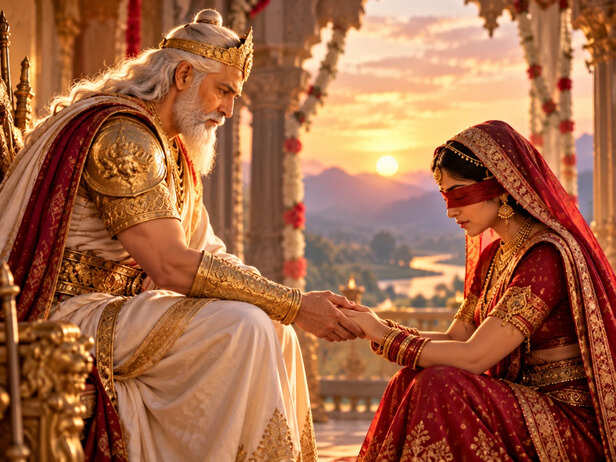
Out of all the princesses of her time, why was Gandhari the one chosen to marry a blind king? The Mahabharata gives a political reason, but folk tradition points somewhere deeper: to lives lived long before. Stories of a crushed nest, a cruel king and a mother’s curse are told in villages and temples across India. Layered over them is a grand divine plan involving the burden of the earth itself. This article walks through these tales, one by one, and ends with a question that leads straight to Kunti.
A Match Beyond Politics
On the surface, the match was arranged for the sake of power. The Kuru house wanted a strong alliance, and Gandhara was a respected kingdom. But old storytellers always felt that something deeper was at work. Why would a gifted princess agree to marry a man who could not see? Why did the families on both sides accept so easily? Folk tradition says the answer is not found in this life at all. It lies in earlier births, where actions had consequences that waited patiently for their time. That is where this story begins.
The Stone and the Eggs
According to a folk tale, in a past life Gandhari once sat down on a stone. Beneath it lay a hundred tortoise eggs, and every one of them was crushed. The mother tortoise, shattered by grief, cursed her: just as a hundred of her children had died, a hundred of Gandhari’s children would also be lost. She had not meant to cause harm, yet the pain was real. This tale reminds us that careless actions can leave deep wounds, and that in this tradition, every deed returns to its doer in some form.
The King and the Swan
The same tradition tells of Dhritarashtra’s past. In an earlier birth, he was said to be a cruel king who blinded a swan and had her hundred offspring killed. The details vary from one telling to another, and they are folk accounts rather than the main text of the Mahabharata. Still, the message is clear. His blindness in this life and the loss of his hundred sons are seen as echoes of that cruelty. Many believe this shared debt of sorrow is what drew the two together in one marriage.
The Weight on Mother Earth
The epic gives a larger explanation. Demons were being born as powerful kings, and the Earth felt crushed under their weight. She appealed to Brahma, who asked the gods to descend in part forms to restore balance. In this telling, a goddess was born as Gandhari. The hundred sons who would arrive as her children carried the nature of demonic forces, headed by the eldest, said to be Kali’s part form, known as Duryodhana. Here, the personal story of one family becomes part of a vast cosmic drama.
The Boon of a Hundred Son
Gandhari was a deeply devoted woman. She worshipped Lord Shiva with great sincerity, and in return received a boon: she would have a hundred sons. It was a blessing that seemed to promise joy. Yet, in the logic of the tale, every boon carries a hidden weight. What she asked for and what she would eventually face were two very different things. This part of the story shows how a mother’s greatest wish and her greatest sorrow can come from the very same source, and how faith does not always shield us from fate.
The Blindfold of Love
When King Subala agreed to the proposal, Gandhari learned that her husband-to-be could not see. She did not complain. Out of love and respect, she tied a cloth over her own eyes and chose never to see the world again. Some admire this as the highest form of devotion. Others feel it cost her the ability to guide her sons. Both views can hold truth. What cannot be denied is the strength of her decision, made quietly and kept for a lifetime without a single word of regret.
The Question That Leads to Kunti
While Hastinapura prepared for this marriage, another story was unfolding. In the house of Kuntibhoja lived a young girl, Kunti. A sage gave her a powerful mantra that could summon any deity she wished. But why was such a gift given to a young girl? What was meant to follow? That question opens the next chapter of the epic, where the five Pandavas will eventually be born. It also reminds us that in the Mahabharata, no event stands alone; every thread is quietly tied to another.
Unlock insightful tips and inspiration on personal growth, productivity, and well-being. Stay motivated and updated with the latest at My Life XP.